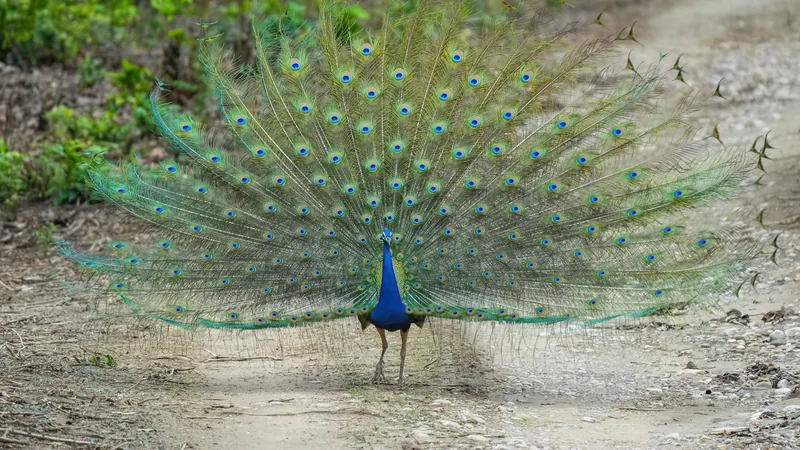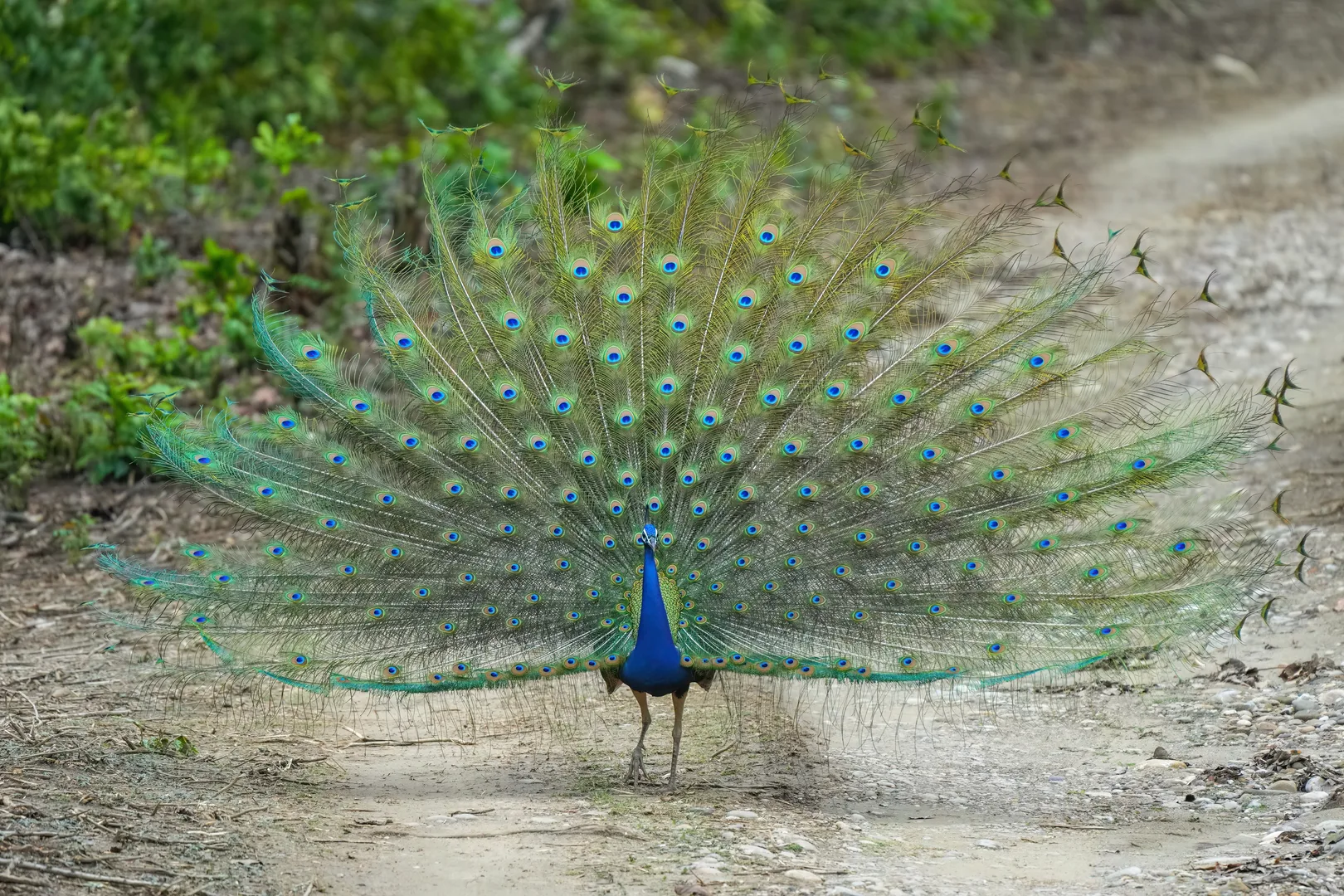
A peacock displaying in Jim Corbett National Park, India.
Field
notes
The best-known feature of the Indian Peafowl (Pavo cristatus) is not its tail. The long train behind a male is made of tail coverts, the feathers that cover the base of the tail. Its color comes from structure: the cortex of each colored barbule contains a two-dimensional photonic crystal, and varying the crystal’s spacing, its lattice constant, produces the different colors.
Big Train, Long Life
Adults weigh 2.7 to 6 kilograms and measure 0.86 to 2.12 meters long, and males are the larger sex. Animal Diversity Web says it can live up to 25 years in the wild. Its range includes India, Pakistan and Sri Lanka; it is most common in deciduous, open forest, and it needs a lot of water to drink.
A Fan That Rattles
When a peacock displays, he props up the train with his shorter, stiffer tail feathers and spreads it into a wide fan. Around 30 to 40 of the eyespots, or ocelli, around the outer edges are not round but V-shaped. In the train-rattling display he stridulates, rubbing those tail feathers against the train 25.6 times a second, on average. Each train feather is up to 1.5 meters long and weighs under 2 grams, yet endures hundreds of hours of display every breeding season, which spans two to three months.
Low Notes Train-rattling makes a broadband, pulsating sound with very low-frequency components, at 20 hertz and below. Peafowl have been shown to perceive playbacks of those components.
Killer of Snakes, Target of Tigers
Indian Peafowl are omnivores. Termites are their food of choice, and they also eat other insects, worms, lizards, frogs and snakes, including young cobras, plus tree and flower buds, petals, grain, and grass and bamboo shoots.
Tigers, leopards, jungle cats, mongooses and stray dogs are among their predators. Because peafowl are so effective at running away and disappearing into shrubbery, predators usually take them down with a surprise attack. If a predator grabs the train, the long feathers pull out easily, and the peacock can fly away. Tigers can stretch up to three meters and a male’s train can be over a meter long, so a peacock needs to roost at least five meters off the ground to be secure.
Peafowl are always alert, and both sexes have up to six alarm calls, the type depending on the threat. The alarm is loud, and it also alerts other wildlife in the area.
Published Updated
Traits
Intel
& FAQ
Sources
- 01Pavo cristatus (Indian peafowl). Animal Diversity Web, University of Michigan.
- 02Peafowl. San Diego Zoo Wildlife Alliance.
- 03Zi et al. (2003). Coloration strategies in peacock feathers. Proceedings of the National Academy of Sciences.
- 04Dakin et al. (2016). Biomechanics of the Peacock's Display: How Feather Structure and Resonance Influence Multimodal Signaling. PLOS ONE.
- 05Pavo cristatus. The IUCN Red List of Threatened Species 2025: e.T22679435A154429562.