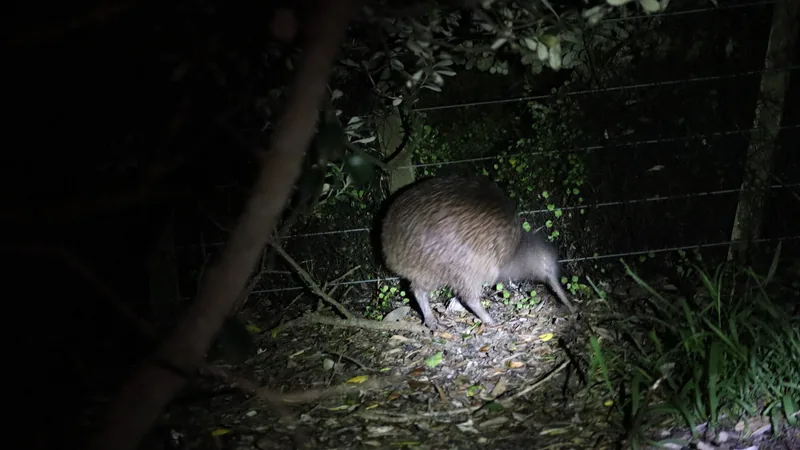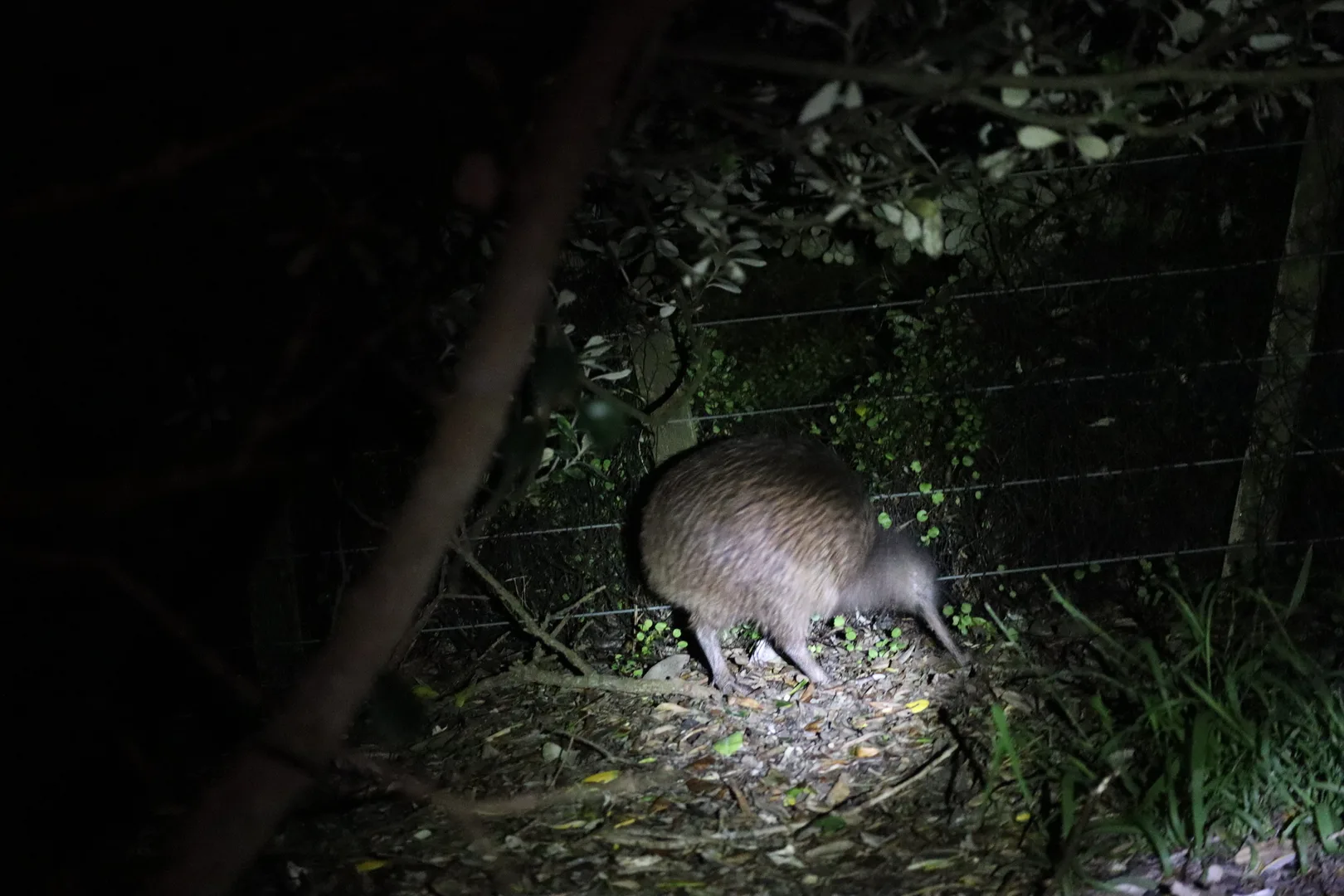
North Island Brown Kiwi (Apteryx mantelli), Tāwharanui Regional Park, Matakana, Auckland, NZ
Field
notes
Nostrils near the tip of the beak
The North Island brown kiwi (Apteryx mantelli) is a flightless bird that forages at night. Its long, curved bill is unique in the bird world in having the nostrils near the tip. A kiwi plunges that bill again and again into the leaf litter of the forest floor. It often snuffles audibly as it searches, a sound that may come from a valve behind the nostrils that stops it inhaling dirt.
Kiwi use that bill to sniff out food. Scientists compared kiwi with 55 other bird species, and the kiwi’s olfactory bulbs (the brain regions that process smell) were proportionately larger than any other bird’s in the study. Touch may help too. The bill tip holds mechanoreceptors, cells that sense vibration and pressure, set in pits arranged like those of sandpipers and snipe. A kiwi may be able to locate prey the same way.
Egg math A female kiwi lays an extremely large egg, an average of 15 percent of her body weight. It weighs about 450 grams and is over 60 percent yolk.
Size, menu and home
Kiwi are stout birds that stand 0.5 to 0.6 metres tall. Females are heavier than males, at 2 to 3.9 kilograms against 1.4 to 3.2 kilograms.
The menu is varied: earthworms, beetles, snails, crayfish, insects, fruits and berries. Kiwi forage actively from dusk to dawn.
Every brown kiwi lives on New Zealand’s North Island, in lowland and coastal native forest and subalpine areas. There are four distinct forms: the Northland, Coromandel, Western and Eastern brown kiwi. A territory covers 5 to 50 hectares depending on habitat quality, and each one holds several burrows.
Long lives, falling numbers
New Zealand’s Department of Conservation says other kiwi live to be 40 to 65 years old, but the Northland form of this species averages only 14 years.
After the female lays, she leaves the male to incubate the eggs, which takes about 68 to 91 days. Brown kiwi breed faster than other kiwi, with up to two eggs a clutch and one to two clutches a year.
Even so, numbers are falling. A 1996 estimate said North Island kiwi had probably declined by at least 90% over the previous century, and the Department of Conservation puts the population at about 26,000. Adults are usually feisty enough to defend themselves against smaller predators, but eggs and newly hatched young are very vulnerable. Predators include rats, weasels, cats, dogs and pigs. The IUCN Red List rates the species Vulnerable.
Published
Traits
Intel
& FAQ
Guess
first
How big is a North Island Brown Kiwi, really? Slide, lock in, and see what the sources say. Every answer is a figure from this page, quoted from where it came from.
Sources
- 01North Island brown kiwi. Smithsonian's National Zoo and Conservation Biology Institute.
- 02Brown kiwi. New Zealand Department of Conservation.
- 03Butler & McLennan. Kiwi Recovery Plan. New Zealand Department of Conservation, Threatened Species Recovery Plan Series No. 2.
- 04Corfield et al. (2014). Anatomical Specializations for Enhanced Olfactory Sensitivity in Kiwi, Apteryx mantelli. Brain, Behavior and Evolution.
- 05Cunningham, Castro & Alley (2007). A new prey-detection mechanism for kiwi (Apteryx spp.) suggests convergent evolution between paleognathous and neognathous birds. Journal of Anatomy.
- 06Martin et al. (2007). Kiwi Forego Vision in the Guidance of Their Nocturnal Activities. PLoS ONE.
- 07Taborsky & Taborsky (1991). Social Organization of North Island Brown Kiwi: Long-term Pairs and Three Types of Male Spacing Behaviour. Ethology.
- 08Apteryx mantelli. The IUCN Red List of Threatened Species 2017: e.T45353580A119177586.
What the sources say: 45 claims checked word for word against these sources →