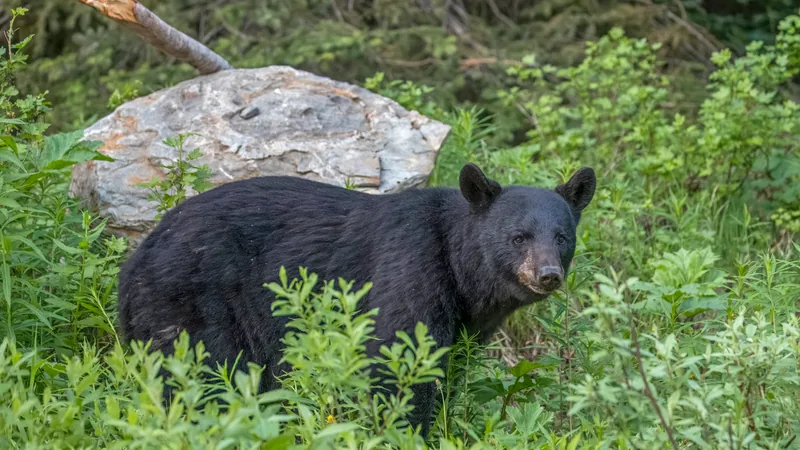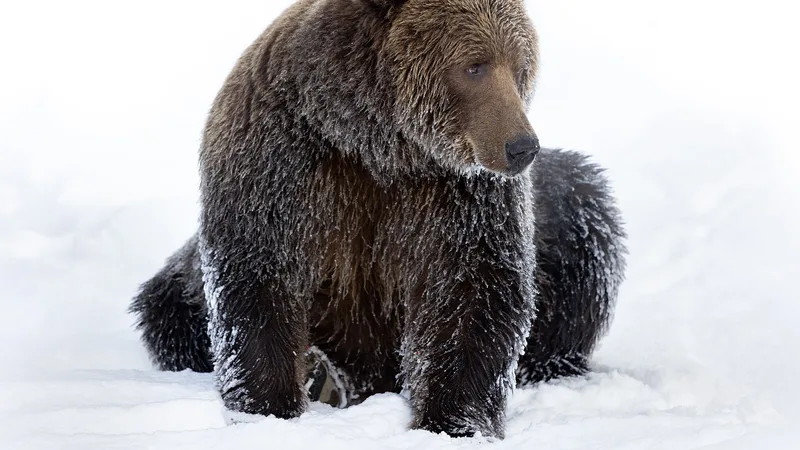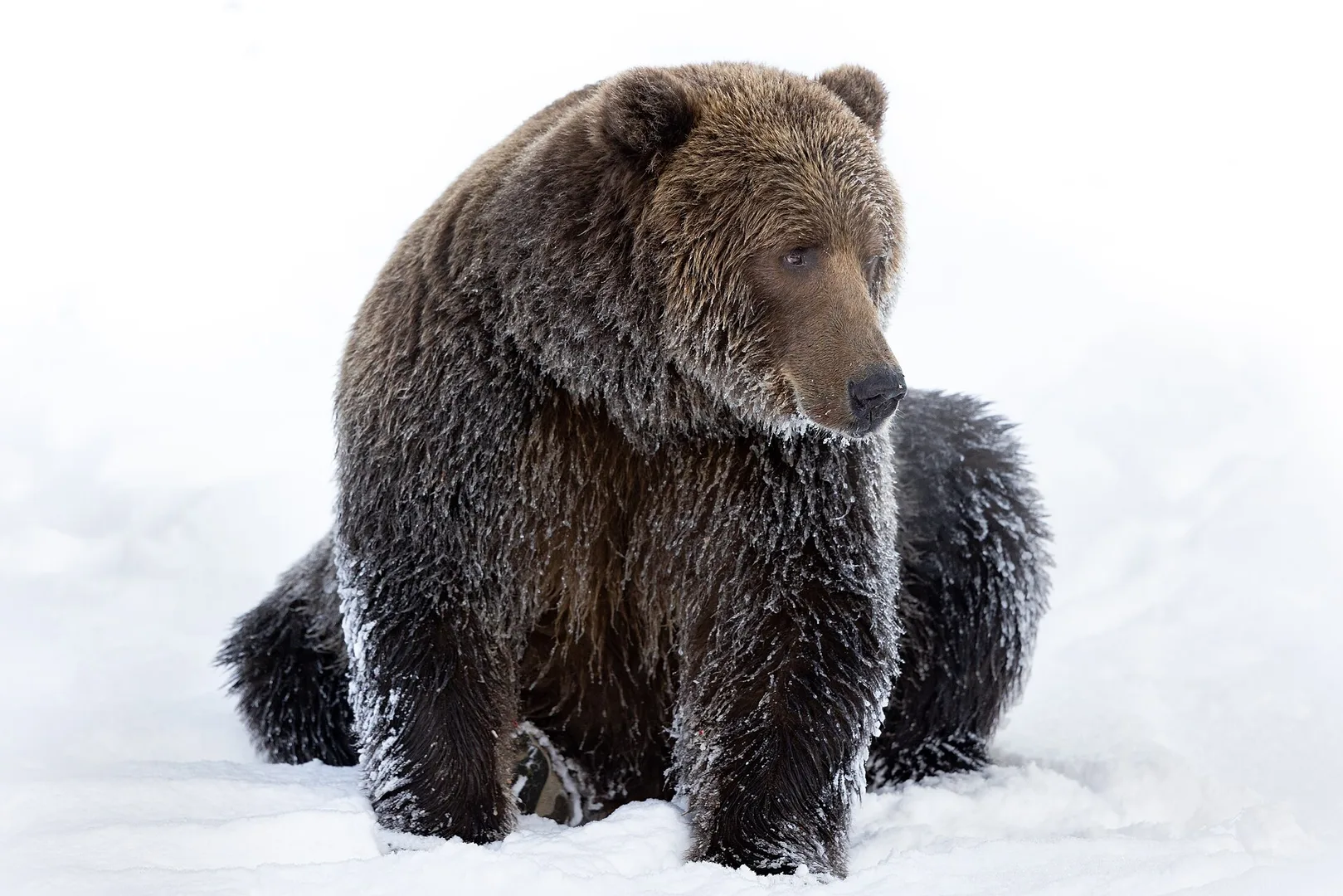
Female Kodiak brown bear navigating winter river snow on Kodiak Island
Field
notes
Coastal Heavyweights
The Kodiak bear (Ursus arctos middendorffi) is a subspecies of brown bear that lives only on Alaska’s Kodiak Archipelago. It stands 3 to 5 feet (0.9 to 1.5 meters) high on all fours and up to 10 feet (3 meters) tall upright. Adult males weigh 600 to 1,400 pounds (272 to 635 kilograms) and adult females 300 to 700 pounds (136 to 318 kilograms), and a large male brown bear in coastal areas may weigh up to 1,500 pounds (680 kilograms). The Boone and Crockett Club’s world-record bear is a Kodiak brown bear, with a skull measuring 30.75 inches (78.1 centimeters) in width plus length.
Kodiak bears are thought to have diverged from their brown bear relatives around 12,000 years ago, after becoming geographically isolated at the end of the last ice age. Some research suggests the genetic and size differences between them and other Alaskan brown bears are minimal, and that environment and food supply could largely explain the size differences. Still, genetic diversity within the Kodiak population is the lowest of any recorded North American brown bear population, a major conservation concern.
Islands Stacked With Food
Dense Sitka spruce forest grows on the northern islands, glaciated mountains rise to 4,470 feet (1,360 meters) along the central spine of Kodiak Island, and the south end has rolling hills and flat tundra. Bears are most often seen on low-elevation salt marshes in spring and on salmon streams or berry patches in summer, and they travel the beaches patrolling for marine mammal carcasses, clams or invertebrates among the kelp.
Salmon makes up about 64% of a Kodiak bear’s diet, and plant matter such as sedges, forbs and berries another 26%. An estimated 3,500 bears live on the archipelago, and the Karluk Lake drainage has one of the densest bear populations in the world.
Crowds on the Salmon Streams
Brown bears are generally solitary but often gather in large groups at feeding areas such as salmon spawning streams, and because of this they have developed a complex language and social structure to minimize serious fights. Kodiak bears communicate mainly with body language and are therefore quiet much of the time. On salmon streams they function within strict social hierarchies: large males are often dominant, but females can also hold top positions. They sometimes huff, a quick exhale of air, in a surprise encounter with a person or another bear, or to warn their cubs of danger.
Obese but Healthy Brown bears double their fat stores during summer and use that stored fat during hibernation. They become seasonally obese, yet remain metabolically healthy.
Months in the Den
Brown bears lose 20 to 40% of their body mass during hibernation, and while in the den they do not eat, drink, urinate or defecate. On Kodiak, bears typically begin denning in early to mid-November, although in its relatively mild winters some males stay active all winter. Kodiak cubs are born in the den in January or February, weighing less than a pound and unable to walk or see. The average litter has 2.4 cubs, and they stay with their mother for 2 to 3 years before she drives them off to live on their own. Kodiak brown bears are considered old at 20, but they can live past 30 years in the wild and past 40 in captivity.
Published Updated
Traits
Intel
& FAQ
Guess
first
How big is a Kodiak Bear, really? Slide, lock in, and see what the sources say. Every answer is a figure from this page, quoted from where it came from.
Sources
- 01Kodiak Brown Bear (Ursus arctos middendorffi). U.S. Fish & Wildlife Service, Species Profile.
- 02Species. Kodiak National Wildlife Refuge, U.S. Fish & Wildlife Service.
- 03Brown Bear. Alaska Department of Fish and Game, Wildlife Notebook Series.
- 04Van Daele, L.. Kodiak Bear Fact Sheet. Alaska Department of Fish and Game.
- 05Sommer et al. (2016). The Gut Microbiota Modulates Energy Metabolism in the Hibernating Brown Bear Ursus arctos. Cell Reports.
- 06Huber (2025). Ursus arctos. The IUCN Red List of Threatened Species 2025: e.T41688A216873475.
What the sources say: 64 claims checked word for word against these sources →