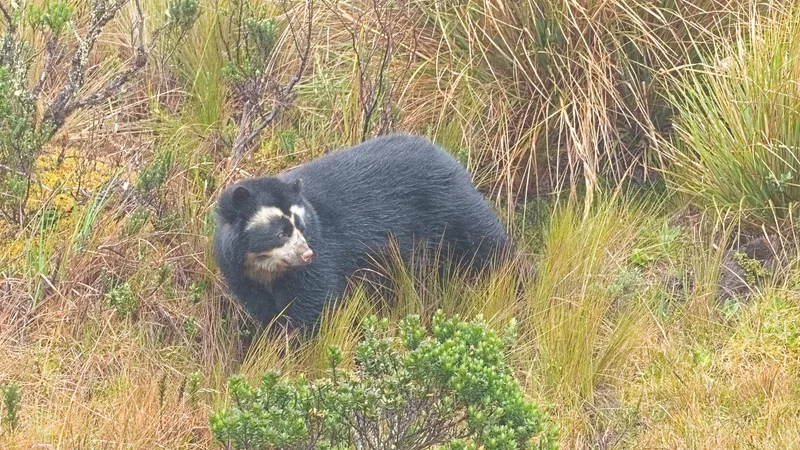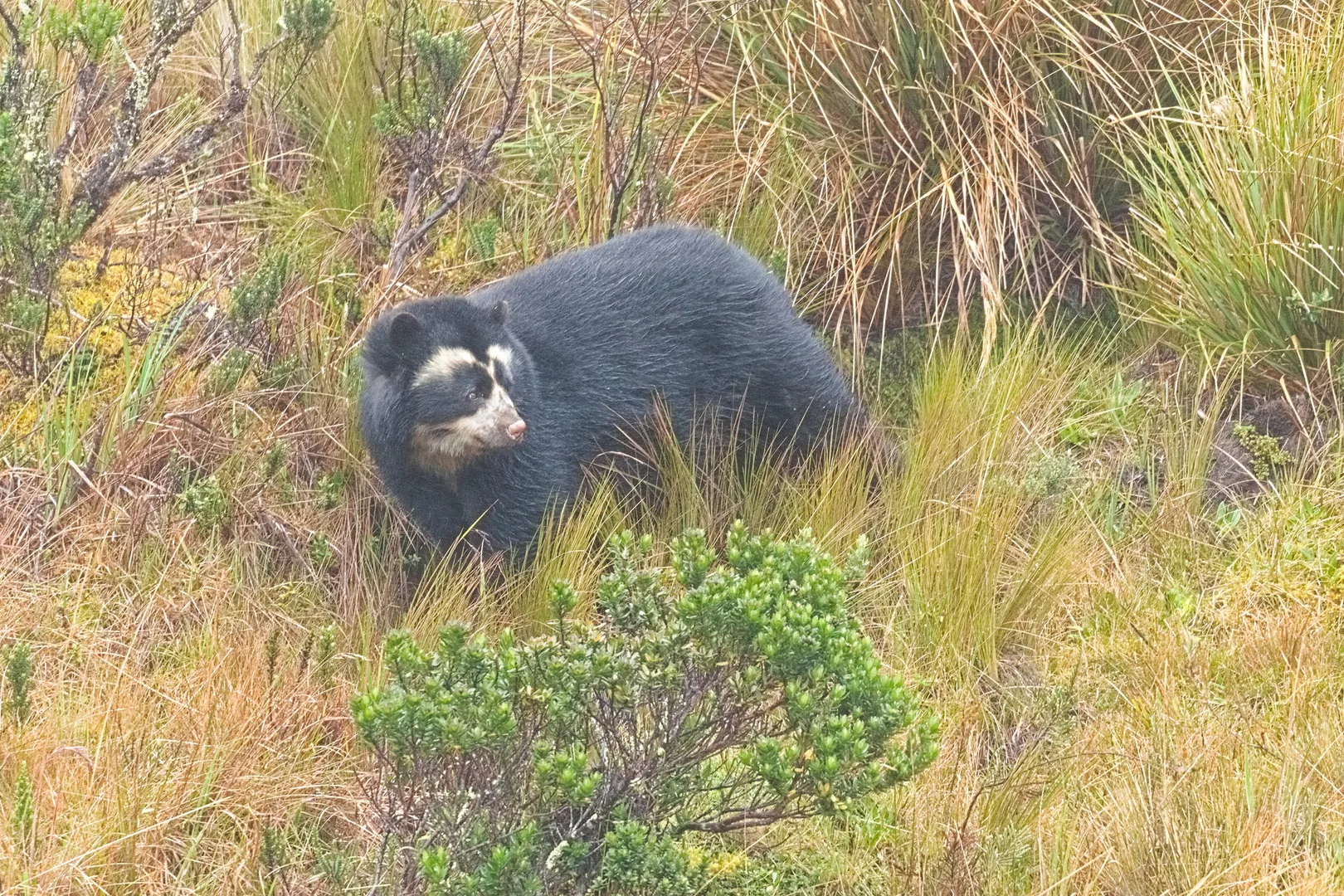
In paramo grassland.
Field
notes
Spectacles like fingerprints
The spectacled bear, Tremarctos ornatus, has whitish or cream rings around its eyes. That pale color can extend down to the throat and chest, and each bear has its own set, a “fingerprint” of markings. The thick coat is usually black or brown, sometimes tinged with red.
It is a medium-sized bear. It grows 1.5 to 1.8 meters (5 to 6 feet) long and stands 0.6 to 0.9 meters (2 to 3 feet) high at the shoulder. Males grow up to 30 percent larger than females and weigh up to 154 kilograms (340 pounds). Females rarely top 81 kilograms (180 pounds).
A bear with a tree-top workshop
This bear climbs trees as well as foraging on the ground, and it builds stick platforms to reach food that sits high up. Fruit and bromeliads are favorites, but the menu also takes in berries, grasses, bulbs, cactus flowers and small animals such as rodents, rabbits and birds. Near settlements, bears sometimes raid cornfields.
It is the only bear native to South America. It lives in the Andes and outlying mountain ranges, from western Venezuela south to Bolivia. Many live between 1,829 and 2,682 meters (6,000 and 8,800 feet) above sea level, and others live lower. Their habitats run from rainforest to thorny dry forest.
Cousin of the giants
The last of its line The spectacled bear is the only living tremarctine, a subfamily of bears found only in the New World. Its extinct relatives include two of the largest land mammal carnivores that have ever lived, the giant short-faced bears, at 1,000 kilograms or more. DNA from a thigh bone found in a Chilean cave showed that the South American short-faced bears were more closely related to the spectacled bear than to the short-faced bears of North America.
A long life with an open question
In human care, the average age is around 20 years, and it is not uncommon for a bear to live into its late twenties or occasionally its early thirties. The maximum recorded in AnAge, a database of animal lifespans, is 39 years, for a wild-born bear that died in captivity. How long they live in the wild is unknown. The IUCN rates the species Vulnerable.
Published
Traits
Intel
& FAQ
Guess
first
How big is a Spectacled Bear, really? Slide, lock in, and see what the sources say. Every answer is a figure from this page, quoted from where it came from.
Sources
- 01Andean bear. Smithsonian's National Zoo and Conservation Biology Institute.
- 02Tremarctos ornatus (spectacled bear). AnAge: The Animal Ageing and Longevity Database, Human Ageing Genomic Resources.
- 03Vela-Vargas et al. (2021). Tremarctos ornatus(Carnivora: Ursidae). Mammalian Species.
- 04Mitchell et al. (2016). Ancient mitochondrial DNA reveals convergent evolution of giant short-faced bears (Tremarctinae) in North and South America. Biology Letters.
- 05Velez-Liendo & García-Rangel (2017). Tremarctos ornatus. The IUCN Red List of Threatened Species 2017: e.T22066A123792952.
What the sources say: 39 claims checked word for word against these sources →