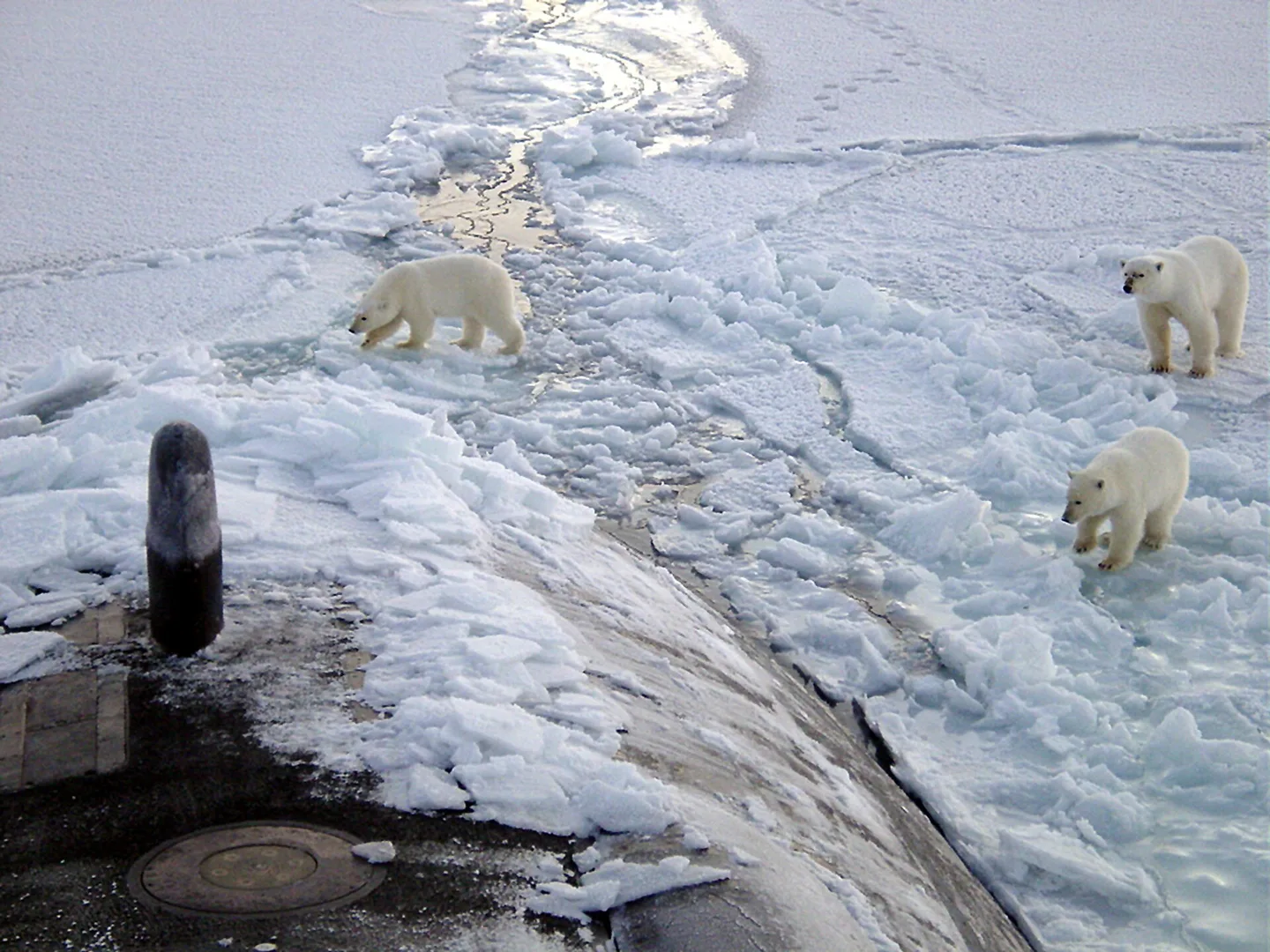
Three polar bears approach the starboard bow of the Los Angeles-class fast attack submarine USS Hono
Field
notes
Built Big
A polar bear (Ursus maritimus) is, most experts agree, the longest of the world’s eight bear species, and San Diego Zoo Wildlife Alliance reports that males can stand over 12 feet (3.7 meters) on their hind legs. Typical adult males weigh 300 to 635 kilograms (660 to 1,400 pounds); one enormous bear on record weighed more than 770 kilograms (1,700 pounds). Females run smaller, at 150 to 250 kilograms (330 to 550 pounds), though a pregnant female can weigh more than 453 kilograms (1,000 pounds) before she dens for winter. Alongside the brown bear, it’s one of the two largest carnivores that live on land. Wild polar bears are estimated to live 25 to 30 years; Animal Diversity Web’s oldest captive record, a female at the Detroit Zoo, reached 43 years and 10 months.
A Nose Built for a White World
Polar bears have two ways to hunt, and still-hunting is the one they use most: waiting motionless for hours beside a seal’s breathing hole in the ice until it surfaces. San Diego Zoo Wildlife Alliance says a polar bear’s nose can pick up a seal’s scent from 20 miles (32 kilometers) away, sniff out a seal’s den under the snow, and find a breathing hole in the ice up to a mile (1.6 kilometers) away. Moving around is expensive: the zoo notes it costs a polar bear about twice the energy of most mammals, which helps explain why it prefers to sit and wait rather than chase. A study that measured the metabolic rates of nine wild bears found their energy use ran 1.6 times higher than scientists had assumed, leaving more than half the bears studied in an energy deficit.
The Fiber-Optic Myth
Zero white pigment Each guard hair is a hollow, clear tube, and what looks like white fur is really light refracting off that structure over jet-black skin underneath.
That much is real biology. What doesn’t survive testing is the popular add-on that those hollow hairs work like fiber-optic cables that guide ultraviolet light. A 1998 study in Applied Optics measured how fast light fades inside real polar bear hairs, 2 to 8 decibels per millimeter, a loss rate that, with a reanalysis of older data, its author says seems to rule the idea out. Underneath the coat sits a layer of fat 5 to 10 centimeters (2 to 4 inches) thick. It is backup energy when food is scarce, and it may also help insulate the bear and keep it afloat.
Swimming a Sea That Keeps Shrinking
Polar bears are excellent swimmers, paddling with their broad front feet and steering with their back legs like rudders. San Diego Zoo Wildlife Alliance says they have been known to swim more than 100 kilometers (60 miles) without resting. In the southern Beaufort and Chukchi seas, a study that GPS-tracked 52 adult females over six years logged 50 long-distance swims by 20 bears, averaging 154 kilometers and reaching as far as 687 kilometers, some lasting up to 9.7 days. The researchers suggest the swims are a response to shrinking summer sea ice. The U.S. Fish and Wildlife Service puts the global population at about 26,000 bears as of 2023, spread across 19 subpopulations. The IUCN lists the species as Vulnerable. San Diego Zoo Wildlife Alliance notes that disappearing sea ice is linked to declines in polar bears’ body condition, reproduction and survival.
Published Updated
Traits
Intel
& FAQ
Guess
first
How big is a Polar Bear, really? Slide, lock in, and see what the sources say. Every answer is a figure from this page, quoted from where it came from.
Sources
- 01Polar Bear. San Diego Zoo Wildlife Alliance.
- 02Polar Bears: Icons of the Arctic. San Diego Zoo Wildlife Alliance.
- 03Ursus maritimus (polar bear). Animal Diversity Web, University of Michigan.
- 04Polar Bear (Ursus maritimus). U.S. Fish & Wildlife Service.
- 05Koon (1998). Is polar bear hair fiber optic? Applied Optics.
- 06Pagano et al. (2018). High-energy, high-fat lifestyle challenges an Arctic apex predator, the polar bear. Science.
- 07Pagano et al. (2012). Long-distance swimming by polar bears (Ursus maritimus) of the southern Beaufort Sea during years of extensive open water. Canadian Journal of Zoology.
What the sources say: 49 claims checked word for word against these sources →