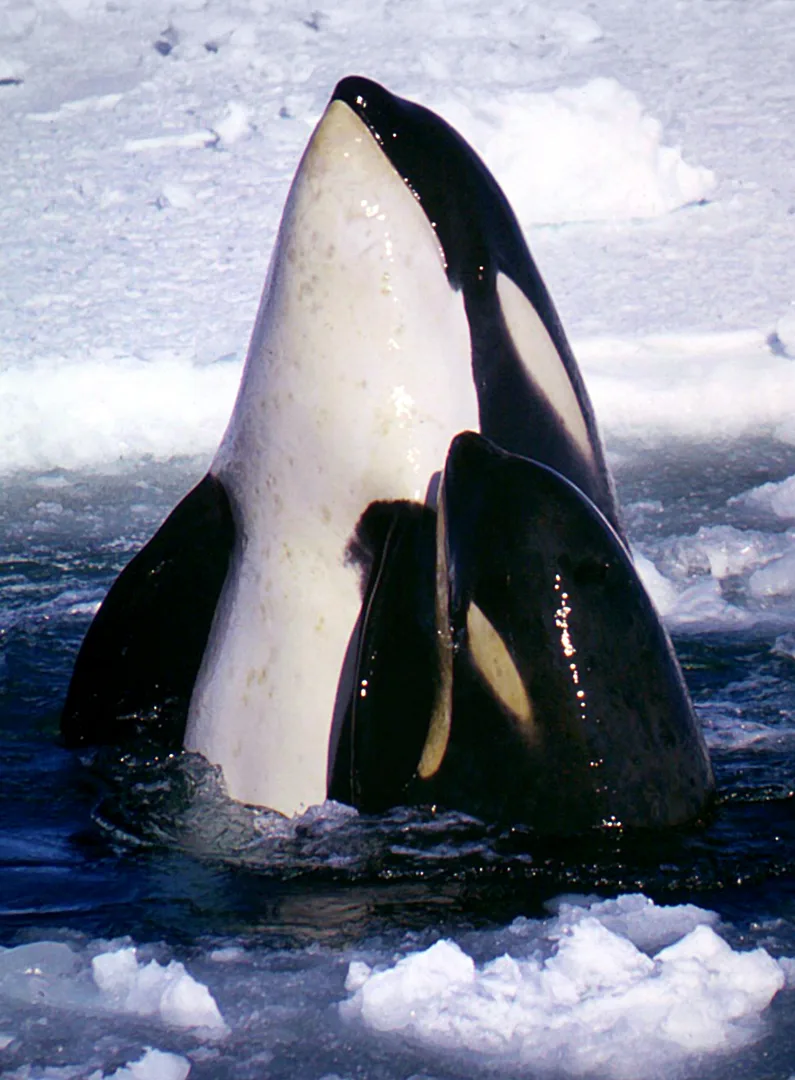
Rescuing Killer Whales (Orcinus orca) at Uyeasound A dozen Killer Whales were repeatedly beaching, a
Field
notes
The Lowdown
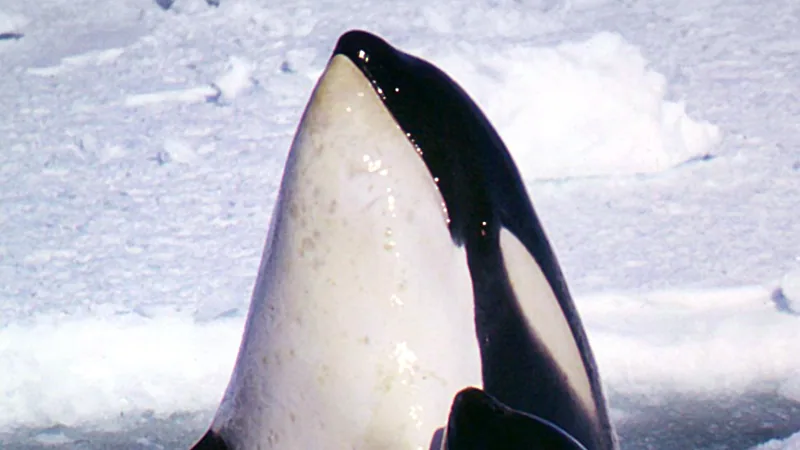
The orca (Orcinus orca) is the largest member of the dolphin family and the ocean’s apex predator, with no natural predators once grown, though young orcas may be attacked by other killer whales or large sharks. Orcas rely on underwater sound to feed, communicate, and navigate. The Southern Residents, a fish-eating population in the eastern Pacific, hunt by echolocation, clicking out sound and reading the echoes so precisely that they can tell one salmon species from another. Echolocation lets killer whales detect fish up to 500 feet away, much farther than they could see in dark water. Each pod also has its own dialect of calls, learned and culturally passed on between whales, and one study puts the average detection range of resident orcas’ long-range calls at 10 to 16 kilometers, about 6 to 10 miles, in a calm sea.
Different ecotypes have their own learned hunting tactics. Off the Antarctic Peninsula, groups of pack ice killer whales work together to make waves that wash Weddell seals off ice floes. In one study they caught 12 of the 16 Weddell seals they attacked, and a successful attack took four waves on average. Off northern Norway, orcas use carousel feeding: they herd herring into a tight, dense ball near the surface, then slap its edge with their tail flukes to stun the fish before eating them one by one.
Dialects that shift A study that recorded two resident orca families for 12 to 13 years found one of their call types changing, in a similar way in both families. Hunting skills are taught as well, passed to younger whales in the pod through apprenticeship.
Off the coast of South Africa, a killer whale has been filmed trying to roll a great white shark upside down, into a position that sends sharks into tonic immobility, a paralysis-like state, before biting into its abdomen just behind the pectoral fins. That matches the attack researchers had suspected from shark carcasses missing their livers, and one study estimated that the liver of an adult white shark of about 428 kilograms holds roughly as much energy as an adult male orca needs in a day. At California’s Southeast Farallon Island, transient orcas killed a white shark in 1997 and ate only its liver. In 2009, orcas stayed just over two and a half hours and were not seen killing any shark, yet the island stayed virtually shark-free for the rest of that season.
Published Updated
Traits
Intel
& FAQ
Sources
- 01Killer Whale. NOAA Fisheries.
- 02Orcinus orca (killer whale). Animal Diversity Web, University of Michigan.
- 03Sound Strategy: Hunting with the Southern Residents, Part 2. NOAA Fisheries.
- 04Miller (2006). Diversity in sound pressure levels and estimated active space of resident killer whale vocalizations. Journal of Comparative Physiology A.
- 05Similä & Ugarte (1993). Surface and underwater observations of cooperatively feeding killer whales in northern Norway. Canadian Journal of Zoology.
- 06Pitman & Durban (2011). Cooperative hunting behavior, prey selectivity and prey handling by pack ice killer whales ( Orcinus orca ), type B, in Antarctic Peninsula waters. Marine Mammal Science.
- 07Towner et al. (2022). Direct observation of killer whales preying on white sharks and evidence of a flight response. Ecology.
- 08Jorgensen et al. (2019). Killer whales redistribute white shark foraging pressure on seals. Scientific Reports.
- 09Guinet & Bouvier (1995). Development of intentional stranding hunting techniques in killer whale (Orcinus orca) calves at Crozet Archipelago. Canadian Journal of Zoology.
- 10Deecke, Ford & Spong (2000). Dialect change in resident killer whales: implications for vocal learning and cultural transmission. Animal Behaviour.