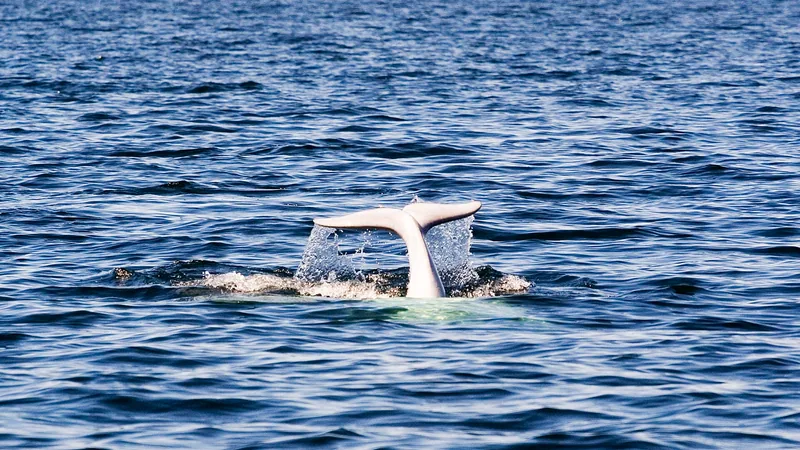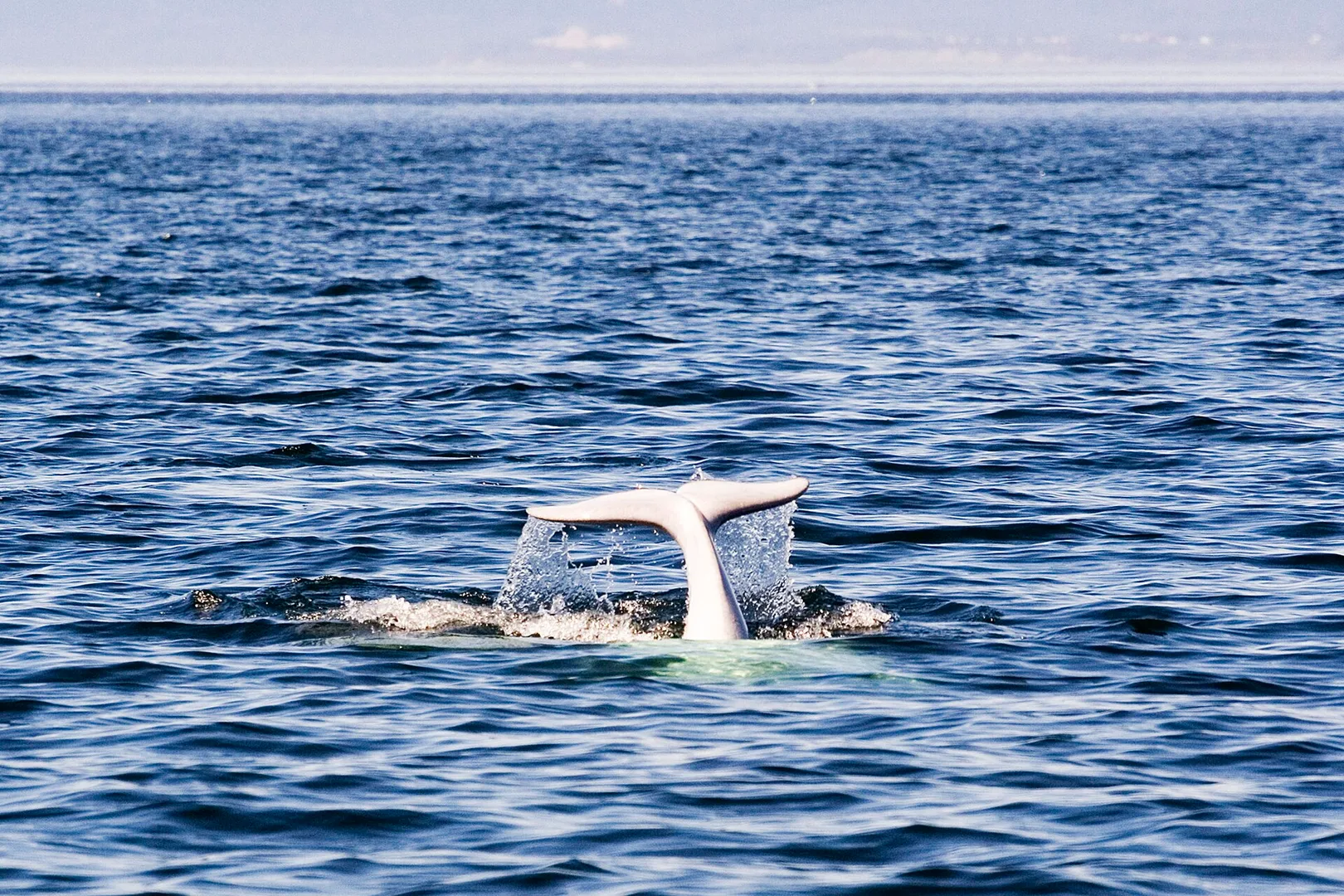
A wild beluga whale surfaces in the Churchill River near Hudson Bay, Canada, lifting its rounded white head clear of the water.
Field
notes
A Forehead Built to Break Ice
An adult beluga whale (Delphinapterus leucas) is white, with no dorsal fin, no pronounced beak and a round bulge on top of its head. That bulge is the melon, a flexible organ that focuses and modulates the whale’s calls, including its echolocation clicks. Belugas use those clicks along with their melon-like forehead to find cracks in the ice, and are commonly seen using that same bulbous forehead to break through ice 10 centimetres thick to make a hole for breathing.
A beluga weighs 3,150 pounds (about 1,430 kg) on average and grows up to 16 feet (4.9 m) long. It can live up to 90 years. Scientists can age a beluga by its teeth, which lay down one growth layer a year, like tree rings. The oldest beluga on record had 80 layers, and because teeth wear down, it may have been even older.
Life on the Ice Edge
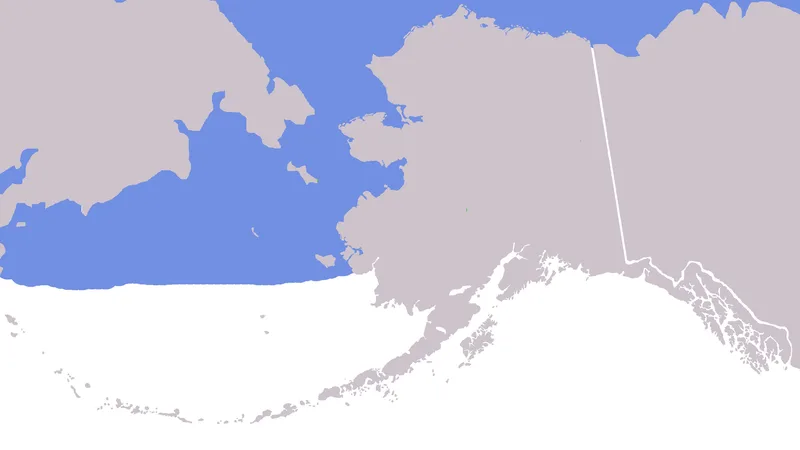
Belugas live in the Arctic Ocean and its nearby seas, and are common in many parts of Alaska, Russia, Canada and Greenland. In summer they are usually found in shallow coastal waters, and they also move seasonally into estuaries and large river deltas to feed on fish runs. In other seasons they may head for deeper water, diving to 1,000 metres for up to 25 minutes. Their diet is a broad seafood spread: salmon, eulachon, cod, herring, smelt and flatfish, plus octopus, squid, crabs, shrimp, clams, snails and sandworms. Their predators include killer whales and polar bears.
Winter-Proofed by Design
The genus name Delphinapterus translates to “dolphin without a fin.” Instead of a fin, belugas carry a tough dorsal ridge, which allows them to swim easily under ice floes, sheets of floating ice. A layer of blubber up to 40 percent of their body weight keeps them warm and stores energy, and every summer some populations shed their outer skin in an annual molt, rubbing against coarse gravel in shallow water to help remove the old, yellowed skin. Their neck is unusual too: unlike other whales and dolphins, whose neck vertebrae are fused, a beluga’s are not, allowing it to nod and move its head from side to side.
Menopause at Sea Belugas are known to go through menopause, along with humans and other whales such as killer whales and narwhals. In northwest Alaska, pregnancy rates showed signs of decline after age 46, yet the oldest female there, aged 70, was carrying a near-term fetus, a calf nearly ready to be born.
Published Updated
Traits
Intel
& FAQ
Guess
first
How big is a Beluga Whale, really? Slide, lock in, and see what the sources say. Every answer is a figure from this page, quoted from where it came from.
Sources
- 01Beluga Whale. NOAA Fisheries.
- 02Delphinapterus leucas (beluga). Animal Diversity Web, University of Michigan.
- 03Lowry, Reeves & Laidre (2017). Delphinapterus leucas. The IUCN Red List of Threatened Species 2017: e.T6335A50352346.
What the sources say: 44 claims checked word for word against these sources →