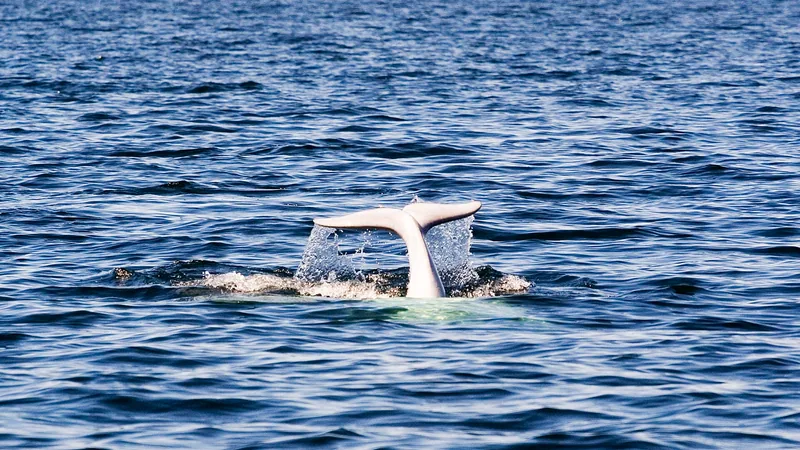
A narwhal seen from the air, its pale, spotted back just breaking the surface.
Field
notes
The Tooth Behind the Unicorn Myth
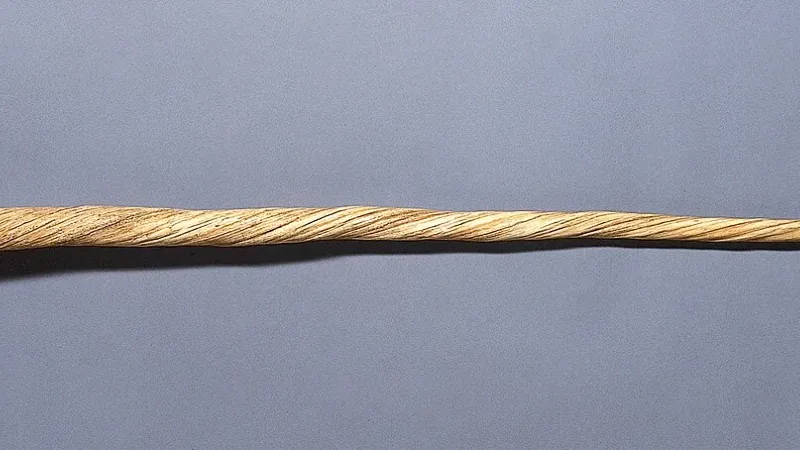
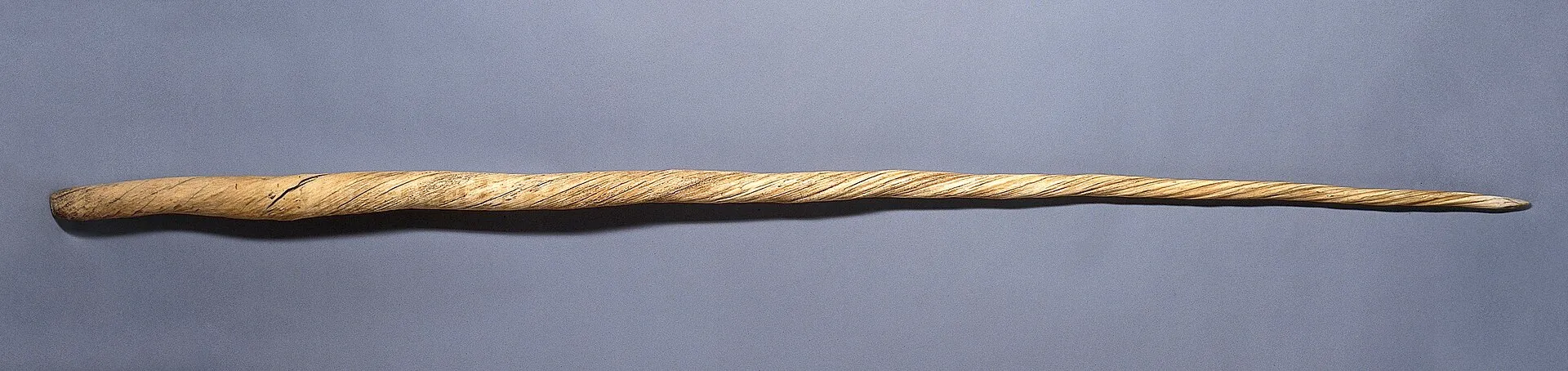
As early as the Middle Ages, narwhal tusks traded out of the Arctic reached Europe and became the source of the unicorn myth. The tusk is really a left canine tooth that grows out through the upper lip in males and spirals counter-clockwise, reaching up to 9.8 feet (3 m) long and over 20 pounds. In females, both teeth usually stay hidden in the jaw. It may also work as a sensory tool for detecting changes in the environment, but nobody has ever seen a narwhal use it to break ice, spear fish, dig in the seabed or swordfight. The scientific consensus is that it is a sexual trait, like a stag’s antlers: males have been seen carefully crossing tusks, often with a female between them, which might help maintain dominance.
Half a Mile Down, on One Breath
Narwhals spend six months of the year diving under dense winter pack ice to feed. They typically dive to at least 800 meters 18 to 25 times a day, and more than half of those dives reach at least 1,500 meters, staying down about 25 minutes each time. An average-size narwhal carries about 70 liters of oxygen in its lungs, blood and muscles, enough for more than 20 minutes underwater at 1 meter per second, and can shut off blood flow to organs it doesn’t need mid-dive. Their muscles hold twice as much oxygen-storing myoglobin as some seals and eight times as much as land mammals. The record dive depth is about 1,800 meters, over a mile.
A heart that nearly stops Scientists who fitted recorders to East Greenland narwhals released from nets and strandings found their heart rate fell to four beats a minute or less as they fled, even as their bodies burned three to six times their resting rate of energy.
Built for the Ice, Trapped by It
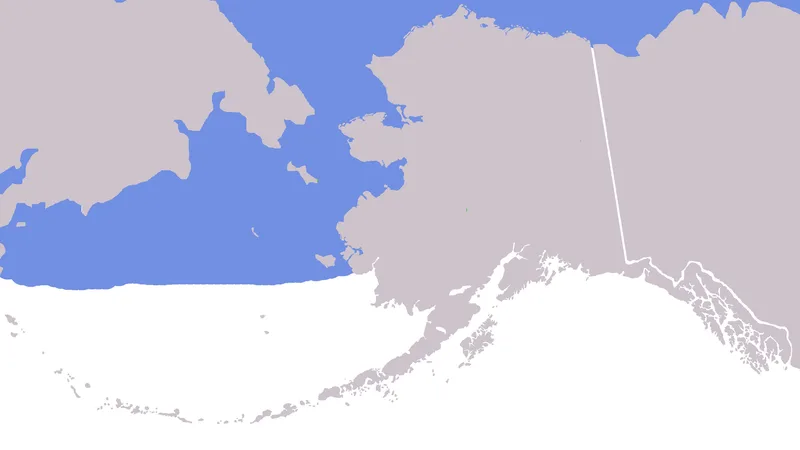
Narwhals live in the Arctic Ocean, mainly from central Canada to Greenland to eastern Russia. Adult males reach up to 15.7 feet and 3,527 pounds, females up to 13.8 feet and 2,204 pounds. Narwhals live at least 25 years and may live up to 50. They do not appear to feed in summer; in fall and winter they eat Greenland halibut and armhook squid, and in spring polar and Arctic cod. The ice is also a trap. Narwhals cannot break holes in dense ice, and when sudden weather changes seal its leads and cracks, hundreds of whales might be trapped in one small opening, an event called a sassat, and they often die.
Least Concern, Still Vulnerable
A 2019 genome study cites an estimated global population near 170,000, the estimate behind the narwhal’s 2017 downgrade from Near Threatened to Least Concern; the current Red List assessment, from 2023, keeps that rating. A 2018 study estimated narwhals to be the most vulnerable of seven Arctic marine mammal species to the vessel traffic opening up as the Northwest Passage and Northern Sea Route lose their ice. In January 2025 the UK’s Ivory Act was extended to ban importing, exporting and dealing in items containing narwhal ivory, alongside hippo, orca and sperm whale ivory, with penalties up to an unlimited fine or five years in jail.
Published Updated
Traits
Intel
& FAQ
Sources
- 01Narwhal. NOAA Fisheries.
- 02Monodon monoceros (narwhal). Animal Diversity Web, University of Michigan.
- 03Laidre, K.. Narwhal FAQ. Polar Science Center, Applied Physics Lab, University of Washington.
- 04Westbury et al. (2019). Narwhal Genome Reveals Long-Term Low Genetic Diversity despite Current Large Abundance Size. iScience.
- 05Williams et al. (2017). Paradoxical escape responses by narwhals (Monodon monoceros). Science.
- 06Hauser, Laidre & Stern (2018). Vulnerability of Arctic marine mammals to vessel traffic in the increasingly ice-free Northwest Passage and Northern Sea Route. Proceedings of the National Academy of Sciences.
- 07Sharpe & Berggren (2023). Monodon monoceros. The IUCN Red List of Threatened Species 2023: e.T13704A254246310.
- 08Ivory Act protections come into force for four more species. Department for Environment, Food & Rural Affairs (GOV.UK).