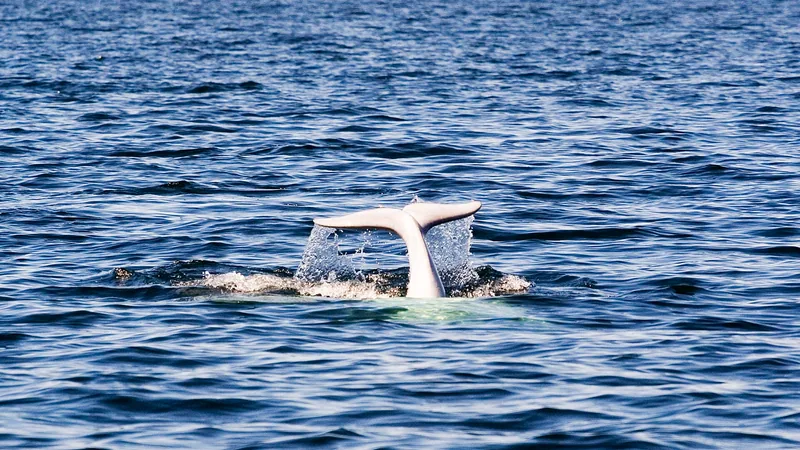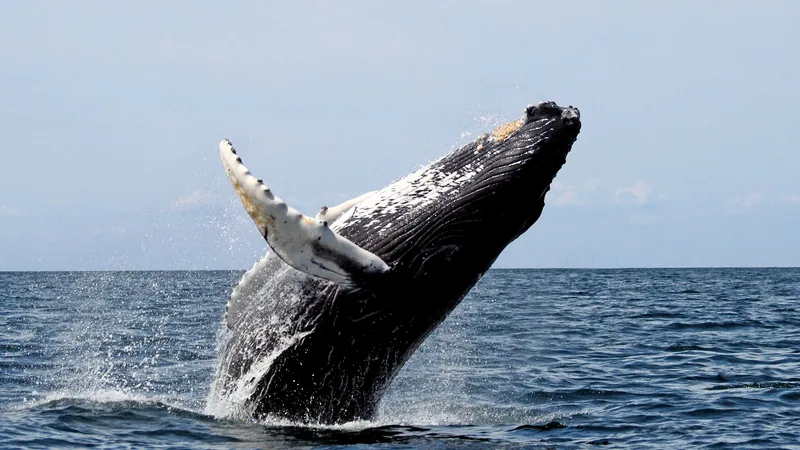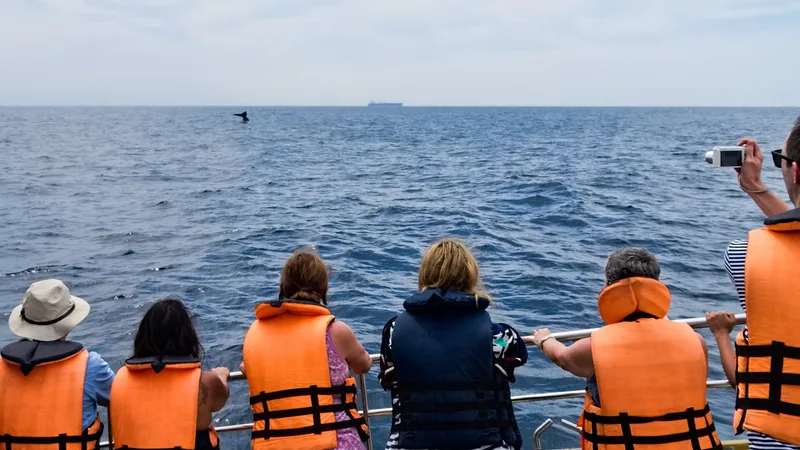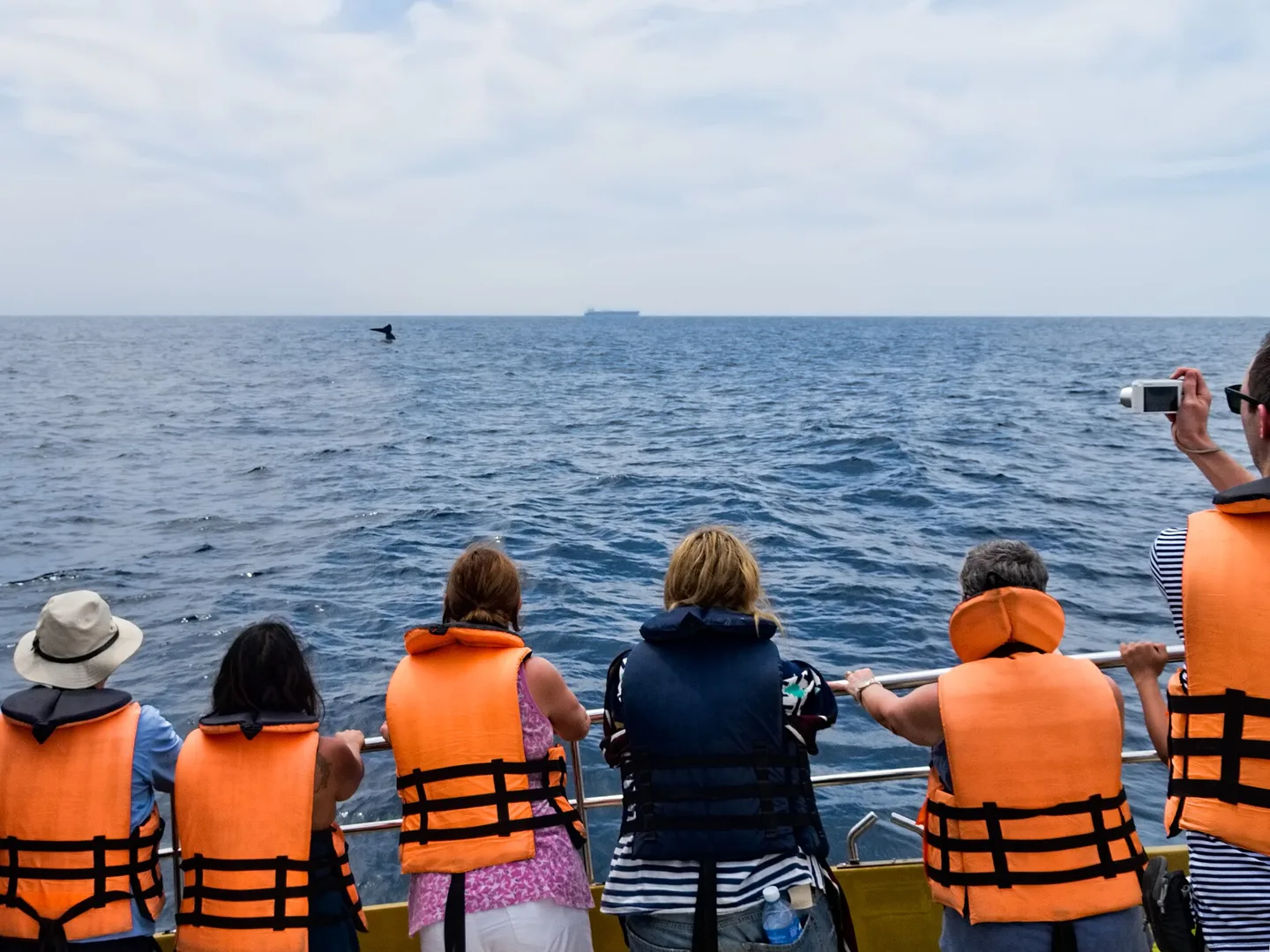
A blue whale surfaces, seen from a NOAA survey aircraft
Field
notes
The Biggest Animal There Has Ever Been
The blue whale (Balaenoptera musculus) is, as far as anyone can tell, the biggest animal that has ever lived: NOAA Fisheries calls it “the largest animal on Earth” and “the largest animals ever to live on our planet.” NOAA Fisheries records blue whales at up to 110 feet long and 330,000 pounds. The longest blue whale reliably measured, a female, came in at 33.26 meters (109.12 feet); a 2024 study built to test whether an ancient fossil whale called Perucetus colossus was heavier concluded that it wasn’t. A blue whale’s average lifespan is estimated at around 80 to 90 years, and the species is still listed as Endangered by the IUCN Red List, decades after commercial whaling in the early 1900s cut its numbers to a small fraction of what they were.
One Gulp, Eighty Cubic Meters of Ocean
Blue whales eat almost exclusively krill, tiny shrimp-like animals strained out of huge mouthfuls of seawater through baleen plates that hang from the roof of the mouth. Some of the biggest whales can eat up to 6 tons of krill a day, according to NOAA Fisheries. To catch that much, a whale lunges into a school of krill with its mouth open, its pleated throat ballooning outward to trap water and prey together, then pushes the water back out through the baleen with its tongue while the krill stays trapped behind.
Eighty Cubic Meters in Seven Seconds That’s how much water and krill a blue whale can gulp down in a single lunge, more than three times faster than a continuously feeding bowhead whale manages the same volume.
Lunge feeding like this comes with a high energetic cost. Even so, researchers who tagged foraging blue whales estimated their foraging efficiency runs nearly ten times higher than other marine mammals’, but only when they lunge into extremely dense krill. Tagged whales even switch strategy to match the krill: two or three lunges per dive to conserve oxygen when krill are sparse, then four to eight per dive to maximize energy on denser patches.
A Calf That Doubles In Length Before Weaning
Antarctic blue whale calves are born at about 7 meters (23 feet) long, and a 2020 study of whaling records says they are weaned just 7 months later at around 16 meters (52.5 feet), more than double their birth length. Females are generally the larger sex, and an Antarctic female reaches sexual maturity at around 23.7 meters long, at about age 10. Calves are born mostly in winter, and a female’s average calving interval is estimated at 2 to 3 years.
One Of The Loudest Voices In The Ocean
NOAA Fisheries counts blue whales among the loudest animals on the planet. Recordings made off the Antarctic Peninsula measured their calls averaging 189 decibels in a low rumble between 25 and 29 Hz. Hydrophones in the mid-Atlantic picked up an even deeper sound that researchers attribute to blue whales: a two-part moan at roughly 18 Hz that lasts 25 seconds. NOAA Fisheries says those calls are thought to carry up to 1,000 miles in the right ocean conditions. Scientists think whales use them to communicate and maybe to navigate the dark ocean depths by sonar.
Published Updated
Traits
Intel
& FAQ
Guess
first
How big is a Blue Whale, really? Slide, lock in, and see what the sources say. Every answer is a figure from this page, quoted from where it came from.
Sources
- 01Blue Whale. NOAA Fisheries.
- 02Balaenoptera musculus (blue whale). Animal Diversity Web, University of Michigan.
- 03Cooke (2018). Balaenoptera musculus. The IUCN Red List of Threatened Species 2018: e.T2477A156923585.
- 04Motani & Pyenson (2024). Downsizing a heavyweight: factors and methods that revise weight estimates of the giant fossil whale Perucetus colossus. PeerJ.
- 05Branch & Monnahan (2020). Sex ratios in blue whales from conception onward: effects of space, time, and body size. Marine Mammal Science.
- 06Širović, Hildebrand & Wiggins (2007). Blue and fin whale call source levels and propagation range in the Southern Ocean. The Journal of the Acoustical Society of America.
- 07Nieukirk et al. (2004). Low-frequency whale and seismic airgun sounds recorded in the mid-Atlantic Ocean. The Journal of the Acoustical Society of America.
- 08Hazen, Friedlaender & Goldbogen (2015). Blue whales (Balaenoptera musculus) optimize foraging efficiency by balancing oxygen use and energy gain as a function of prey density. Science Advances.
- 09Goldbogen et al. (2011). Mechanics, hydrodynamics and energetics of blue whale lunge feeding: efficiency dependence on krill density. Journal of Experimental Biology.
What the sources say: 58 claims checked word for word against these sources →