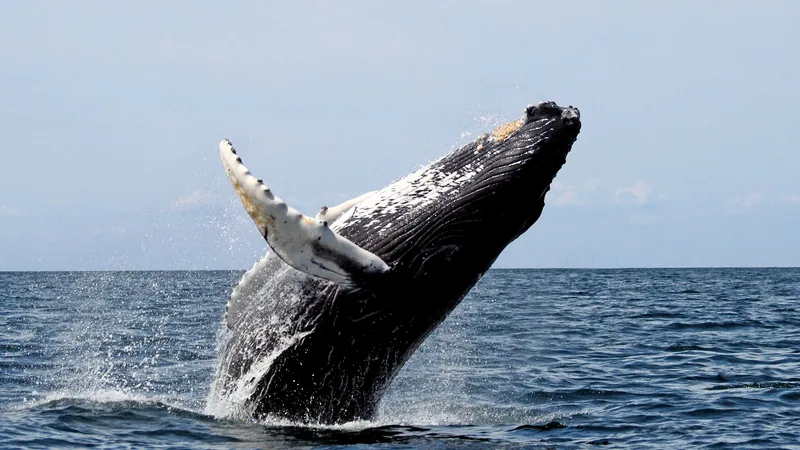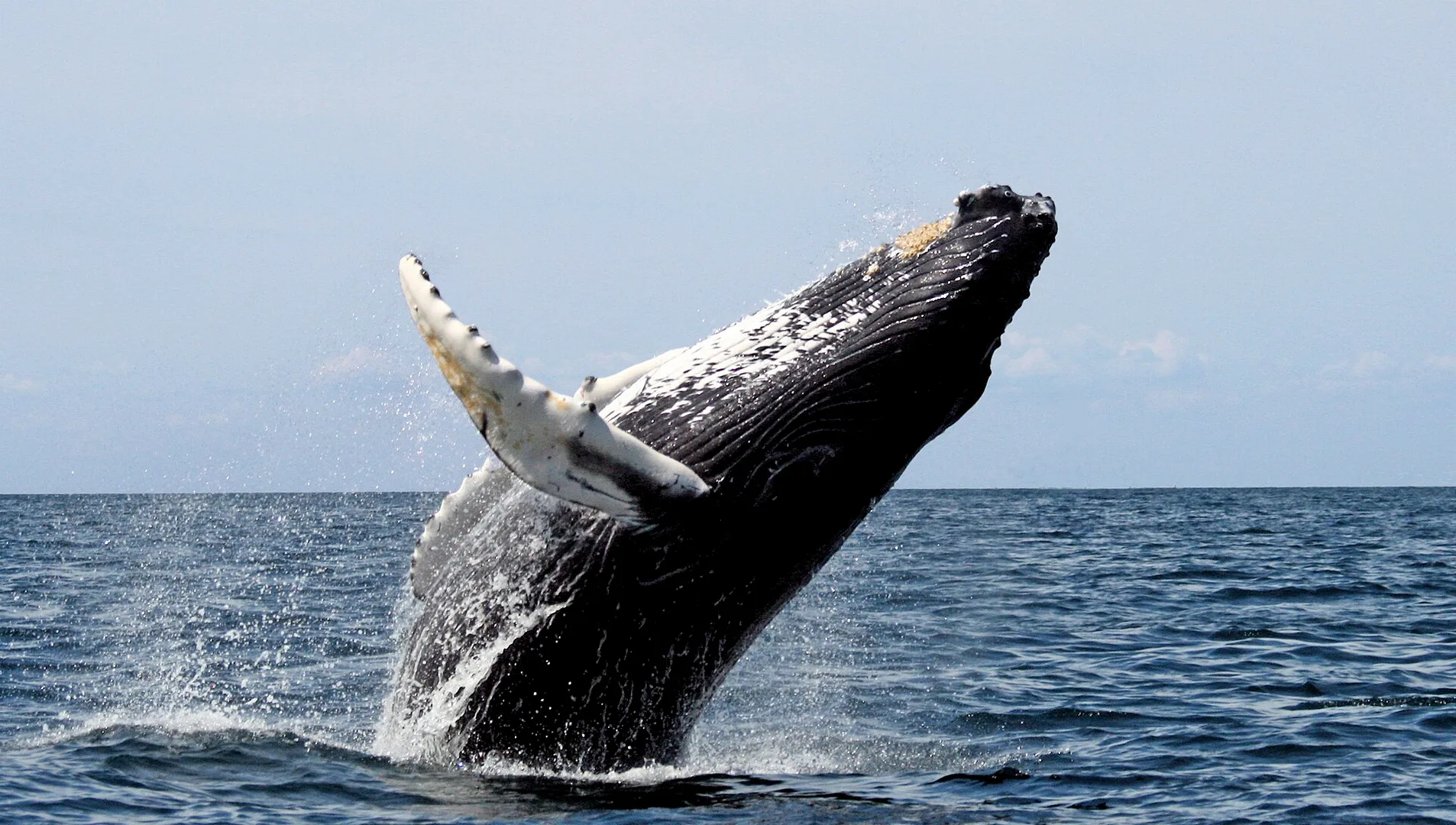
Humpback Whale, breaching, Stellwagen Bank National Marine Sanctuary
Field
notes
Hunting With Rings of Bubbles
The humpback whale (Megaptera novaeangliae) herds, corrals and confuses its prey, and its methods can include bubbles, sounds, the seafloor and even its flippers. Animal Diversity Web lists five main feeding tricks. In one, the “ring of foam,” the whale swims a circle at the surface, slapping the water with its flukes so foam surrounds its prey, then dives beneath the ring and surfaces in the center, mouth open. Underwater, it can also blow “bubble clouds” or “bubble columns”; the columns can form rings that act like a sieve net, herding or concentrating prey. Typically it gulps food and water together, its throat grooves expanding to hold large volumes, then shuts its mouth and presses the water out, leaving the food caught in its baleen plates.
Flippers, Flukes and a Hump
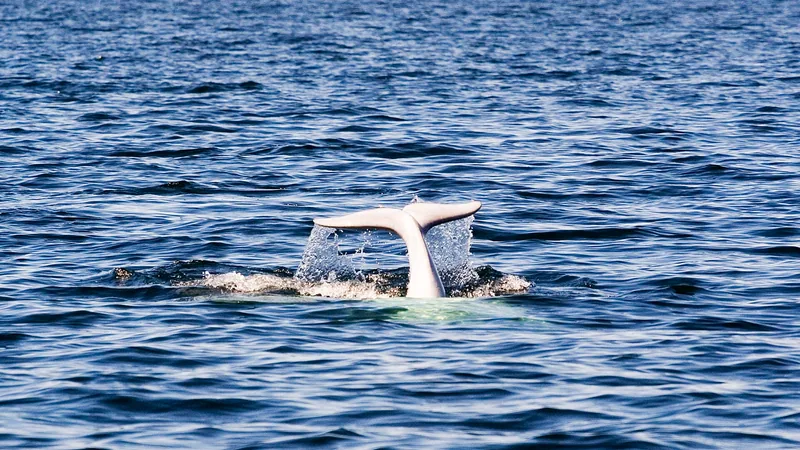
It can grow to about 60 feet long and weigh up to about 40 tons, according to NOAA Fisheries. The flippers are a giveaway: they can reach almost a third of the whale’s total body length and are largely white, with knobs along the leading edge, per Animal Diversity Web. Its tail flukes carry distinctive gray-and-white patterns with a scalloped trailing edge. Its dorsal fin often has a stepped or humped shape, one source of the name “humpback”; another is its habit of rounding its back as it dives. Females grow larger than males. NOAA Fisheries puts its lifespan at about 80 to 90 years.
Predators, Escorts and Whalers
Humpbacks have few predators besides humans. Animal Diversity Web says killer whales sometimes harass and perhaps kill them, and sharks feed on their carcasses. A mother and calf may be accompanied by “escort” whales, believed to be mostly males, which turn aggressive toward other humpbacks that approach and sometimes blow bubbles as an apparent screen. Humans have been the real danger: before a final moratorium on commercial whaling in 1985, all humpback populations were greatly reduced, most by more than 95 percent. The species is now increasing in much of its range, and the IUCN Red List rates it Least Concern. Not every population has recovered, though: under the US Endangered Species Act, four of the humpback’s 14 distinct population segments are still listed as endangered, among them Central America and the Arabian Sea.
Whale Culture: Songs and Habits That Spread
Lone males sing the famous songs during the winter mating season, the San Diego Zoo says. Payne and McVay’s 1971 study described each song as a series of sounds lasting 7 to 30 minutes, repeated with considerable precision and no obvious pause between songs, so a session can run for several hours. A later analysis found strong rules, a kind of syntax, shaping the song, with patterns that recur every 6 to 8 sound units and again every 180 to 400.
A Song That Spreads Like a Trend Researchers tracking populations across the western and central South Pacific found new song versions moving eastward from one population to the next, again and again, over 11 years: the whale version of a hit song.
Songs are not the only tradition humpbacks keep. Lobtail feeding, which combines a tail slap with bubble feeding, spread through a population of humpback whales over a period of 27 years; the evidence for models with social learning was 6 to 23 orders of magnitude stronger than for models without it, meaning the trick passed whale to whale.
Published Updated
Traits
Intel
& FAQ
Guess
first
How big is a Humpback Whale, really? Slide, lock in, and see what the sources say. Every answer is a figure from this page, quoted from where it came from.
Sources
- 01Megaptera novaeangliae (humpback whale). Animal Diversity Web, University of Michigan.
- 02Whale. San Diego Zoo Wildlife Alliance.
- 03Cooke (2018). Megaptera novaeangliae. The IUCN Red List of Threatened Species 2018: e.T13006A50362794.
- 04Payne & McVay (1971). Songs of Humpback Whales: Humpbacks emit sounds in long, predictable patterns ranging over frequencies audible to humans. Science.
- 05Garland et al. (2011). Dynamic Horizontal Cultural Transmission of Humpback Whale Song at the Ocean Basin Scale. Current Biology.
- 06Suzuki, Buck & Tyack (2006). Information entropy of humpback whale songs. The Journal of the Acoustical Society of America.
- 07Allen et al. (2013). Network-Based Diffusion Analysis Reveals Cultural Transmission of Lobtail Feeding in Humpback Whales. Science.
- 08Humpback Whale. NOAA Fisheries.
What the sources say: 54 claims checked word for word against these sources →