AnimalTracks.wiki
Birds of PreyProfile 392

Osprey

Pandion haliaetus

The fish-hawk that hovers over water, then plunges feet first to grab a fish in its talons.

Danger tierLowEffectively harmless to people.
IUCN status [LC]Least ConcernPopulation stable and widespread in natural habitats.Source: IUCN Red List
Vibe checkSlintPost-Rock & Cinematic OrchestralListen ↓

Field
notes

Checked against 5 sources ↓

Hover, then plunge

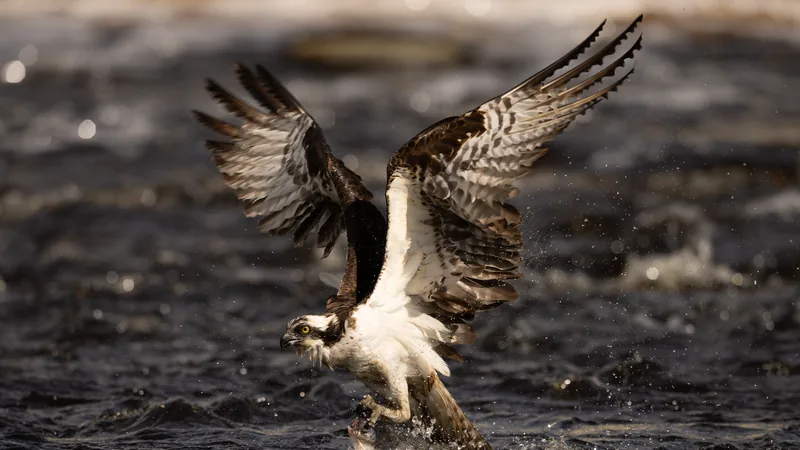
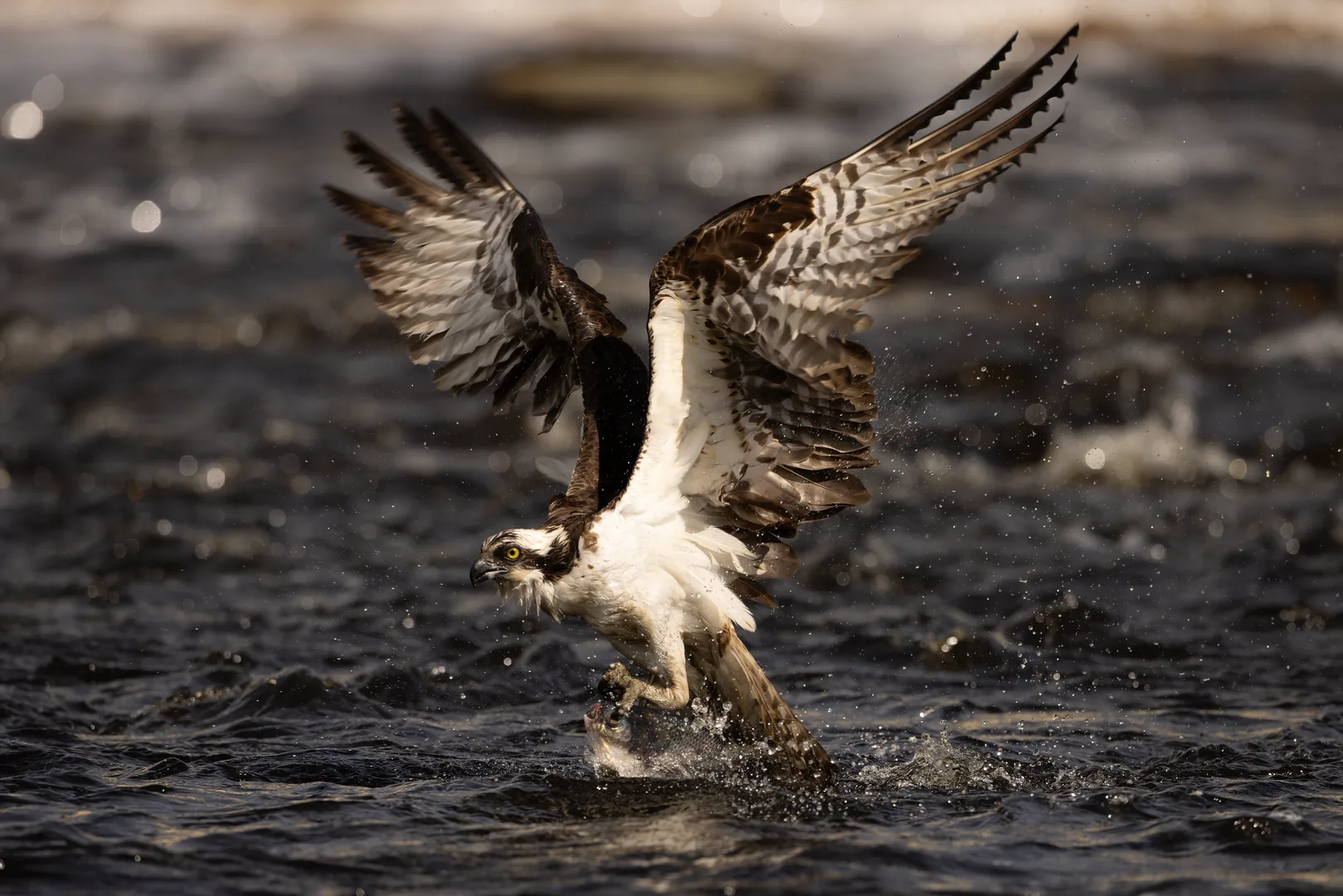
The osprey is a fish-hawk, and its hunting move is a plunge. Its diet is almost entirely fish. It flies slowly over the water and pauses to hover when it spots a fish below. If the fish is close enough to the surface, the osprey drops feet-first and grasps its prey in its talons. Just before it hits the water, it swings its legs forward and bends its wings back. Then it lifts off with strong, almost horizontal wing beats, carrying the fish head-forward with its feet. The Bald Eagle sometimes chases an osprey and forces it to drop its catch.

Built for slippery prey

An osprey has relatively long legs for a raptor, which is a bird of prey, and long, sharp, curved claws. It also has dense oily plumage and efficient nasal valves that stop water entering its nostrils when it dives.

Grip gear An osprey has spiny footpads called spicules and a reversible outer toe to aid in gripping slippery fish.

Size, weight and lifespan

Audubon’s North American field guide gives an osprey’s length as 54 to 58 cm, with a wingspan of 1.5 to 1.8 m. Its weight is 1.4 to 2 kg. Female ospreys are 20% heavier than males on average, according to ADW, though not necessarily longer. Tropical and subtropical ospreys tend to be smaller than those that breed at higher latitudes. AnAge lists a maximum longevity of 32 years in the wild.

Nearly worldwide

The osprey is one of six landbird species known to breed in every biogeographical region of the world except Antarctica. Nests are usually on top of large trees, and also on utility poles and other structures. A pair uses the same nest year after year, repairing it and adding material before eggs can be laid. The male brings fish, and the female feeds them to the young. In North America, some ospreys are permanent residents in southern Florida, while the rest migrate, and migrants travel singly, not in flocks.

A 2015 genetic study of two mitochondrial genes found the osprey structured into four genetic groups in mostly separate regions: Indo-Australasia, Europe and Africa, the Americas, and north-east Asia.

Published Updated

Traits

Intel
& FAQ

01Do ospreys ever eat anything besides fish?

Rarely. Fish make up at least 99% of an osprey's prey items, but ospreys have also been seen eating birds, snakes, voles, squirrels, salamanders and even a small alligator.

Source: Animal Diversity Web, University of Michigan

02How often does an osprey catch a fish when it dives?

Ospreys catch fish on 24 to 74% of their dives, according to ADW, and the rate is affected by individual ability, weather and tide.

Source: Animal Diversity Web, University of Michigan

03Do ospreys need to drink water?

Not generally. Fish flesh supplies enough water to meet their needs.

Source: Animal Diversity Web, University of Michigan

04Are ospreys endangered?

No. The IUCN Red List rates the osprey Least Concern. Audubon adds that pesticides seriously endangered it in the mid-20th century, and that since DDT and related pesticides were banned in 1972 it has made a good comeback in many parts of North America.

Source: National Audubon Society, Guide to North American Birds

Guess
first

How big is a Osprey, really? Slide, lock in, and see what the sources say. Every answer is a figure from this page, quoted from where it came from.

  1. ?
  2. ?

Sources

More Birds of Prey

Accipitriformes, Falconiformes & Strigiformes

Apex avian hunters with telescopic zoom vision, curved meat-shearing talons, and silent flight.

Bald eagle swooping low over a lake, talons out to grab a fish

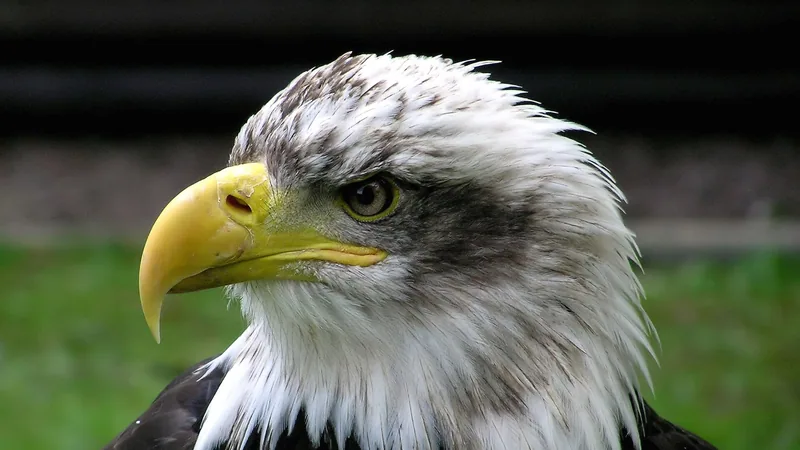
Bald Eagle

Haliaeetus leucocephalus

An apex fish hunter with a talon grip ten times as strong as an average human's, carried on a wingspan of up to eight feet.

A talon grip ten times as strong as an average human's, with spiny toe scales and rough foot pads that help it hold slippery fish.View →
▸ Tom PettyClassic Hard Rock & Southern Blues
Western barn owl on a wooden fence rail with both wings raised, facing the camera

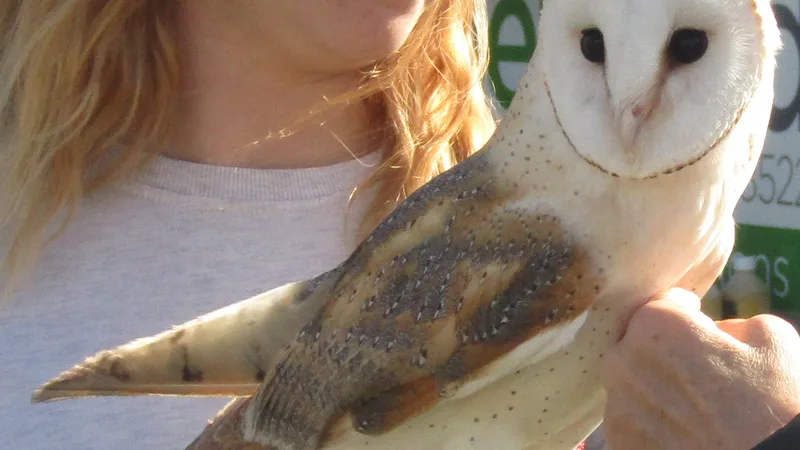
Barn Owl

Tyto alba

A heart-faced hunter that is completely silent on the wing and, in tests, found prey in total darkness by sound alone with an error of under one degree.

In tests, it found prey in total darkness by sound alone with an error of under one degree. Its two external ears are asymmetric, and a flap of skin in front of each ear opening can redirect where that ear is most sensitive.View →
▸ GrouperGlacial Ambient & Drone Soundscapes
Adult bearded vulture soaring against a clear blue sky, its long dark wings spread and pale underside showing

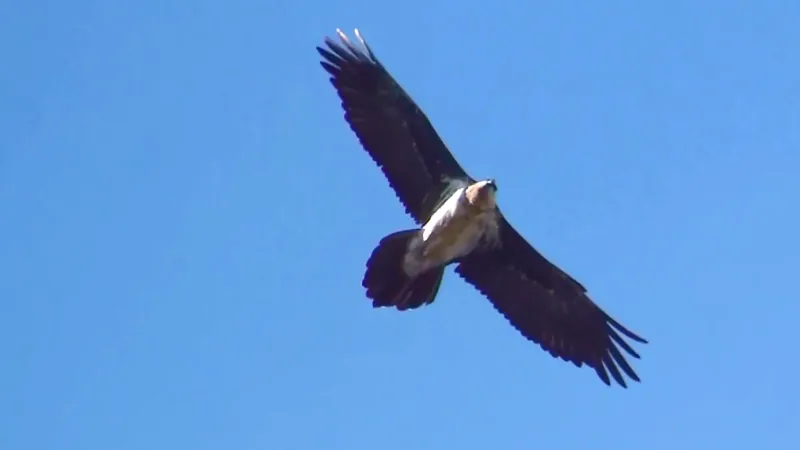
Bearded Vulture

Gypaetus barbatus

One of the few vertebrates that lives mostly on bone, which it breaks open by dropping it from the sky and digests in a stomach whose pH could be below 1.

A stomach whose pH could be below 1, and dropping bones from the sky to break them open for the marrow insideView →
▸ NightwishSymphonic Metal & Gothic Power
Golden eagle swooping low over grass with its talons lowered and wings raised

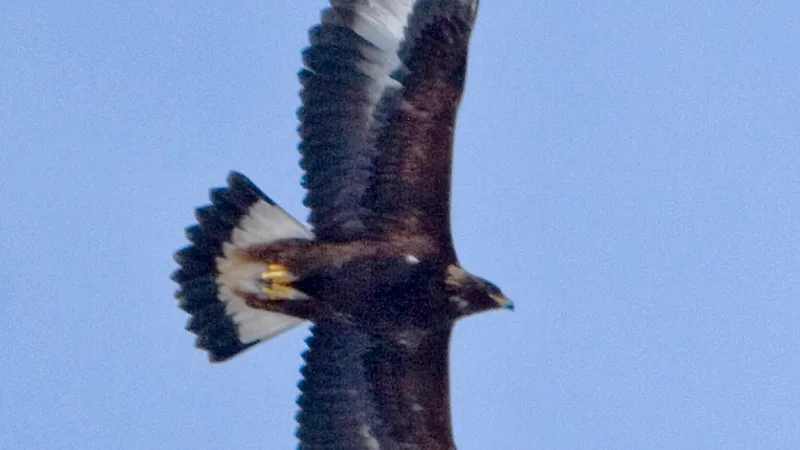
Golden Eagle

Aquila chrysaetos

A hunter with a wingspan of up to 2.3 meters that dives at up to 120 mph (193 km/h) and, on autumn migration across eastern North America, rides mostly on wind pushed up by ridges.

A dive of up to 120 mph (193 km/h) and a hunting style that often has one eagle drive prey toward its waiting partner.View →
▸ Boards of CanadaIDM & Glitch Ambient Synthesis

Clade factPeregrine falcons exceed 380 km/h in terminal hunting dives, assisted by specialized nostril baffles that regulate air pressure.

Explore all 15 →

Head-to-head showdowns

Simulated face-offs, biological power gauges, and 3-round combat

Down the Rabbit Hole

Associative matches based on weird shared evolutionary traits