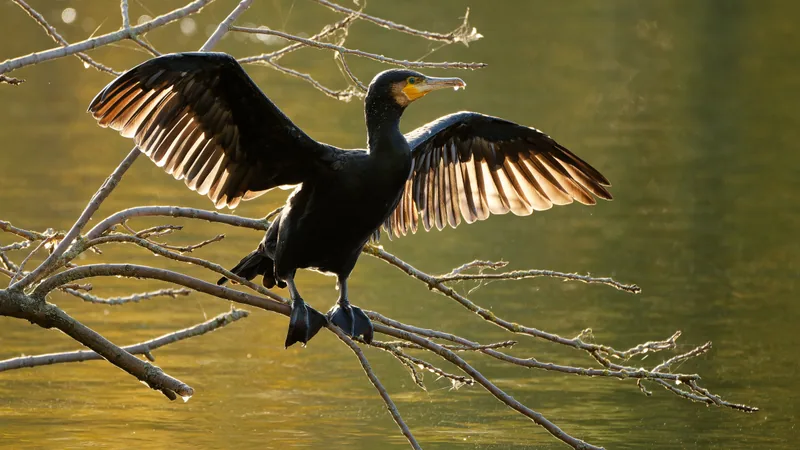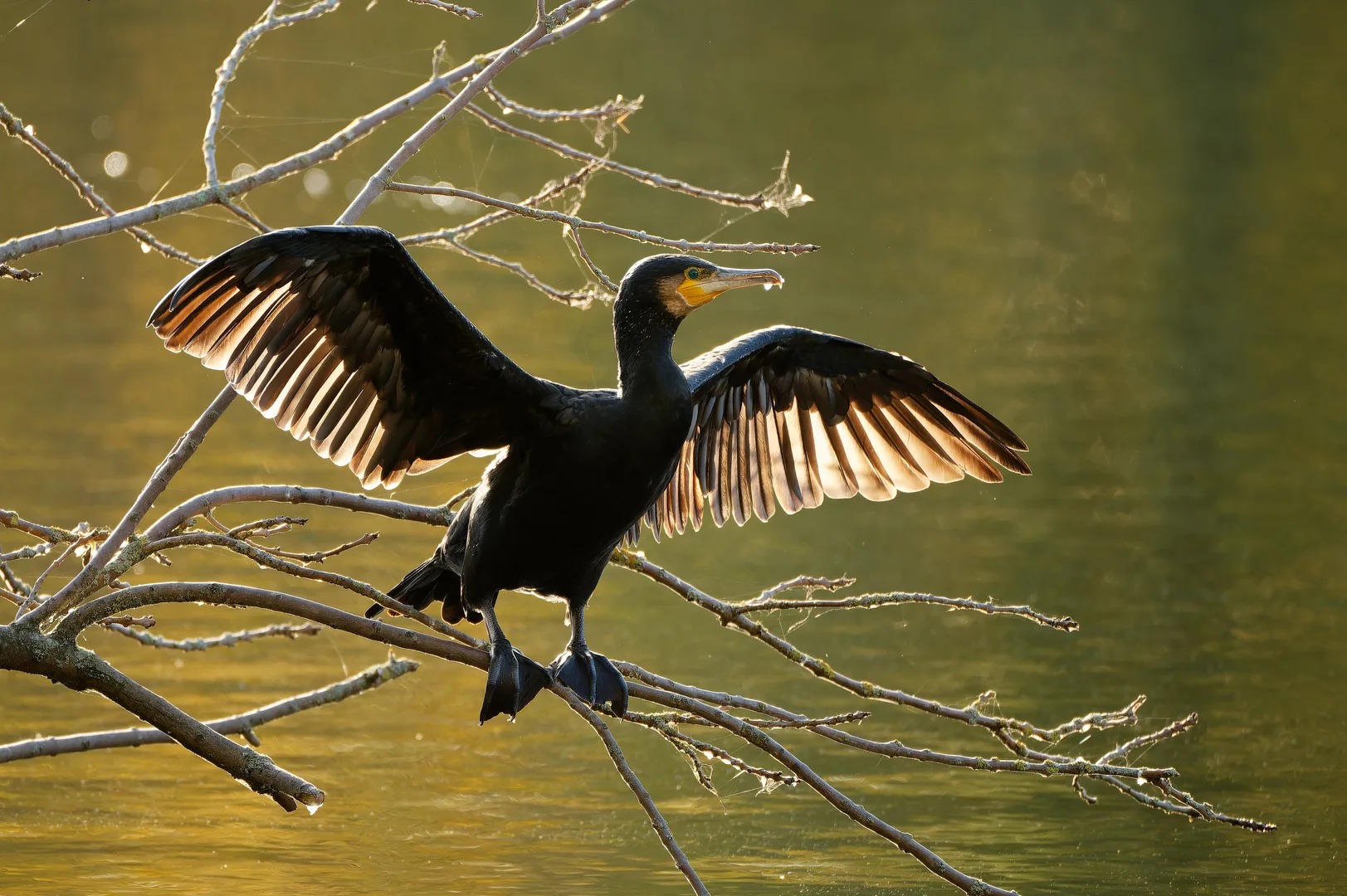
Wings out to dry.
Field
notes
Low buoyancy
Great cormorants are clumsy on land but fast, agile swimmers. They have wettable feathers and low buoyancy.
Underwater it paddles with its feet, tucks its wings away and steers with its tail. Mean dive times recorded are 21 to 51 seconds, and deeper water tends to mean longer dives. It hunts by sight, chasing fish anywhere from the surface to the bottom, depending on the prey. It eats almost exclusively fish under 20 cm long. Now and then it takes a bigger one, up to 75 cm long or 1.5 kg. Most of its fish are caught in water less than 20 m deep. Small fish get eaten underwater, and bigger ones are brought to the surface to be swallowed.
The price of wet feathers
Wettable plumage means a lot of time spent drying off and preening. It flaps its wings, shakes its body when it leaves the water and holds its wings outstretched to dry. A preening session can last up to 30 minutes.
Sea-water drinker A great cormorant can drink sea water, then clear the extra salt from its body through its salt glands.
Size, lifespan and range
An adult is 84 to 90 cm long with a wingspan of 130 to 160 cm and weighs 2.6 to 3.7 kg. Males are up to 20% heavier than females.
In Britain, a cormorant that survives to breeding age typically lives 11 years and starts breeding at about 3. The longevity database AnAge lists one banded wild bird that was at least 32.1 years old.
The species is one of the most widespread cormorants, found across Europe, Asia, Africa and Australia, and along the northeastern coast of North America. In North America it is strongly tied to sea coasts. In Europe it also lives on inland fresh water and in coastal estuaries, where rivers meet the sea.
A fishing partner
In east Asia, people have trained great cormorants to fish for them, an ancient practice dating back to the 5th century in China. A ring or other obstruction around the neck lets the bird catch a fish but not swallow it, and the fisher takes the fish from its throat. Tamed cormorants also fished for people in England and France in the 17th and 19th centuries.
Breeding birds nest in dense colonies of up to several thousand, though 20 to 200 pairs is more usual.
Published
Traits
Intel
& FAQ
Guess
first
How big is a Great Cormorant, really? Slide, lock in, and see what the sources say. Every answer is a figure from this page, quoted from where it came from.
Sources
- 01Phalacrocorax carbo. The IUCN Red List of Threatened Species 2021: e.T22696792A166315940.
- 02Phalacrocorax carbo (great cormorant). Animal Diversity Web, University of Michigan Museum of Zoology.
- 03BirdFacts: Cormorant (Phalacrocorax carbo). British Trust for Ornithology.
- 04AnAge entry for Phalacrocorax carbo. AnAge: The Animal Ageing and Longevity Database, Human Ageing Genomic Resources.
What the sources say: 45 claims checked word for word against these sources →