Austria, Vienna, Tiergarten Schönbrunn
Field
notes
The Mangrove Sniper
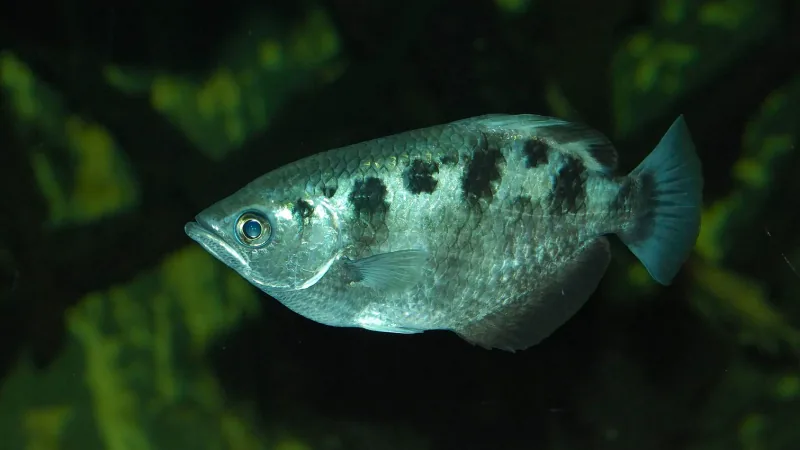
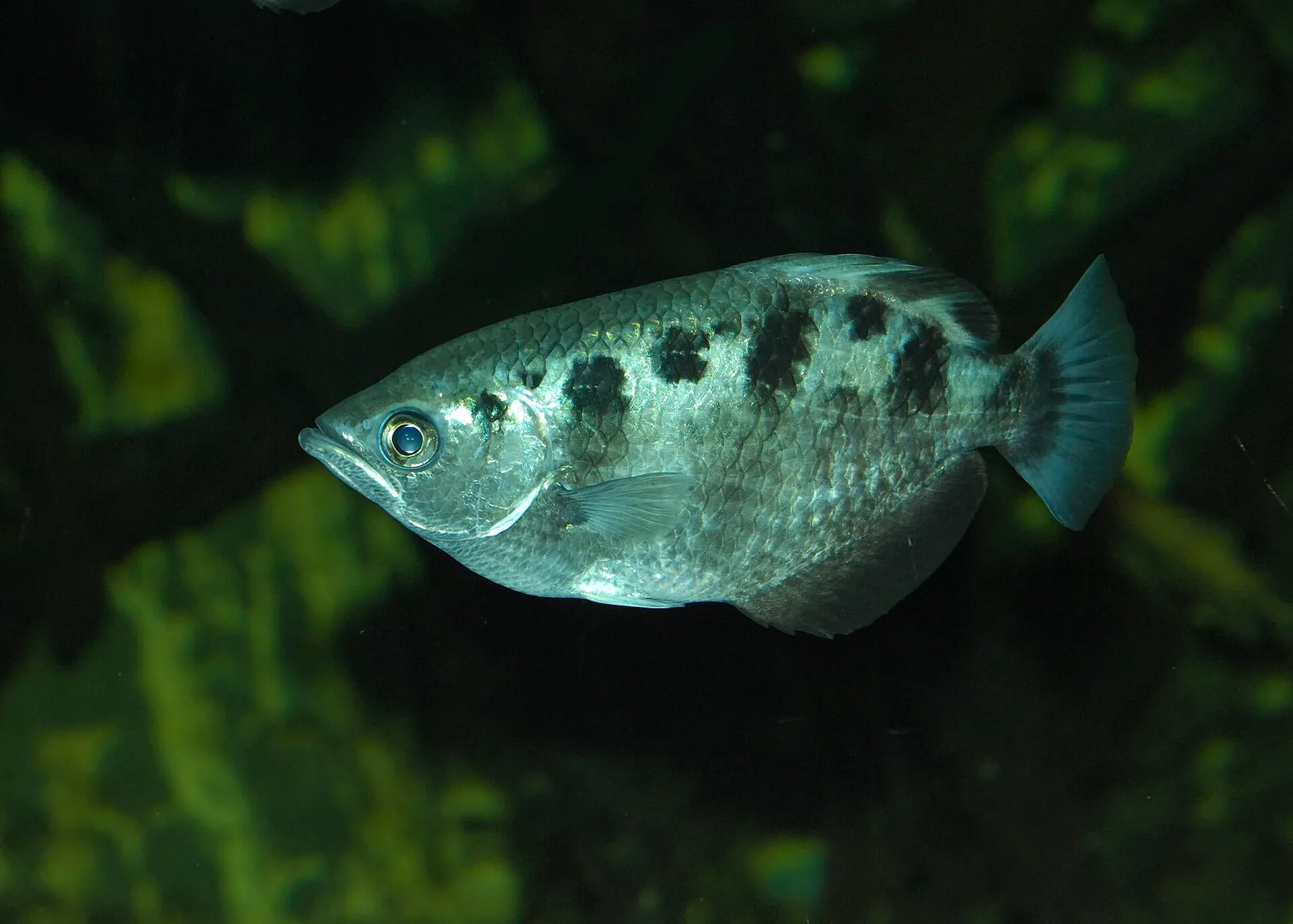
The banded archerfish (Toxotes jaculatrix) patrols brackish mangrove estuaries from India east to the Philippines and south to Indonesia and northern Australia, pushing up into rivers and small streams. It feeds at the surface by day, usually in small groups sneaking along under overhanging vegetation. Adults are commonly around 20 cm, and the species reaches 30 cm. Egg-bearing females sampled in Johor coastal waters, Malaysia, weighed 25.7 to 275 grams. It lives fast: archerfish are short-lived in the wild, about two years. Its diet is whatever it can knock down or scoop up. In one Malaysian study, crustaceans and insects were the most abundant prey in both archerfish species sampled, led by red-clawed crabs and ants.
A Tongue-Built Water Cannon
The archerfish’s weapon starts in its mouth. It presses its tongue against the groove on the roof of its mouth to form a tube, then snaps its gill covers shut to force water powerfully out. A fish can fire up to seven shots in quick succession, and while the jet itself can travel 2 to 3 meters, it is only accurate out to about 1 to 1.5 meters.
What makes the shot land so hard is not raw muscle. High-speed filming of T. jaculatrix shows the fish speeding up the jet partway through the shot, so the trailing water catches the leading water and gathers into a single heavy slug right before it hits.
The trick is outside the fish Measured against the muscle that fires it, the jet’s power at impact reaches about 3,000 watts per kilogram, where a vertebrate muscle tops out around 500 watts per kilogram; the extra punch comes from the water, not the fish.
The force at that impact averages about 200 millinewtons, at least five times the anchoring force of most prey insects.
Eyes Built for the Shot
Aiming through the water surface is hard: light bends as it crosses from air to water, and the target isn’t where it looks like it is. The banded archerfish is renowned for compensating for that refraction as it aims, but its eyes do not do it automatically: archerfish have to learn the correction. The retina supplies the detail: T. jaculatrix can detect visual structures as fine as 0.075 to 0.15 degrees of angle, with photoreceptors packed 5.8 micrometers apart in the area centralis, the patch of retina a target’s image lands on. Archerfish can knock down small prey as high as two meters above the water.
Predicting the Splash
An archerfish does not wait to see where its victim falls. About 100 milliseconds after a shot dislodges an insect, it turns to face the point where the falling prey will hit the water and swims straight there, without needing to track the insect’s actual fall. Archerfish also learn by watching each other: a fish that observes a groupmate successfully hit a fast-moving target can pick up the timing itself, without practicing the shot first.
Published Updated
Traits
Intel
& FAQ
Guess
first
How big is a Banded Archerfish, really? Slide, lock in, and see what the sources say. Every answer is a figure from this page, quoted from where it came from.
Sources
- 01Hoese (2012). Toxotes jaculatrix. The IUCN Red List of Threatened Species 2012: e.T196451A2458352.
- 02Toxotes jaculatrix (Pallas, 1767), Banded archerfish. FishBase.
- 03Banded Archerfish, Toxotes jaculatrix (Pallas, 1767). Australian Museum.
- 04Banded archerfish. Dallas World Aquarium.
- 05Simon et al. (2009). Population growth, trophic level, and reproductive biology of two congeneric archer fishes (Toxotes chatareus, Hamilton 1822 and Toxotes jaculatrix, Pallas 1767) inhabiting Malaysian coastal waters. Journal of Zhejiang University SCIENCE B.
- 06Vailati, Zinnato & Cerbino (2012). How Archer Fish Achieve a Powerful Impact: Hydrodynamic Instability of a Pulsed Jet in Toxotes jaculatrix. PLoS ONE.
- 07Ben-Simon et al. (2012). Visual acuity in the archerfish: Behavior, anatomy, and neurophysiology. Journal of Vision.
- 08Rossel, Corlija & Schuster (2002). Predicting three-dimensional target motion: how archer fish determine where to catch their dislodged prey. Journal of Experimental Biology.
- 09Schuster et al. (2006). Animal Cognition: How Archer Fish Learn to Down Rapidly Moving Targets. Current Biology.
What the sources say: 26 claims checked word for word against these sources →