Silkeormer
Field
notes
Built to grow, built to spin
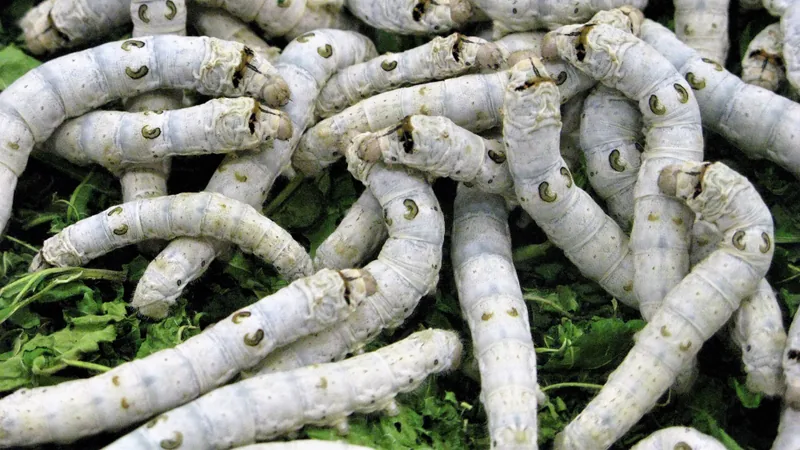
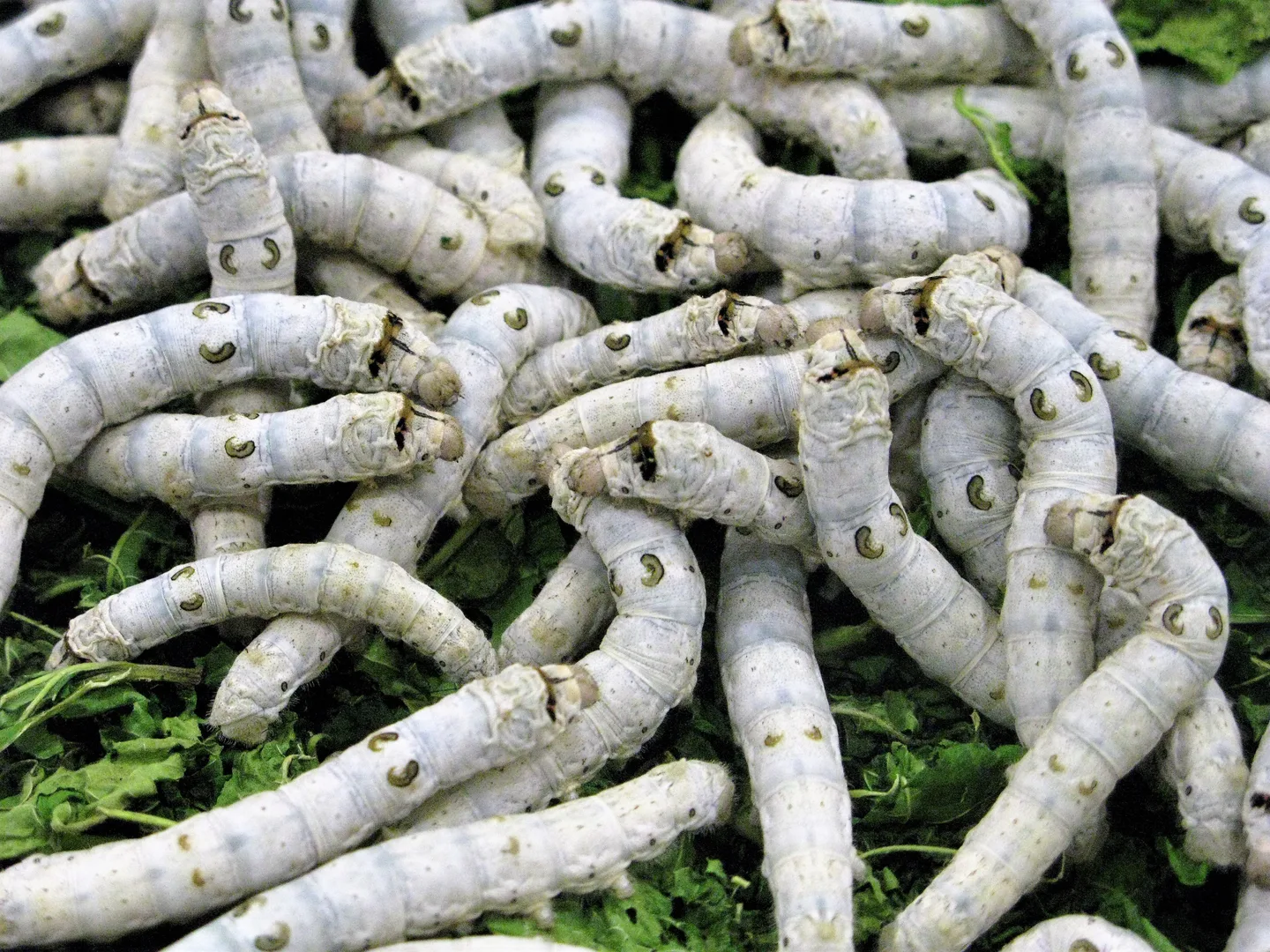
A silkworm is the caterpillar of the silk moth Bombyx mori. It starts tiny. A newly hatched larva (the caterpillar stage) is dark, about 3 millimetres long and weighs about half a milligram. On the figures of the silk museum display in Rovereto, Italy, it reaches 9 cm and 4 grams in about a month, growing 30 times longer. Strains differ: in a 2022 rearing study in northern Iraq, final-stage larvae averaged 5.25 grams. The growth comes in stages separated by moults, also known as sleeps.
The larva feeds on mulberry leaves. In the farmhouse kitchens around Rovereto where silkworms were once raised, the noise of their jaws just before they climbed to spin grew into a continuous, deep rumble that made the whole house vibrate.
One thread, 1,800 metres long
Silk comes from two glands beneath the larva’s mouth. After four moults, the larva’s torpor gives way to a period of agitation known as “fury”, and it tries to climb to find a support on which to attach its cocoon. The cocoon is made from a single, highly resistant thread that can be as long as 1,800 metres. In three or four days the larva has completely wrapped itself in silk and turns into a chrysalis. Cocoons in the Iraq study weighed 1.7 to 2.5 grams each.
Silk upgrade Genetically engineered silkworms carrying both silkworm and spider silk proteins spun fibres tougher than normal silkworm silk and as tough as the dragline silk spiders make, according to a 2012 report from the University of Notre Dame.
A species with no wild left
Bombyx mori originated in east central Asia and no longer exists in a wild state. It was domesticated from its wild ancestor, Bombyx mandarina, about 5,000 years ago. The Iraq study set out to revive rearing there after three decades without it, using silkworms imported from a sericulture centre in Bursa, Turkey.
Compared with its wild ancestor, the domestic silk moth has lost the ability to fly.
Its whole life cycle is complete in approximately 45 days. The adult moth does not feed, and its only duty is to ensure the conservation of the species.
Published
Traits
Intel
& FAQ
Guess
first
How big is a Silkworm, really? Slide, lock in, and see what the sources say. Every answer is a figure from this page, quoted from where it came from.
Sources
- 01The silkworm (Display board 5, C'era una volta un filo di seta). Fondazione Museo Civico di Rovereto.
- 02Mohammed & Ayoub (2022). Biology and Behavior of Mulberry Silkworm (Bombyx mori) in Northern Iraq. ISPEC Journal of Agricultural Sciences, FAO AGRIS record.
- 03Bombyx mori. Animal Diversity Web, University of Michigan.
- 04Tong et al. (2022). High-resolution silkworm pan-genome provides genetic insights into artificial selection and ecological adaptation. Nature Communications.
- 05Hybrid silkworms spin stronger spider silk. University of Notre Dame College of Science.
What the sources say: 31 claims checked word for word against these sources →