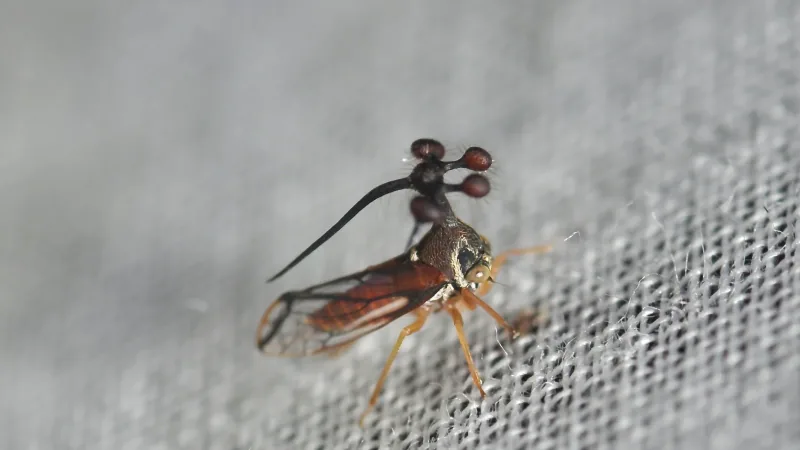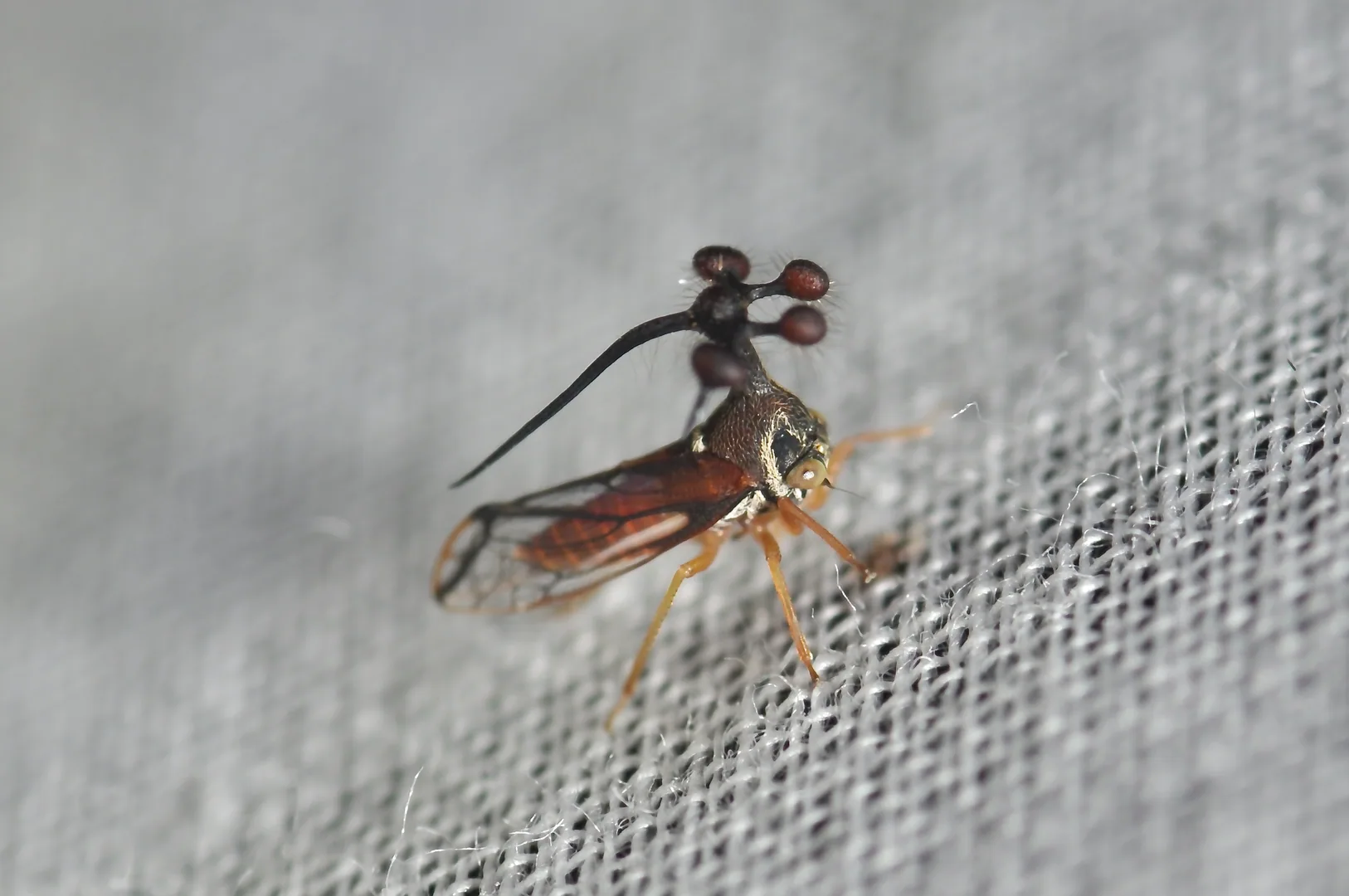
Brazilian treehopper (Bocydium globulare) displaying its ornamental pronotal headpiece.
Field
notes
Under a rainforest leaf, usually only a few feet off the ground, sits an insect wearing a crown that looks borrowed from another animal: dark, glossy globes held out on slender horns. The Brazilian Treehopper (Bocydium globulare) feeds on the undersides of leaves, and the headgear has been argued over since 1903 with nobody settling what it does.
A Question Nobody Has Closed. The entomologists who reviewed its genus in 1999 put it plainly: “the actual function of the peculiar pronotal structures is unknown, as are the life histories of many of the species.”
A Guess From 1903, Still Untested
The crown is an outgrowth of the pronotum, the hardened plate that caps an insect’s first chest segment. In 1903 the entomologist Poulton suggested the shape might mimic Neotropical seeds or small, spiny fruit, the sort of thing a hungry bird would rather not bite. Nobody has tested whether it fools a predator. A 2025 study lists camouflage, mimicry, warning colour and physical defence among the jobs proposed for a treehopper’s pronotum, and says “there is currently little experimental evidence addressing these hypotheses.”
Unpacked in Half an Hour
Whatever the crown is for, it is built in a hurry. Researchers in Costa Rica collected late-stage nymphs, carried them back to a hotel room and filmed the final molt. A Bocydium went from a densely folded package under its old skin to a finished crown in roughly 30 minutes. In a related treehopper the same transformation took about 35 minutes, and the team concluded it “likely occurs by pumping hemolymph (body fluid)” into ridges inside the structure, the way an insect pumps up a fresh pair of wings. Growing new cells would be far too slow to shape anything that fast.
Life a Few Feet Off the Ground
The 1999 revision of its genus gives no measurement for B. globulare by itself. It diagnoses the genus as a whole, 15 species of Bocydium, at a total length of 4.6 to 7.5 millimeters, roughly the size of a match head. Field notes from 1925 record that this species “usually occurs only a few feet above the ground, feeding on the undersides of leaves,” rather than high in the canopy, and it has been collected from Miconia shrubs. Microbes that live inside the insect, called endosymbionts, have been recorded in it too.
An Electric Sense, Tested on a Cousin
A 2025 study found that another treehopper, Poppea capricornis, “can detect electric fields, responding behaviorally,” and that the wasps that hunt treehoppers and the stingless bees that guard them in exchange for honeydew carry measurably different charges, so a treehopper may be able to “distinguish friend from foe via electroreception alone.” Bocydium globulare was not among the living insects tested. It appears in that paper as a dried museum specimen under an electron microscope, carrying pit-shaped sensory hairs on its wing like the ones the researchers argue may work as electroreceptors. Their computer model of an extreme pronotum, not of this animal, puts the electric field in the first 0.1 mm around it at “over 100 kV/m, compared to approximately 3 kV/m around the nonextreme pronotum.”
Published Updated
Traits
Intel
& FAQ
Sources
- 01Cryan & Deitz (1999). Review of the New World treehopper tribe Stegaspidini (Hemiptera: Membracidae: Stegaspidinae): I. Bocydium Latreille, Lirania Stal, and Smerdalea Fowler. Proceedings of the Entomological Society of Washington 101(3): 469-489.
- 02England et al. (2025). Electroreception in treehoppers: How extreme morphologies can increase electrical sensitivity. Proceedings of the National Academy of Sciences.
- 03Adachi et al. (2020). Structure and development of the complex helmet of treehoppers (Insecta: Hemiptera: Membracidae). Zoological Letters.