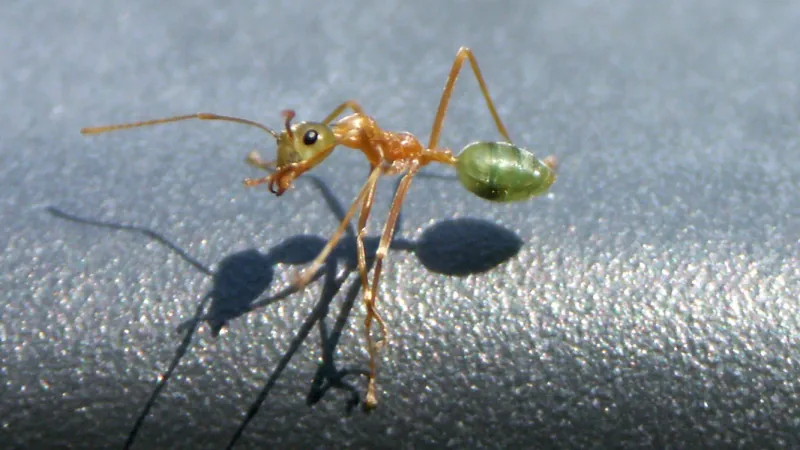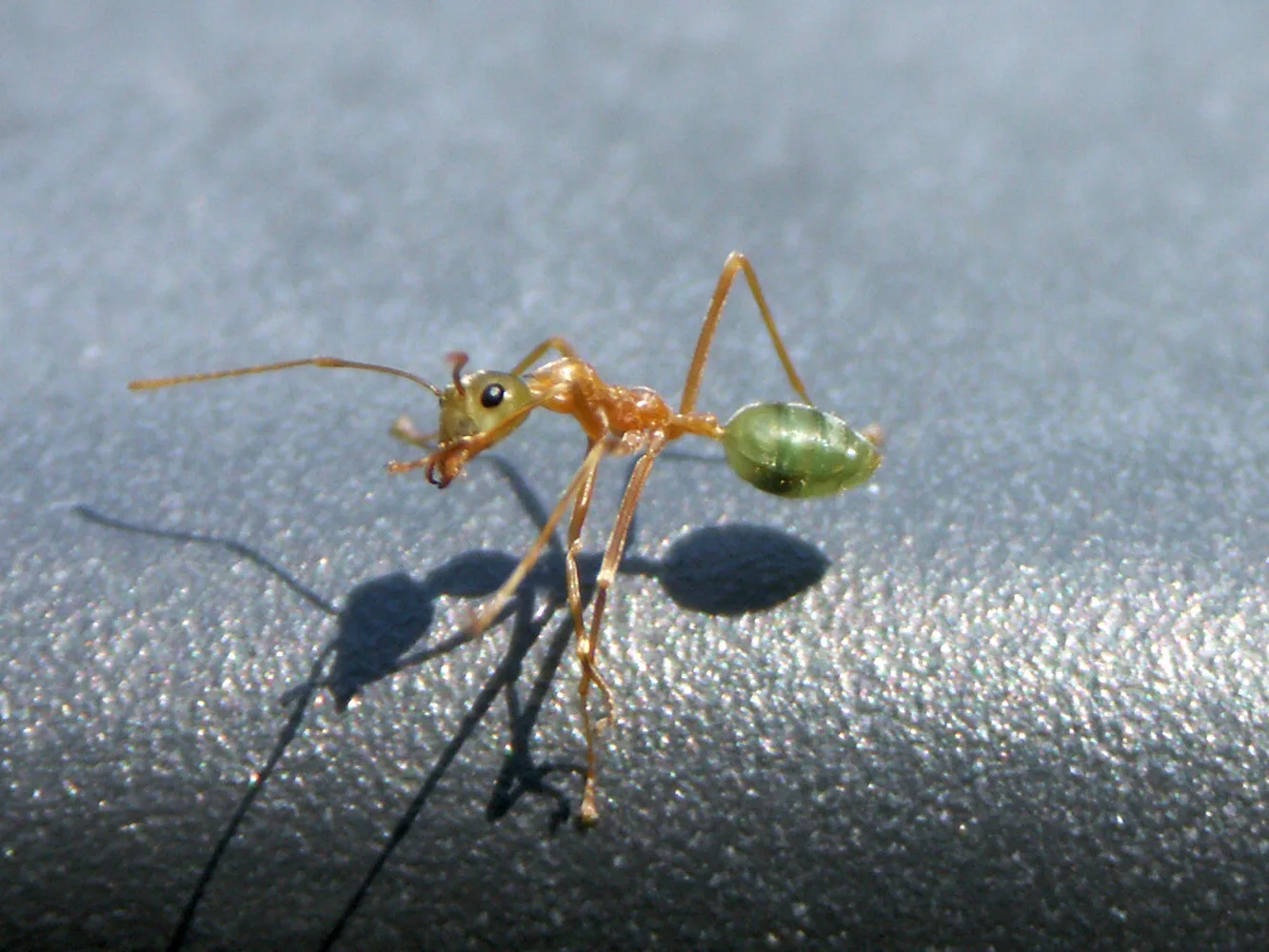
A green tree ant (Oecophylla smaragdina) near Cape Tribulation, Queensland, Australia.
Field
notes
The Asian Weaver Ant (Oecophylla smaragdina) builds its nest from leaves still on the tree, glued together with silk from its own larvae.
Building With Living Rope
A few workers bite a leaf edge, pull it closer, and hold on. If the target leaf is far away, a group of workers forms a chain and pulls it toward the nest, shortening the chain one ant at a time until the leaves are close enough to glue. Then another worker arrives carrying a larva in its final growth stage (the last instar) in its jaws. It gently squeezes the larva, which produces silk, and uses that silk to glue the leaves together.
On average, each ant pulls harder in a bigger team. In human and animal teams, each member’s effort can drop as the team grows, an effect known as the Ringelmann effect. Weaver ant pulling teams show the opposite: the average force each ant contributed nearly doubled as team size increased. The researchers propose a “force ratchet,” where some ants actively pull and the force they generate is stored in chains of “passive resisters.”
Those resisters rely on the remarkable grip of their feet. Between the claws sits a flexible pad called an arolium, which unfolds and folds back with every step when the ants run upside down on a smooth surface. In severed weaver ant legs, raising the pressure of the ant’s blood (hemolymph) by just 15 kilopascals was enough to inflate the pad to full size.
Different Sizes, One Colony
Workers come in two distinct sizes. In colonies collected in Australia, major workers were about 8 millimetres long and weighed about 3 milligrams dried; minor workers were about 4.5 millimetres and weighed a third as much. Majors aggressively defend the colony’s treetop territory, while minors nurse the brood. Their brains differ too: one study counted 220 of the small structures called glomeruli in a major worker’s smell centre, against 140 in a minor’s.
Defending the colony is dangerous work, and researchers consider it very likely that majors die from outside causes far more often than minors. In a lab study of three colonies, every worker had died within 43 weeks, but minors had a significantly higher chance of survival than majors, though the study could not say by how much. Majors’ brains also hold more octopamine, a brain chemical that helps control aggression; switching its action in the lab reversed each size’s usual aggression level.
Old Genus, Wide Range
The species ranges across tropical Asia into northern Australia. In an Australian rainforest canopy, workers mostly tended scale insects and treehoppers, then aphids and mealybugs, for their honeydew. In Meghalaya, India, they were seen eating insects, grubs, earthworms and sometimes dead rodents or birds. At tuna baits in northern Australian forest and savanna, they and Iridomyrmex ants were the dominant species, monopolizing more than 80 percent of the baits where they turned up.
A study of 15 nests in Meghalaya counted an average of 4,316 queens, workers, larvae and pupae per nest. Workers also clean the nest with venom-gland secretions (formic acid) to ward off bacterial and fungal infections.
The genus is old: two fossil Oecophylla species from Germany, about 47 and 43 million years old, are among its oldest records, and workers of the younger one already show the first adaptations for moving through a forest canopy.
Published Updated
Traits
Intel
& FAQ
Guess
first
How big is a Asian Weaver Ant, really? Slide, lock in, and see what the sources say. Every answer is a figure from this page, quoted from where it came from.
Sources
- 01Chapuisat & Keller (2002). Division of labour influences the rate of ageing in weaver ant workers. Proceedings of the Royal Society of London. Series B: Biological Sciences.
- 02Sangma & Prasad (2021). Population and Nesting Behaviour of Weaver Ants, Oecophylla smaragdina from Meghalaya, India. Sociobiology.
- 03Stewardson et al. (2025). Superefficient teamwork in weaver ants. Current Biology.
- 04Federle et al. (2001). Biomechanics of the movable pretarsal adhesive organ in ants and bees. Proceedings of the National Academy of Sciences.
- 05Kamhi et al. (2015). Polymorphism and division of labour in a socially complex ant: neuromodulation of aggression in the Australian weaver ant, Oecophylla smaragdina. Proceedings of the Royal Society B: Biological Sciences.
- 06Babu & Patil (2021). Antennal lobe organisation in ant, Oecophylla smaragdina: A Golgi study. Journal of Biosciences.
- 07Dlussky, Wappler & Wedmann (2008). New Middle Eocene Formicid Species from Germany and the Evolution of Weaver Ants. Acta Palaeontologica Polonica.
- 08Blüthgen & Fiedler (2002). Interactions between weaver ants Oecophylla smaragdina, homopterans, trees and lianas in an Australian rain forest canopy. Journal of Animal Ecology.
- 09Blüthgen, Gebauer & Fiedler (2003). Disentangling a rainforest food web using stable isotopes: dietary diversity in a species-rich ant community. Oecologia.
- 10Andersen (1992). Regulation of "Momentary" Diversity by Dominant Species in Exceptionally Rich Ant Communities of the Australian Seasonal Tropics. The American Naturalist.
What the sources say: 49 claims checked word for word against these sources →