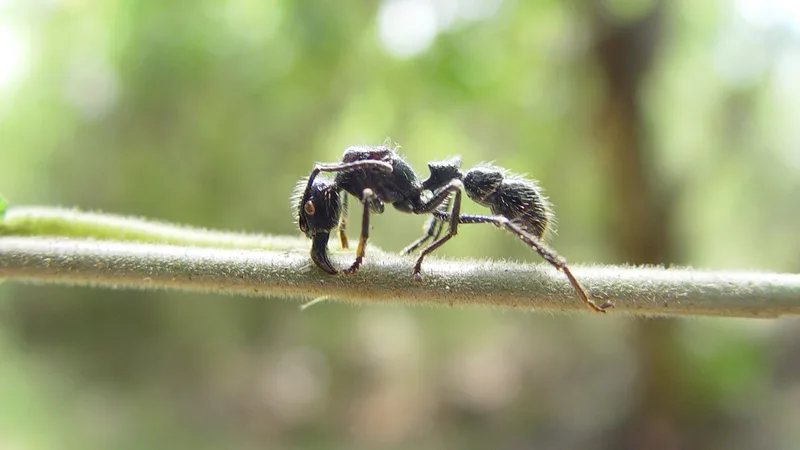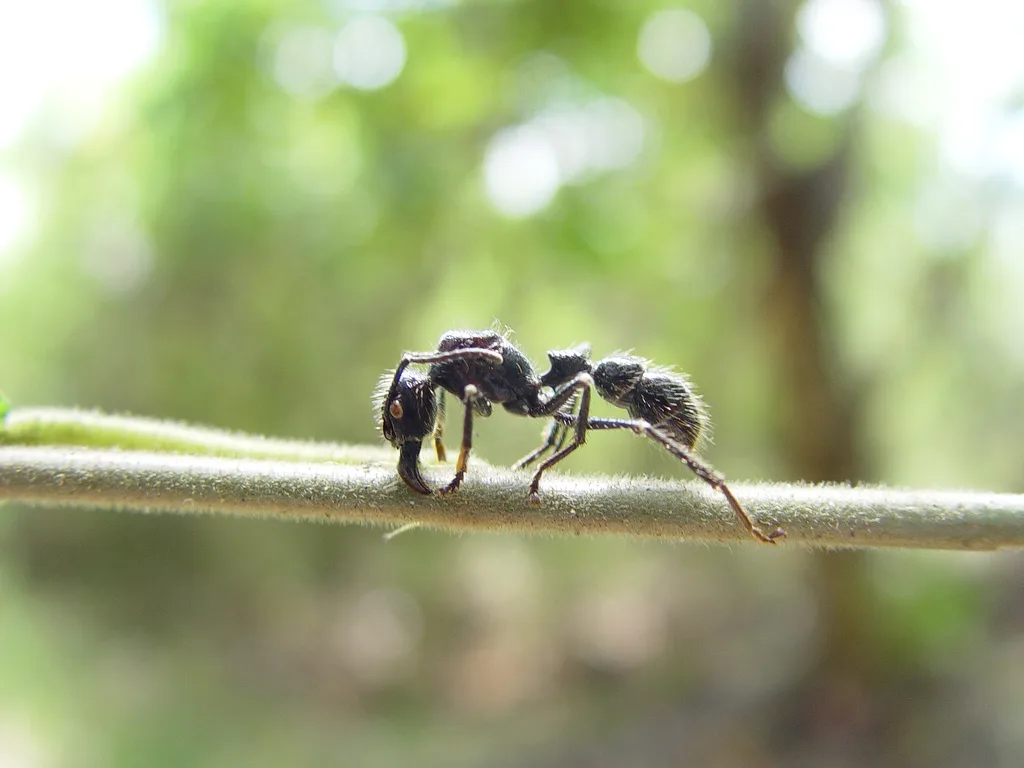
A bullet ant walking a hairy plant stem.
Field
notes
The Sting That Named It
At more than two centimeters long, the bullet ant (Paraponera clavata) is the ant entomologists call the giant tropical ant. What actually earns it a page here is what happens after it stings.
Entomologist Justin Schmidt rated and described the pain of insect venoms from his own experience of being stung, on a scale that runs from one to four. The bullet ant sits at pain level four, the most painful, beside the warrior wasp and the tarantula hawk wasp:
Pure, intense, brilliant pain. Like walking over flaming charcoal with a three-inch nail embedded in your heel.
The most abundant component of that venom is poneratoxin, a molecule built from just 25 amino acids, the building blocks proteins are made of. In cockroaches it induces a current through a voltage-activated sodium channel, one of the tiny gates nerve cells use to fire electrical signals, and that current is slow to switch off: nerve impulses are prolonged and the nerve fires slowly and repeatedly. Several other components of the venom remain uncharacterised. The team that mapped it calls the bullet ant infamous for inflicting the most painful sting among the ants, bees and wasps.
In Brazil the bullet ant is the true tocandira, one of a group of stinging ants known there as the twenty-four-hour ants. Pain is the main symptom of a tocandira sting, extremely violent and capable of staying for periods of up to 24 hours. These are not aggressive ants, but they are vicious defending the nest, making a stridulating sound and stinging with ferocity.
The Glove Test
The Sateré-Mawé of the Brazilian Amazon use the tocandiras, especially this species, in rituals of passage to adult age. Children from about the age of 12 put a hand inside a glove of liana holding up to 300 ants for close to 30 minutes. A young person who withstands the pain can go on to hold leadership positions in the tribe, and tradition has them pass through the ritual 25 times over a lifetime to be respected by the oldest.
Life Between the Canopy and the Soil
Bullet ants live in lowland rainforest from Nicaragua south to Bolivia and Brazil, most commonly from sea level up to 750 meters. Colonies typically nest in soil at the base of rainforest trees, though nests have also been reported in soil collected in tree crotches and, in at least one case, out on treeless dry tropical savanna.
Some workers forage for nectar and others carry back insect prey, and they are choosy about it: offered caterpillars, they reject hairy ones more often than caterpillars of other shapes, and late-stage larvae more often than early ones. Offered nectar far from home, foragers recruit help from the canopy rather than from the nest, and often hand the nectar to other workers to carry back, which cuts the time the colony needs to collect it.
Published Updated
Traits
Intel
& FAQ
Sources
- 01What on Earth? The Schmidt sting pain index. Natural History Museum, London.
- 02Aili et al. (2020). An Integrated Proteomic and Transcriptomic Analysis Reveals the Venom Complexity of the Bullet Ant Paraponera clavata. Toxins.
- 03Murphy & Breed (2007). A Predictive Distribution Map for the Giant Tropical Ant, Paraponera clavata. Journal of Insect Science.
- 04Haddad Junior, Cardoso & Moraes (2005). Description of an injury in a human caused by a false tocandira (Dinoponera gigantea, Perty, 1833) with a revision on folkloric, pharmacological and clinical aspects of the giant ants of the genera Paraponera and Dinoponera (sub-family Ponerinae). Revista do Instituto de Medicina Tropical de São Paulo.
- 05Fewell et al. (1996). Foraging energetics of the ant, Paraponera clavata. Oecologia.
- 06Dyer & Floyd (1993). Determinants of predation on phytophagous insects: the importance of diet breadth. Oecologia.
- 07Fewell et al. (1992). Distance effects on resource profitability and recruitment in the giant tropical ant, Paraponera clavata. Oecologia.
What the sources say: 43 claims checked word for word against these sources →