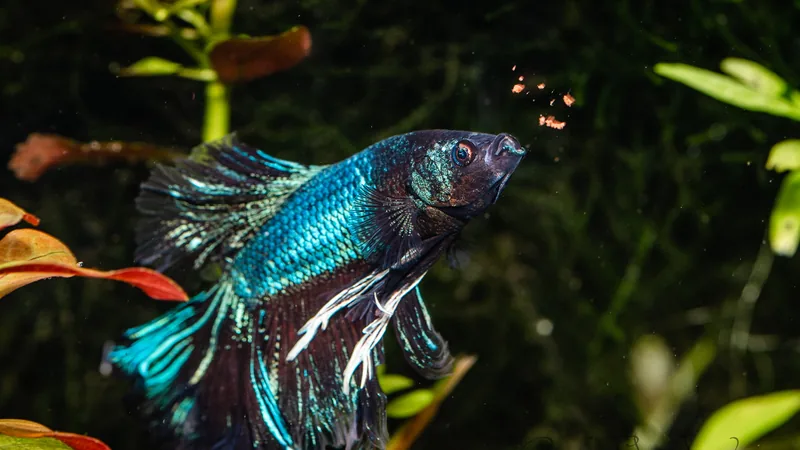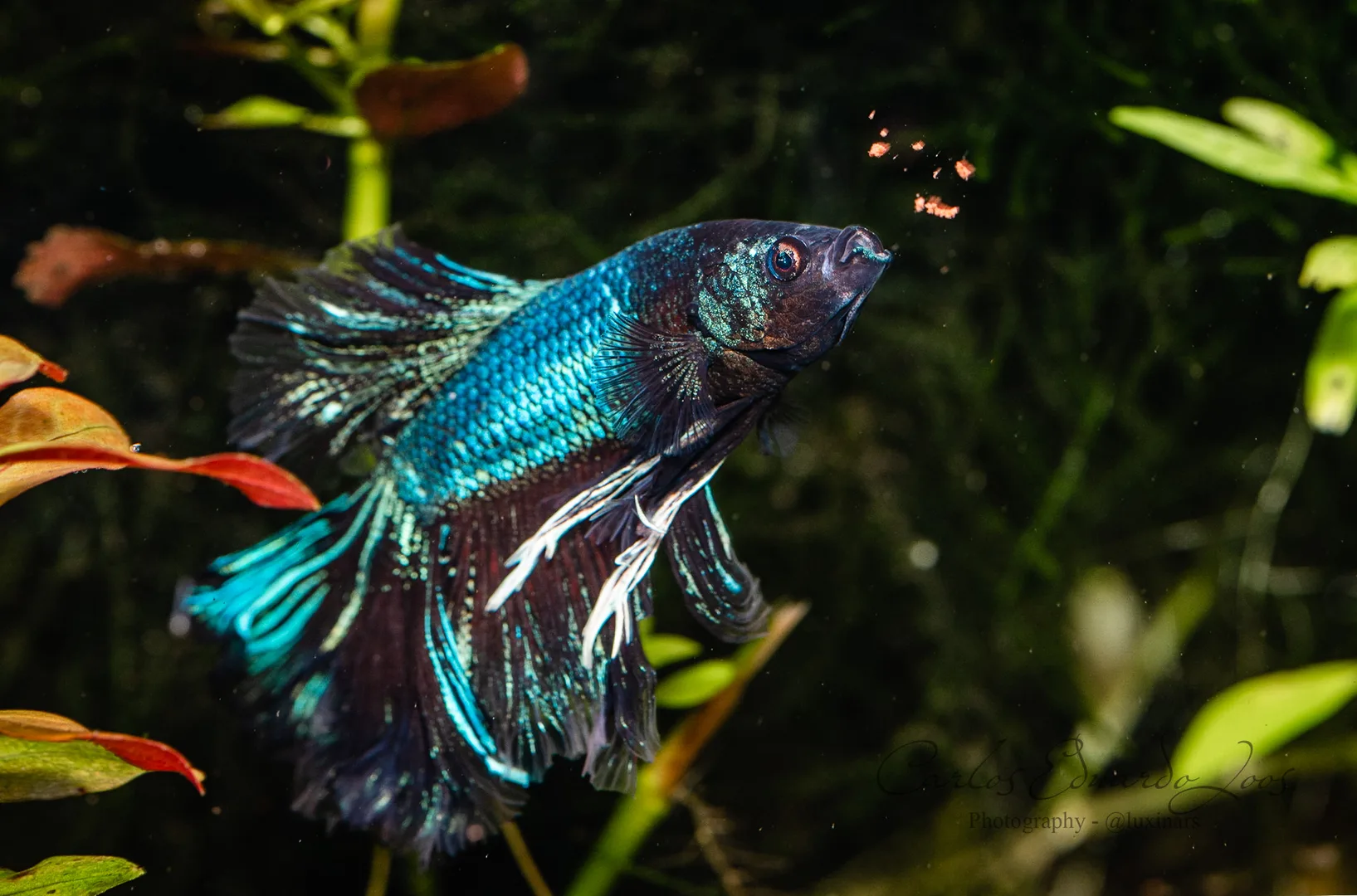
A bred male in a planted tank.
Field
notes
Air-breathing in a puddle
The Siamese fighting fish (Betta splendens) can breathe air. It belongs to the labyrinth fishes, named for the labyrinth organ: folded, bony structures in paired chambers above the gills that let the fish take in air. Life in hypoxic (low-oxygen) water appears to have driven the diversification of this group.
The wild betta is typically found in standing water, from shallow ponds and rice paddy fields to puddles. In one wild population in Thailand the water averaged 29.9°C and about 5.0 cm deep, and its dissolved oxygen averaged about 3.8 mg/L, swinging between 0.0 and about 7.4 mg/L.
Small, short-lived and hungry
FishBase gives a maximum length of 6.5 cm, and the USGS lists the size as 6 cm. The maximum reported age is 2 years. The species is native to Southeast Asia, including the northern Malay Peninsula, central and eastern Thailand, Cambodia and southern Vietnam.
Bettas are carnivores that eat mosquito larvae and other water insects. One estimate says an adult male eats about ten to fifteen thousand larvae per year. The IUCN Red List rates the species Vulnerable, in an assessment published in 2011.
Fins up, gills out
When a male meets another male, he spreads his fins and flares out his gill covers almost immediately. As the fight goes on, the fish bite each other, particularly on the fins and flanks. Male bettas are among the most aggressive of the labyrinth fishes.
Fights between two males were popular in Thailand for gambling, and the first fish to retreat was deemed the loser. The modern aquarium betta is a product of almost 100 years of selective breeding, first for aggression and now for bright colors and elaborate fins. The wild betta, by comparison, is dull brown or green.
Dad builds the nursery
The bubble nest A bubble nest allows eggs to develop in water with elevated temperature, low pH and low dissolved oxygen, relatively free of predators. Placing the eggs at the surface increases oxygen exchange, and the nest also keeps them from drying.
In breeding tanks, the male wraps his body around the female and fertilizes the eggs as she releases them. Then he picks the eggs up in his mouth as they fall and places them in the bubble nest. About 300 eggs are released per spawning event. The male adds bubbles to the nest when needed and keeps newly hatched larvae in it.
Published Updated
Traits
Intel
& FAQ
Guess
first
How big is a Siamese Fighting Fish, really? Slide, lock in, and see what the sources say. Every answer is a figure from this page, quoted from where it came from.
Sources
- 01Evolution, Culture, and Care for Betta splendens. UF/IFAS Extension, University of Florida.
- 02Betta splendens, Siamese fighting fish. FishBase.
- 03AnAge entry for Betta splendens. AnAge: The Animal Ageing and Longevity Database.
- 04Betta splendens Regan, 1910. USGS Nonindigenous Aquatic Species database.
- 05Siamese Fighting Fish (Betta splendens) Ecological Risk Screening Summary. U.S. Fish and Wildlife Service.
- 06Vidthayanon (2011). Betta splendens. The IUCN Red List of Threatened Species 2011: e.T180889A7653828.
- 07Thongprajukaew et al. (2025). Recovery of Male Siamese Fighting Fish (Betta splendens) After Overland Shipping. Animals.
What the sources say: 45 claims checked word for word against these sources →