AnimalTracks.wiki

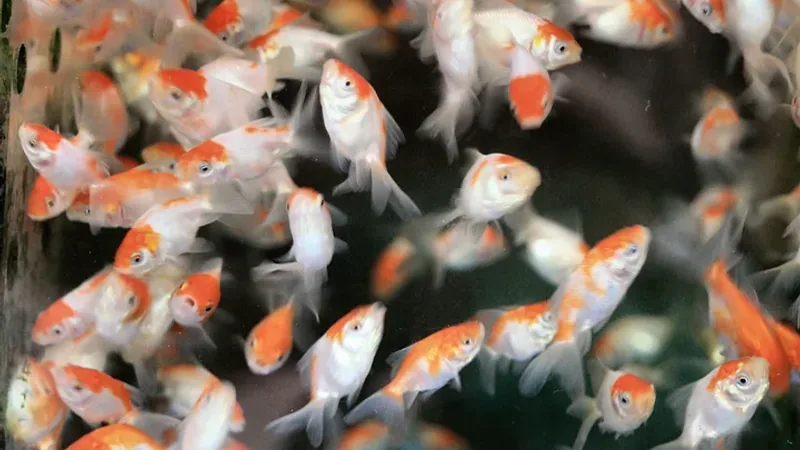
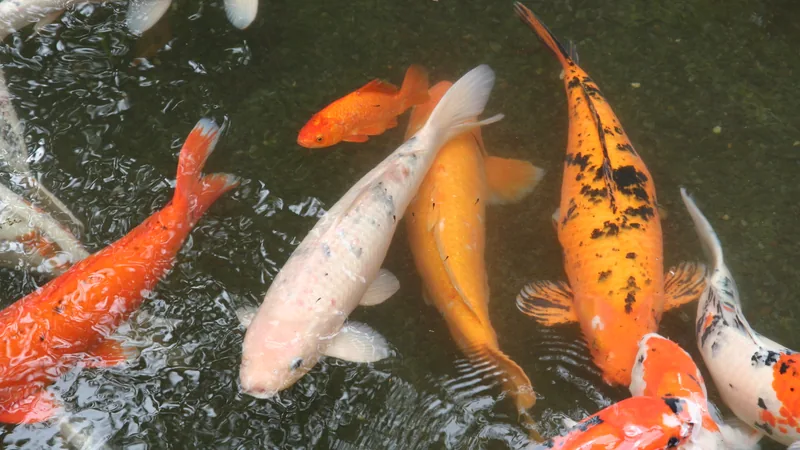
Common Goldfish

Carassius auratus

The pond fish that makes alcohol to survive without oxygen and sees four colors, ultraviolet included.

Danger tierLowEffectively harmless to people.
IUCN status [LC]Least ConcernPopulation stable and widespread in natural habitats.Source: IUCN Red List
Vibe checkHome80s Retrowave & SynthwaveListen ↓

Field
notes

Checked against 5 sources ↓

Brewing Alcohol Without Oxygen

Without oxygen, most vertebrates die within minutes. Goldfish (Carassius auratus) are an exception. Fish of the genus Carassius, the crucian carp and the goldfish, survive prolonged periods without oxygen by producing ethanol as their metabolic end-product. Ethanol is the alcohol in drinks.

Yeast chemistry in a fish The trick rests on a pyruvate decarboxylase, an enzyme (a protein that speeds up a chemical reaction) analogous to the one in brewer’s yeast and the first described in vertebrates. It works alongside a specialized alcohol dehydrogenase.

Four Colors and a Motion Sensor

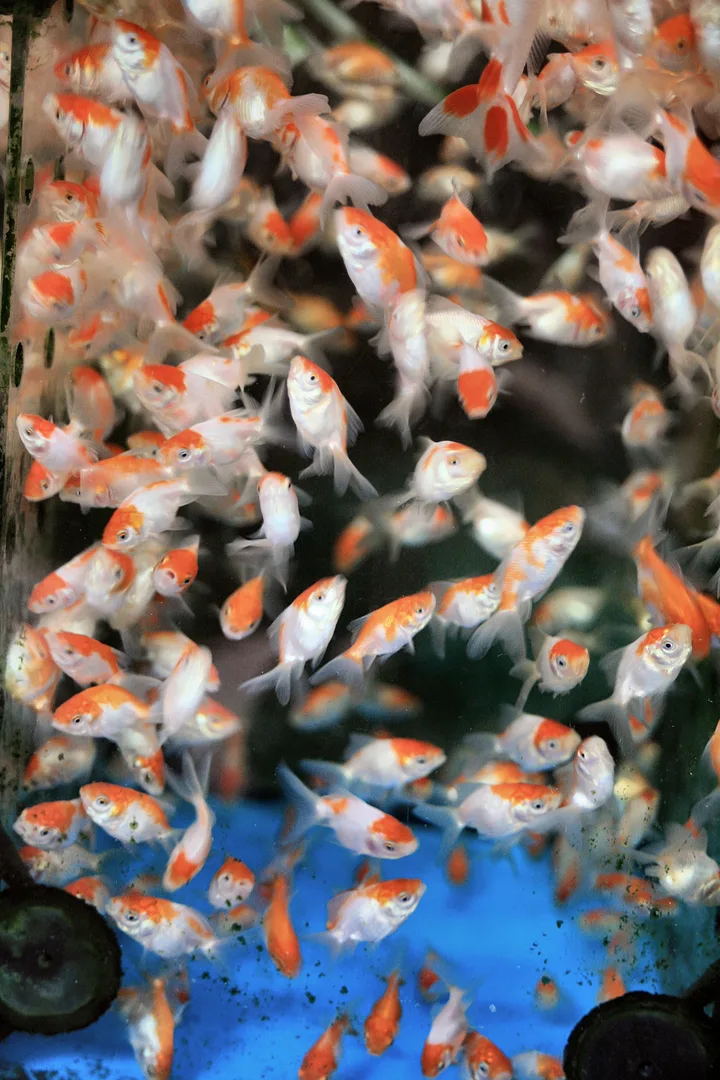
Goldfish are tetrachromats, meaning they can see four colors: red, green, blue and ultraviolet. Along each side runs the lateral line, a row of sensory organs that helps them detect motion in the water around them. Herons, northern river otters and American bullfrogs can prey on goldfish. To defend against predators, goldfish form large groups called schools, and they warn each other with chemical signals that predators are nearby.

A Bottom-Feeding Pond Bulldozer

Goldfish originated in eastern Asia, including China, Hong Kong, Korea and Taiwan, and the range of the species expanded to most of the world. They tend to live in bodies of water with slow or no movement: ponds, lakes, rivers and marshes.

Size depends on where the fish lives. Goldfish generally reach 15 to 20 centimeters and weigh 100 to 300 grams, though the USGS lists a maximum of 59 centimeters and 3.0 kilograms. In captivity, goldfish grow to about 2.5 to 15 centimeters, and wild goldfish often grow bigger than domesticated ones because their environment offers more resources and space to swim. Lifespan is typically 6 to 7 years, and it has been reported as long as 30 years.

They are generalist omnivores that eat insects, eggs, plants and crustaceans. Goldfish feed at the water bottom, where they stir up sediment and increase turbidity, which is how cloudy the water is.

They are tough: adult goldfish can survive water temperatures between 0 and 41 °C. Young goldfish hatch with dark, pigmented scales, which fade 2 to 3 months later. Females normally spawn 2000 to 4000 eggs at a time, and adult goldfish consume their own offspring.

Published Updated

Traits

Intel
& FAQ

01How long can a goldfish survive with no oxygen?

It depends on the temperature. In one lab study, goldfish survived without oxygen for only a few hours at 20 °C, but for several days at 4 °C. Winter goldfish outlasted spring goldfish in the cold, and the study linked that to greater stores of glycogen, a stored fuel, in their livers.

Source: Walker & Johansen 1977

02What happens when a pet goldfish ends up in the wild?

It can breed and spread. The USGS lists goldfish as established or reported in all US states except Alaska, and says they can outcompete native fishes. Bright colors seldom carry on: the surviving offspring of colorful escapees are typically the natural olive-green.

Source: USGS Nonindigenous Aquatic Species database

03What do wild goldfish actually eat?

A study of one Quebec pond found that 45% of the gut contents were plants, 21% were insects such as midges and mosquitoes, and 4% were small crustaceans. Goldfish also eat earthworms and detritus, and pond experiments with caged goldfish suggest they eat amphibian eggs too.

Source: Animal Diversity Web, University of Michigan

Guess
first

How big is a Common Goldfish, really? Slide, lock in, and see what the sources say. Every answer is a figure from this page, quoted from where it came from.

  1. ?
  2. ?
  3. ?

Sources

More Ray-Finned Fishes

Actinopterygii & Sarcopterygii

Hydrodynamic aquatic rulers with lateral line pressure sensors, swim bladders, and electrical weaponry.

A captive African lungfish resting on aquarium gravel, its long thread-like fins trailing from a mottled olive body

African Lungfish

Protopterus annectens

A fish that breathes air through two lungs and can live for over a year inside a cocoon of its own dried slime.

Obligate air breathing through two lungs, and over a year inside a cocoon of dried slimeView →
▸ ElderHeavy Psych & Desert Rock
Close view of an alligator gar's diamond-scaled back and blunt snout breaking a marsh surface

Alligator Gar

Atractosteus spatula

Described as a 100-million-year-old living fossil, armored in interlocking ganoid scales, with two rows of fang-like teeth in its upper jaw and a swim bladder that can work as a lung.

Interlocking ganoid scale armor with a hard outer layer over a tough bony base, two rows of fang-like teeth in the upper jaw, and a vascularized swim bladder that can work as a lungView →
▸ Creedence Clearwater RevivalClassic Hard Rock & Southern Blues
American paddlefish from below in murky green water, the pale bars of its gill rakers showing inside the open gill slit

American Paddlefish

Polyodon spathula

An ancient river giant that carries 50,000 to 70,000 electroreceptor organs, the largest number of any living vertebrate species.

Paddle and head covered in ampullary organs: 50,000 to 70,000 electroreceptors per adult, the largest number of any living vertebrate speciesView →
▸ Blackberry SmokeDelta Blues & Swamp Rock
Live blackfin icefish, a close relative, seen from above in a pale holding tank at Palmer Station

Antarctic Icefish

Champsocephalus gunnari

A Southern Ocean fish with no working red blood cells, whose nearly clear blood carries oxygen dissolved in plasma, along with its own antifreeze.

Belongs to the only vertebrate family that lacks working hemoglobin genes and working red blood cells: its blood carries oxygen dissolved in the plasma instead.View →
▸ BiosphereGlacial Ambient & Drone Soundscapes

Clade factLateral line sensory systems detect water displacement and pressure waves from surrounding swimming creatures.

Explore all 53 →

Head-to-head showdowns

Simulated face-offs, biological power gauges, and 3-round combat

Down the Rabbit Hole

Associative matches based on weird shared evolutionary traits