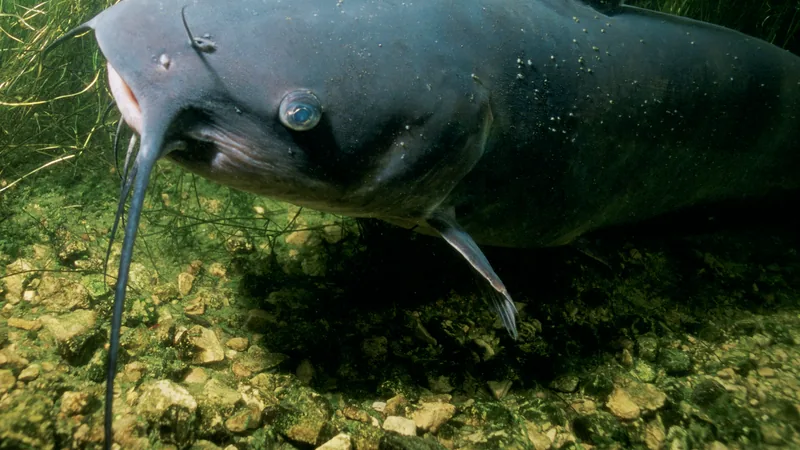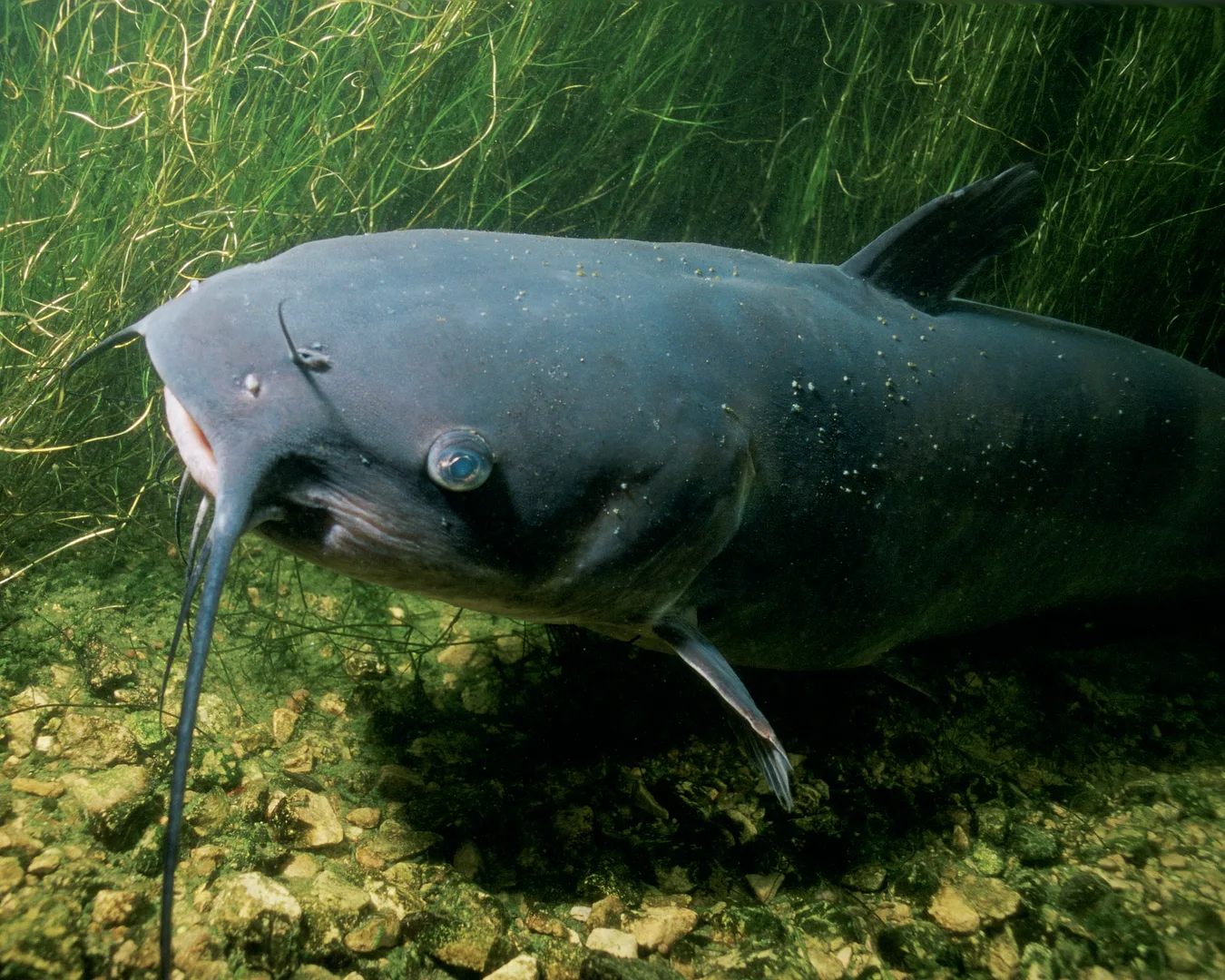
Channel catfish.
Field
notes
A Swimming Tongue
Some people call the channel catfish a swimming tongue, and it earns the name. Its taste buds cover its whole body, and most of them are around the gills and whiskers. Those whiskers are barbels, or sensory feelers: it has eight, with four on the chin, two on the snout and one at each corner of the mouth.
The taste buds help it find food in water where it can barely see, and adults usually forage on the bottom, finding meals by touch and smell. Its eyes are large for a catfish, and it can hunt by sight to a degree. The menu is mainly small fish, crayfish, clams and snails, plus aquatic insects.
Size, Weight and Age
An adult channel catfish is usually 15 to 24 inches (0.4 to 0.6 m) long. An average mature fish weighs two to four pounds (0.9 to 1.8 kg). The world record weight, for a fish caught in South Carolina in 1964, is 58 pounds (26.3 kg). The longest reported reached 52 inches (1.32 m) in total length.
The Florida Museum gives 22 years as the likely maximum age, though it is rare to find one older than 15.
Sound from a spine A channel catfish makes sound by moving the spine of its pectoral fin in the pectoral girdle. A structure called the Weberian apparatus links its swimbladder to its ear, amplifying vibrations that come from the bladder.
Range and Nests
Its native range covers the Great Lakes and St. Lawrence, the Red River part of the Hudson Bay drainage, and the Missouri and Mississippi basins, reaching from southern Quebec to southern Manitoba and Montana, and south to the Gulf. People have also stocked it for sport fishing and food: in the Colorado River the earliest releases date to 1892-1893 or 1906. It prefers warm water averaging 70°F (21.1°C) and turns up in rivers, reservoirs, swamps and even the upper parts of estuaries, in brackish water as salty as 19 to 21 parts per thousand.
It spawns between May and July, when the water warms to about 75°F (23.9°C). To clean the nest site before spawning, the male fans it with his fins and body. Depending on her size, a female may lay anywhere from 2,000 to 70,000 eggs in a year. Once the eggs are out, the male guards the nest and keeps the females away, because they will eat their own eggs.
Published
Traits
Intel
& FAQ
Guess
first
How big is a Channel Catfish, really? Slide, lock in, and see what the sources say. Every answer is a figure from this page, quoted from where it came from.
Sources
- 01Ictalurus punctatus. The IUCN Red List of Threatened Species 2013: e.T202680A18236665.
- 02Channel Catfish. Florida Museum of Natural History, Discover Fishes.
- 03Channel catfish. Smithsonian's National Zoo and Conservation Biology Institute.
- 04Channel Catfish. U.S. Fish & Wildlife Service, Freshwater Fish of America.
- 05Ictalurus punctatus (catfish). Animal Diversity Web, University of Michigan.
- 06Ictalurus punctatus (Rafinesque, 1818). USGS Nonindigenous Aquatic Species database.
- 07Ictalurus punctatus, Channel catfish. FishBase.
What the sources say: 35 claims checked word for word against these sources →