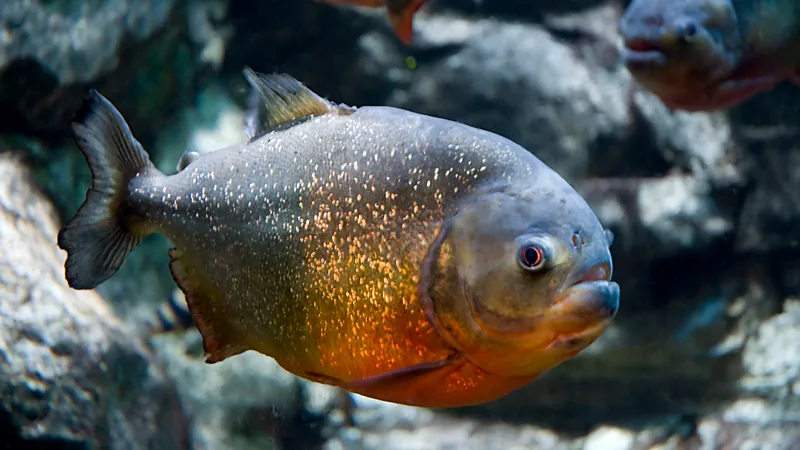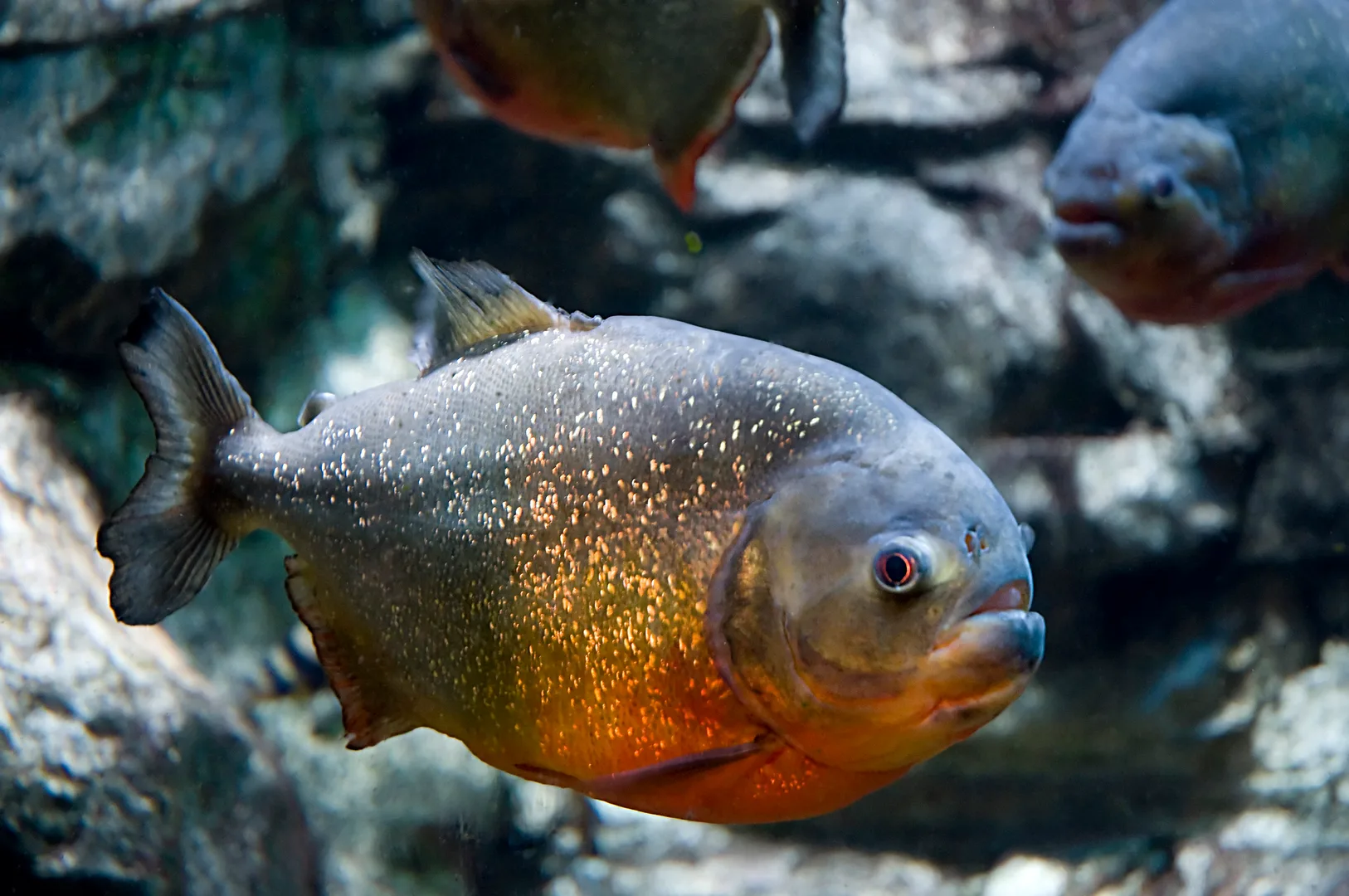
A red-bellied piranha in an aquarium.
Field
notes
A Fearsome Reputation
One research team opens a paper by saying red-bellied piranha shoals “have a fearsome reputation.” The fish can grow to a little over a foot long (30.5 centimeters) and weigh up to 4 pounds (1.81 kilograms).
It is native to South America east of the Andes: the Amazon and Paraná-Paraguay basins, plus rivers of northeast Brazil and the Guianas. The Smithsonian’s National Zoo gives a lifespan of 10 years or more. A study in the Negro River, in Brazil’s Pantanal, estimated a life expectancy of 6.9 years for the piranhas there.
Teeth Like Shears
Under its high forehead sit powerful muscles attached to a short, stout lower jaw. The teeth are triangular and razor sharp, and they interlock with a matching set above. The zoo says this design allows a piranha to bite down with incredible force and shearing ability, which means a slicing cut, like scissors. The teeth are not usually visible: thick, fleshy lips cover them.
Fins, Flesh and Figs
In the wild, a good portion of the diet is fins nipped from the tails of larger fish. The menu can also include bits of flesh, whole small fish, insects, aquatic invertebrates (animals without backbones) and, occasionally, figs and other ripe fruit. Animal Diversity Web says it can be seen lurking or ambushing prey in the daytime, and lists chasing and scavenging as two other ways it gets food. The zoo calls these fish important scavengers.
Smaller piranhas search for food during the day. Larger fish tend to be more active at dawn and dusk.
Safety in Numbers
Red-bellied piranhas tend to travel in schools of 20 or more. The Amazon’s flooded forests hold a variety and abundance of piranha predators. One team suggested predator defence may be an important reason for shoaling.
Experiments with wild-caught piranhas supported the idea that fish in small shoals perceive more risk, measured by how fast their gill covers beat. After a model cormorant (a fish-eating bird) simulated an attack, piranhas in shoals of eight settled back to resting rates faster than those in shoals of two. The researchers concluded that shoaling has a cover-seeking function in this species.
Red-bellied piranhas make sounds In one study, researchers tied three sounds to three behaviours: a many-pulse sound during frontal display, a single pulse during circling and fighting, and a chasing sound linked to the jaw mechanism.
Published
Traits
Intel
& FAQ
Guess
first
How big is a Red-Bellied Piranha, really? Slide, lock in, and see what the sources say. Every answer is a figure from this page, quoted from where it came from.
Sources
- 01Brejão (2024). Pygocentrus nattereri. The IUCN Red List of Threatened Species 2024: e.T186604A1815617.
- 02Red-bellied piranha. Smithsonian's National Zoo and Conservation Biology Institute.
- 03Pygocentrus nattereri (redbelly piranha). Animal Diversity Web, University of Michigan.
- 04Queiroz & Magurran (2005). Safety in numbers? Shoaling behaviour of the Amazonian red-bellied piranha. Biology Letters.
- 05Millot, Vandewalle & Parmentier (2011). Sound production in red-bellied piranhas (Pygocentrus nattereri, Kner): an acoustical, behavioural and morphofunctional study. Journal of Experimental Biology.
- 06Queiroz, Sobanski & Magurran (2010). Reproductive strategies of Red-bellied Piranha (Pygocentrus nattereri Kner, 1858) in the white waters of the Mamirauá flooded forest, central Brazilian Amazon. Environmental Biology of Fishes.
- 07Vicentin, Costa & Súarez (2012). Population ecology of Red-bellied Piranha Pygocentrus nattereri Kner, 1858 (Characidae: Serrasalminae) in the Negro River, Pantanal, Brazil. Environmental Biology of Fishes.
What the sources say: 42 claims checked word for word against these sources →