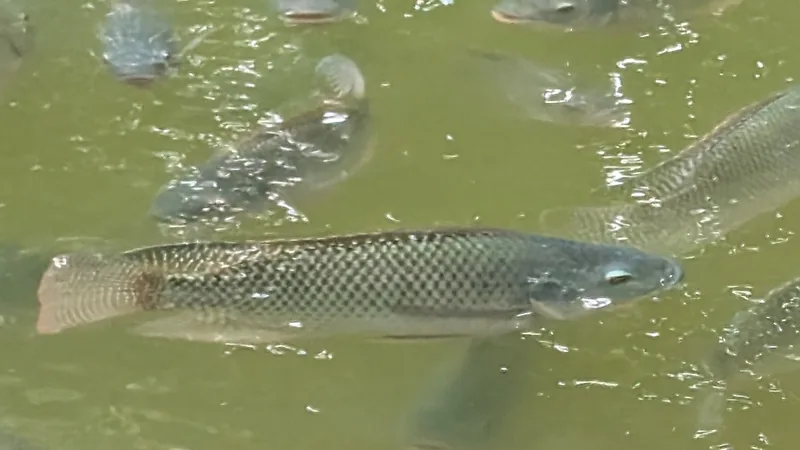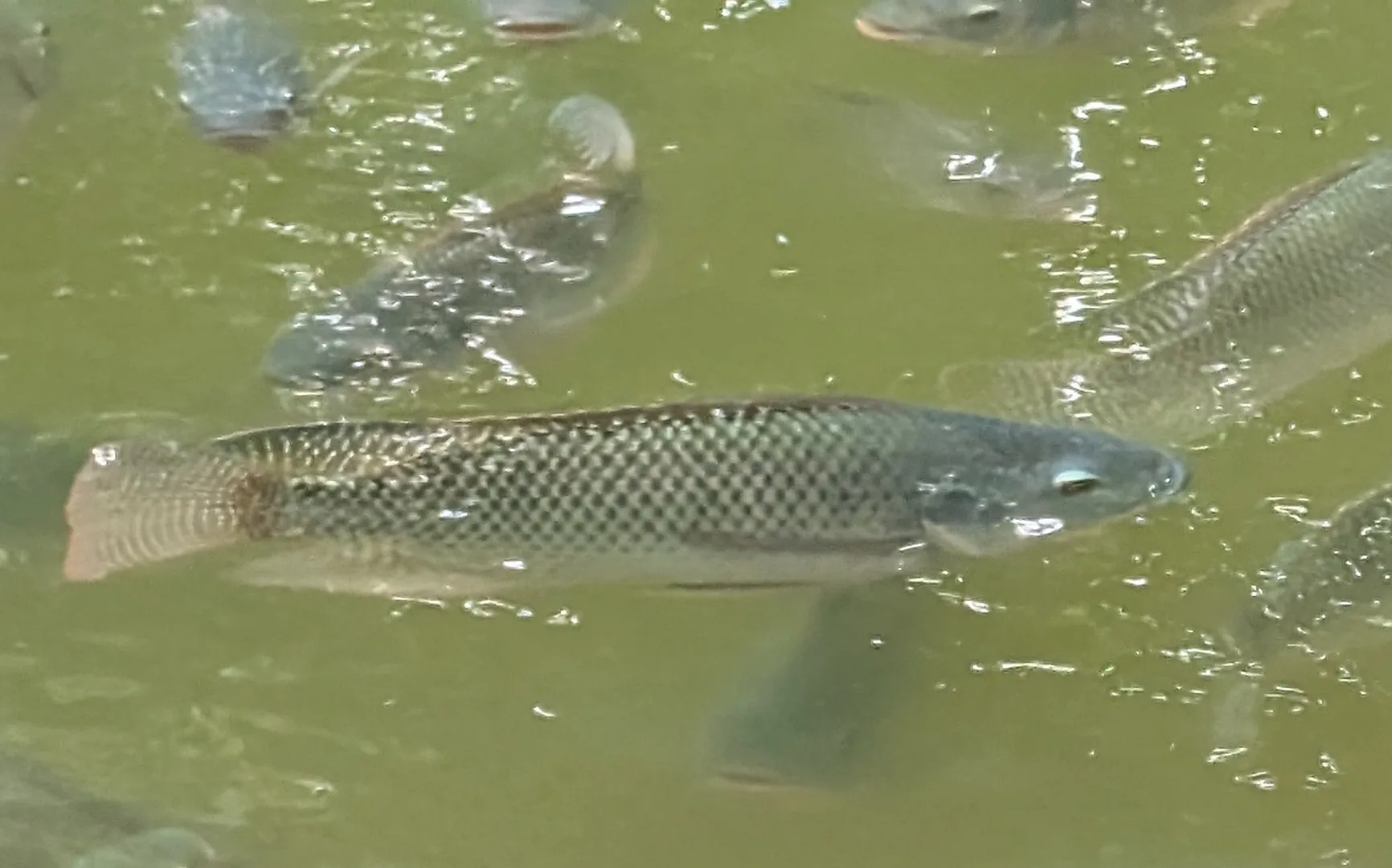
Nile tilapia, Costa Rica.
Field
notes
A mother with a mouthful
Nile tilapia mothers carry their eggs and young inside their own mouths, a habit called mouthbrooding. The male digs a simple pit in shallow water and defends the territory around it, and the females come to him. Courtship lasts several hours. The eggs are shed in batches and fertilized by the male, then the female scoops each batch into her mouth. She holds up to 200 eggs there, and the larvae hatch inside and stay until their yolk sacs, the food packs they are born with, are used up. The female looks after the brood on her own.
Eyes matter In a lab test of 56 pairs, 14 in each of four setups, males with visual contact averaged 24.79 courtship events per 30 minutes. Males with chemical contact alone averaged 0.1.
A switch for maleness
In a 2015 study of one lab strain, males carried a gene called amhy, a copy of the gene amh that is specific to the Y chromosome. Researchers used gene editing to knock out amhy in XY fish, and the fish turned into females. Making extra Amhy in XX fish did the reverse. The authors call amhy the candidate sex-determining gene in their strain, and say other strains may have different ones.
Size, age and appetite
Adults reach up to 60 cm in standard length, which is measured from the snout to the base of the tail fin. The maximum published weight is 4.3 kg, and the oldest reported age is 9 years. Sexual maturity arrives at 3 to 6 months depending on temperature, at about 30 g, and spawning happens several times a year. They feed mainly on phytoplankton (tiny drifting algae) or algae growing on the bottom, with some insect larvae. They are mainly active by day, handle brackish water, and do not do well in pure salt water.
Africa’s export
The Nile tilapia is native to the Nile basin, Lake Tanganyika and other African lakes and rivers, to West African basins such as the Niger and Senegal, and to coastal rivers of Israel. It has since been introduced widely for fish farming. In the United States it was likely released or escaped from fish farms, and in Nevada and Arizona its introduction led to the decline of the endangered Moapa dace and Moapa White River springfish.
Published Updated
Traits
Intel
& FAQ
Guess
first
How big is a Nile Tilapia, really? Slide, lock in, and see what the sources say. Every answer is a figure from this page, quoted from where it came from.
Sources
- 01Diallo et al. (2023). Oreochromis niloticus. The IUCN Red List of Threatened Species 2023: e.T166975A244856058.
- 02Oreochromis niloticus, Nile tilapia. FishBase.
- 03Oreochromis niloticus (Nile Tilapia). USGS Nonindigenous Aquatic Species database.
- 04Li et al. (2015). A Tandem Duplicate of Anti-Müllerian Hormone with a Missense SNP on the Y Chromosome Is Essential for Male Sex Determination in Nile Tilapia, Oreochromis niloticus. PLOS Genetics.
- 05Castro et al. (2009). Visual communication stimulates reproduction in Nile tilapia, Oreochromis niloticus (L.). Brazilian Journal of Medical and Biological Research.
What the sources say: 40 claims checked word for word against these sources →