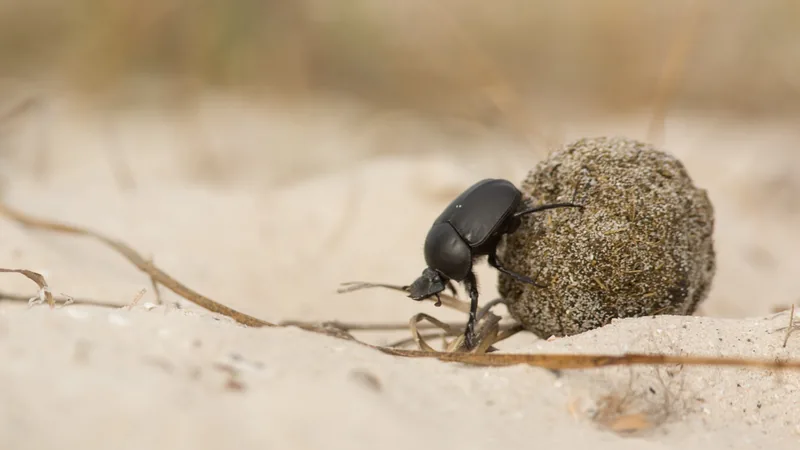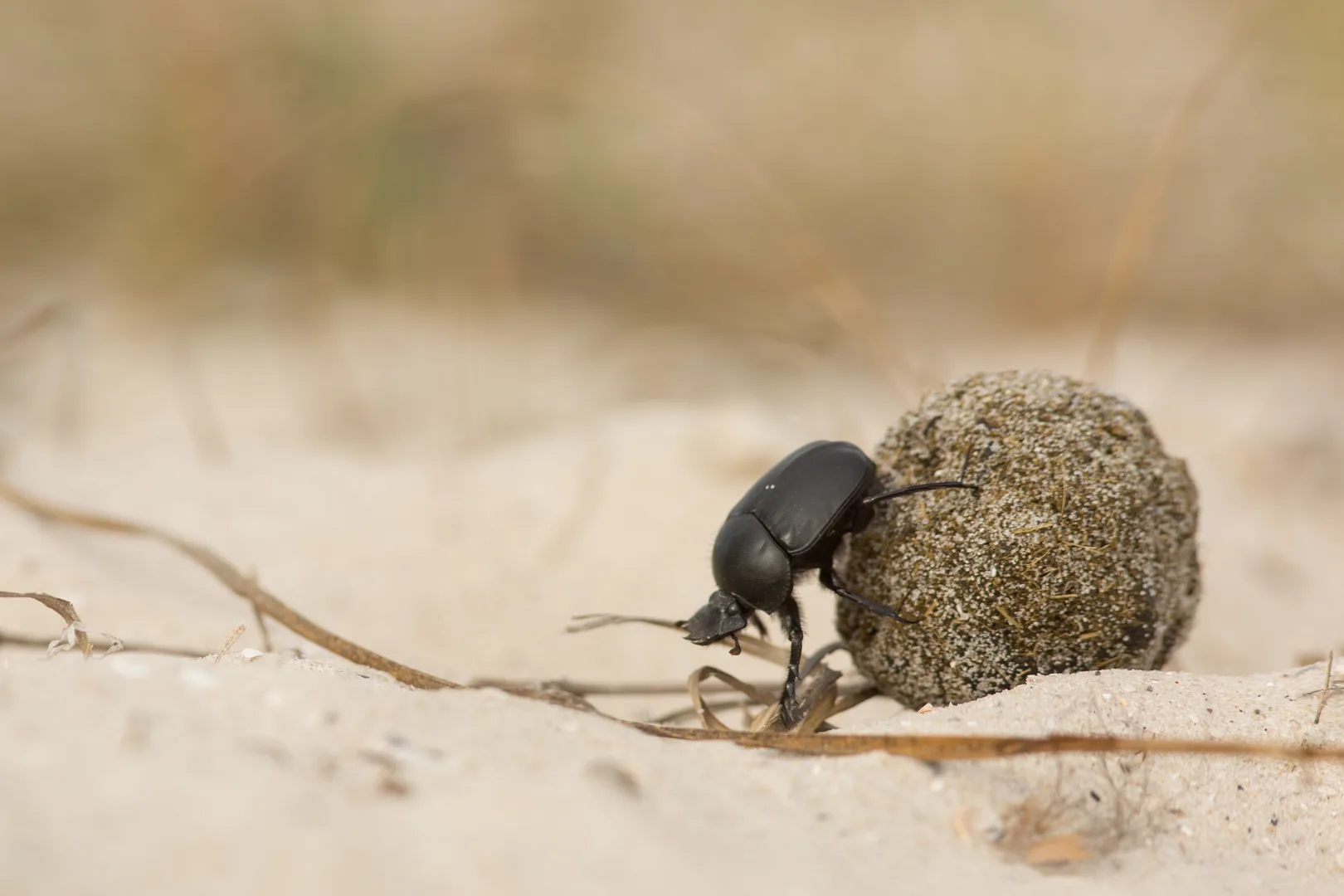
Rolling a dung ball across the sand dunes of Dzharylhach Island on Ukraine's Black Sea coast.
Field
notes
A very large roller
A roller is a dung beetle that cuts off a piece of dung, rolls it some distance away from the pile and buries it. Scarabaeus sacer is one, and a study in Turkey calls it a very large one. In that study the 30 balls it measured ranged from 16 cc to 86 cc in volume. Citing a 1982 study, the same paper gives 30 g as the fresh weight of a ball made by a single sacred scarab. It cites that study again for the three kinds of ball the beetle makes: food balls, brood balls and nuptial balls. A museum in Bulgaria says the beetle can reach 35 to 38 mm long.
Sand, dung and night shifts
The species has been reported from more than 30 countries in a discontinuous belt. The belt runs from the far west of southern Europe and northern Africa across central Asia to western China. It lives in sandy places. The Turkish study ran on a coastal sand dune, where free-ranging domestic water buffalo regularly leave dung pads.
In Spain’s Doñana National Park, the beetle is active from April to July. On the Turkish dune, over two nights in June, 98% of the balls were made at night, and 59% of all balls came between 21.00 and 22.00. Other studies have also recorded it active at dusk and by day.
Heat trap In lab flights by beetles caught in Doñana, its thorax ran 5.6°C warmer than its abdomen on average. Its tracheal system and air sacs took up 11.66% of its body volume, against 2.79% in a close relative, S. cicatricosus.
A flight engine with a heat shield
Before takeoff the beetle shivers its wing muscles to warm up, which makes sure its thorax is hot enough to launch. In flight the thorax is the main heat generation centre, and the abdomen does not actively dump that heat. Researchers call this a passive thermal window.
Air sacs are air-filled pockets inside the body. The study suggests the beetle’s abdominal air sacs, bigger than its relative’s, may work as insulation. The catch is that an abdomen that does not actively shed heat raises the danger of overheating when the air sits around 35 to 40°C.
Crowding at the buffet
On the Turkish dune the beetles also crowded together. They gathered at eight of the larger pads, of 500 g to 2,000 g, which yielded six times as many balls as the other ten pads of those sizes. A 1994 study reported glands in both males and females, which may be responsible for chemical attraction and the crowding.
Published Updated
Traits
Intel
& FAQ
Guess
first
How big is a Sacred Scarab, really? Slide, lock in, and see what the sources say. Every answer is a figure from this page, quoted from where it came from.
Sources
- 01Sacer Dung Beetle. Burgas Regional Museum.
- 02Sullivan et al. (2016). Does one size suit all? Dung pad size and ball production by Scarabaeus sacer (Coleoptera: Scarabaeidae: Scarabaeinae). European Journal of Entomology.
- 03Verdú, Alba-Tercedor & Jiménez-Manrique (2012). Evidence of Different Thermoregulatory Mechanisms between Two Sympatric Scarabaeus Species Using Infrared Thermography and Micro-Computer Tomography. PLoS ONE.
What the sources say: 41 claims checked word for word against these sources →