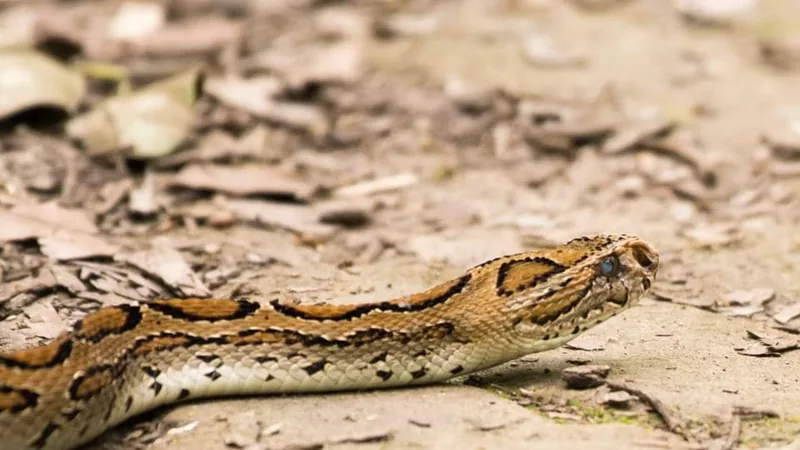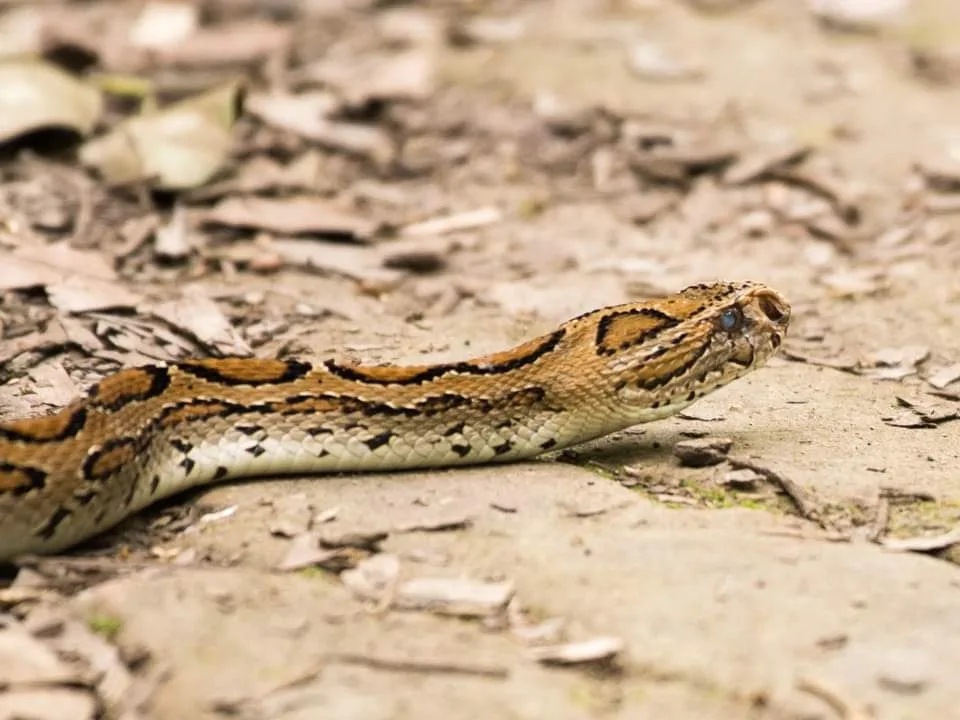
Russell's viper on dry ground.
Field
notes
Venom that changes with the map
Russell’s viper (Daboia russelii) does not carry one fixed venom. A 2021 study compared venom from five biogeographic zones of India, regions defined by climate and landscape. It found significant differences in the venom’s makeup, chemistry and potency.
A 2015 study took apart the venom of Sri Lankan snakes. Basic PLA2s make up about 35 percent of that venom’s protein. The researchers call these enzymes neurotoxic, meaning they attack nerves. They say the mix fits the effects seen in Sri Lankan patients: bleeding, blood-clotting trouble, kidney failure, nerve and muscle damage, and red blood cells bursting.
Antivenom gap In mouse tests, one commercial Indian antivenom worked about equally well against four of the five populations, but poorly against the one from India’s semi-arid north.
Antivenom is the medicine made to counter venom.
Size, weight and markings
Lengths of up to 1.6 metres (about 5 feet) are not uncommon. AnAge lists an average adult weight of 1,306 grams, a little under 3 pounds. The oldest one it records lived 15 years in captivity.
The head is clearly set off from the neck. The back is light brown with three lengthwise rows of large, black-edged blotches, and the middle row often joins into a chain-like stripe. The eye has a vertical, oval pupil, and no sensory pit sits between nostril and eye. It gives birth to live young, 5 to 50 at a time.
Across South Asia
It lives in Pakistan, India, Nepal, Bangladesh and Sri Lanka. In India it turns up in nearly every biogeographic zone, apart from the Trans-Himalayas, most of the northeast and the islands, and it reaches 2,000 m or more in the Himalaya. In Sri Lanka it is recorded up to 1,500 m.
The Reptile Database calls it possibly the most common of the dangerously venomous snakes in southern Asia. A survey published in 2009 identified 860 snakes brought to ten Sri Lankan hospitals along with the patients they had bitten: Russell’s vipers and hump-nosed pit vipers were the most numerous. The 2021 study says it seems to be responsible for the majority of India’s fatal envenomings and long-term injuries. The former subspecies siamensis has been raised to a full species; this profile covers D. russelii only.
Published Updated
Traits
Intel
& FAQ
Guess
first
How big is a Russell's Viper, really? Slide, lock in, and see what the sources say. Every answer is a figure from this page, quoted from where it came from.
Sources
- 01Suraj et al. (2021). Daboia russelii. The IUCN Red List of Threatened Species 2021: e.T172710A1372376.
- 02Daboia russelii. The Reptile Database.
- 03AnAge entry for Daboia russelii. Human Ageing Genomic Resources, AnAge.
- 04Senji Laxme et al. (2021). Biogeographic venom variation in Russell's viper (Daboia russelii) and the preclinical inefficacy of antivenom therapy in snakebite hotspots. PLOS Neglected Tropical Diseases.
- 05Tan et al. (2015). Functional venomics of the Sri Lankan Russell's viper (Daboia russelii) and its toxinological correlations. Journal of Proteomics.
- 06Ariaratnam et al. (2009). Syndromic Approach to Treatment of Snake Bite in Sri Lanka Based on Results of a Prospective National Hospital-Based Survey of Patients Envenomed by Identified Snakes. The American Journal of Tropical Medicine and Hygiene.
- 07Khandakar & Jeny (2020). New distributional records of Russell’s Vipers, Daboia russelii (Shaw and Nodder 1797), in Bangladesh. Reptiles & Amphibians.
What the sources say: 34 claims checked word for word against these sources →