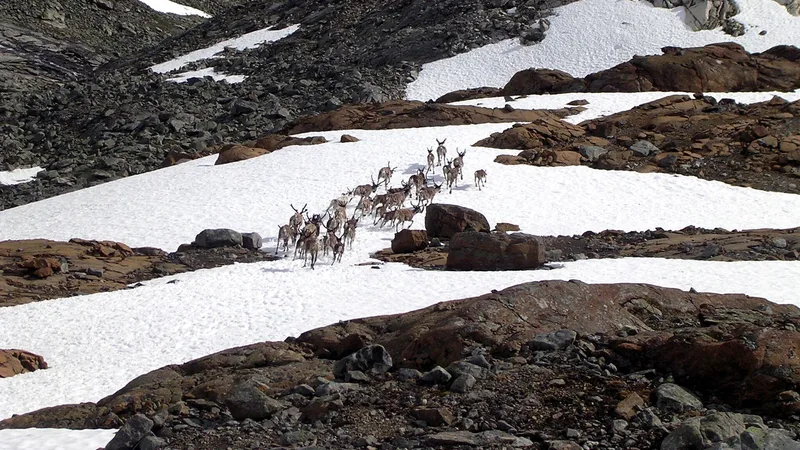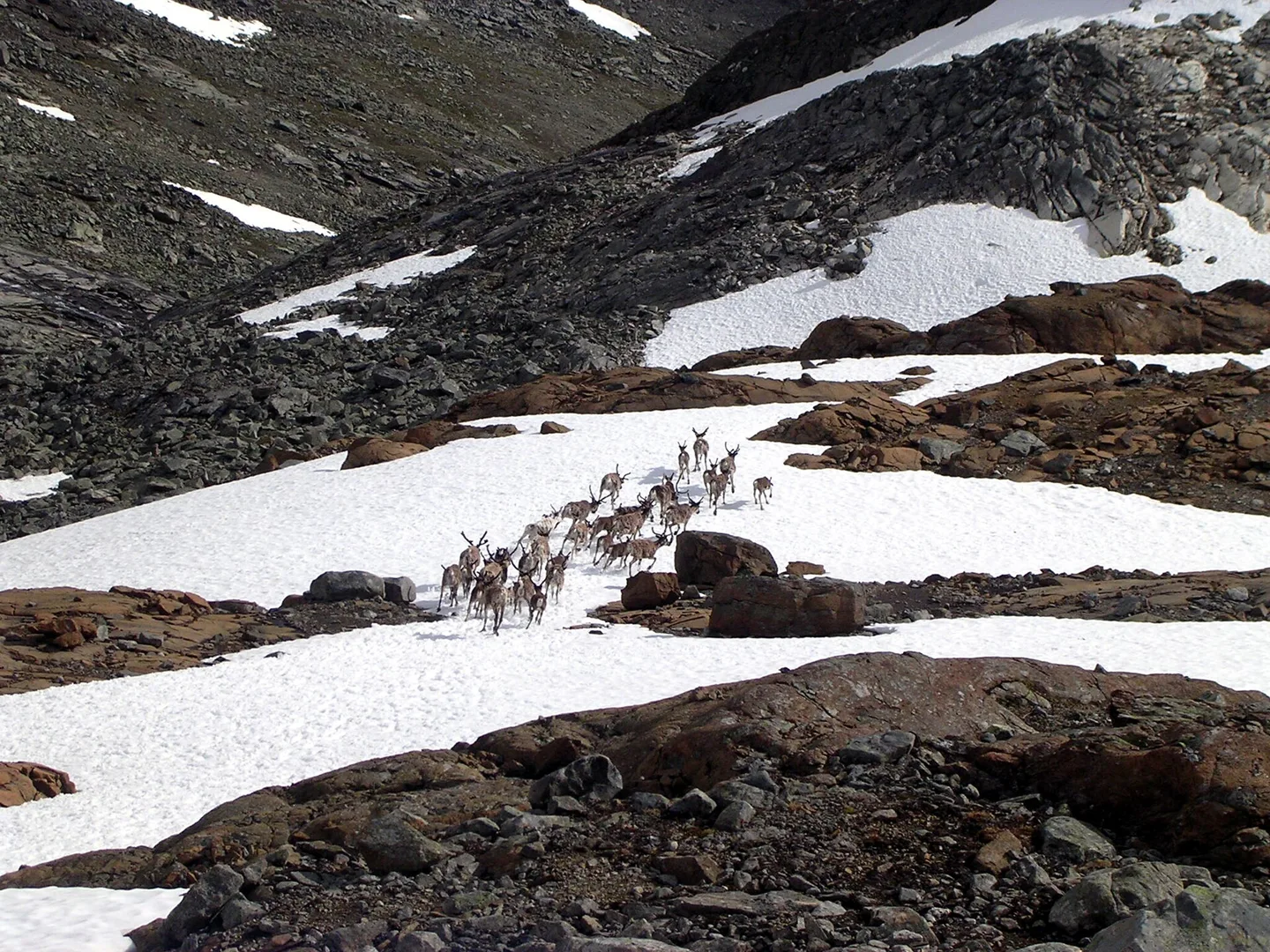
Wild reindeer in Jotunheimen, Norway, near Surtningssui.
Field
notes
The Deer Where Both Sexes Wear a Crown
The reindeer, or caribou (Rangifer tarandus), is the only member of the deer family in which both sexes grow antlers, and most cows carry a set. In Alaska, adult bulls average 350 to 400 pounds (159 to 182 kg), though weights of 700 pounds (318 kg) have been recorded, while mature cows average 175 to 225 pounds (80 to 120 kg). Compared to body size, their antlers are the largest and heaviest of any living deer species: a bull’s can be up to 51 inches long, and a cow’s can reach 20. The large bulls lose theirs after the autumn mating season, but pregnant cows usually keep theirs until their calves are born in late spring. On average a reindeer lives 10 to 11 years, in the wild or in captivity, and the record in captivity is 21.8 years.
Snowshoe Hooves and a Lichen Habit
Caribou live on Arctic tundra, mountain tundra, and in the northern forests of North America, Russia, and Scandinavia. In summer they eat the leaves of willows, sedges, flowering tundra plants, and mushrooms. Using lichens as their primary winter food sets them apart from all other large mammals and has let them survive on harsh northern range. Their large, concave hooves spread wide to hold them up on snow and soft tundra, like snowshoes, and work as paddles when they swim. Walking comes with a click, the sound of tendons snapping past sesamoid bones in the foot. In Alaska, large herds often migrate up to 400 miles between summer and winter ranges, covering up to 50 miles a day once they set off, though smaller herds may not migrate at all.
Wolves, Bears, and a Built-In Alarm
Wolves are the caribou’s primary predator: a wolf eats a variety of prey but needs food equal to 11 to 14 caribou a year. Grizzly and black bears, cougars, wolverines, lynx, coyotes, and golden eagles also prey on caribou. In some areas, wolves, grizzly bears, and golden eagles kill large numbers of newborn calves. Caribou swamp them: the cows in a herd give birth to a lot of calves in a very short time, more food than nearby predators can eat. In danger, a caribou rears up on its hind legs and leaves a scent from glands at the base of its ankles that alerts other caribou.
Antlers Mean Dominance By late winter, when conditions are harshest, pregnant cows still carry their antlers long after the large bulls have dropped theirs. That makes them the dominant members of the herd, able to defend their feeding craters and even push larger caribou off favoured spots.
Eyes Tuned to Arctic Twilight
Reindeer are the only mammal known to seasonally adapt their eyes to the extremely blue Arctic twilight. Behind the retina sits a tapetum lucidum, a mirror-like layer that sends light back through the light-sensing cells for a second pass. In summer it reflects gold and turquoise, like many other mammals’ eyes. In the long Arctic winter it turns deep blue, its peak matching the color of twilight. Researchers propose how: the fluid between its collagen fibers shrinks, letting the fibers pack closer together. In Arctic reindeer the cornea and lens also let some ultraviolet light through, and the retina’s rod and cone cells both respond to it. That may help them pick out differences in how Arctic vegetation and types of snow reflect it.
Published Updated
Traits
Intel
& FAQ
Guess
first
How big is a Reindeer (Caribou), really? Slide, lock in, and see what the sources say. Every answer is a figure from this page, quoted from where it came from.
Sources
- 01Caribou (Wildlife Notebook Series). Alaska Department of Fish and Game, 2025.
- 02Caribou. Alaska Department of Fish and Game.
- 03Fun Facts about Reindeer and Caribou. U.S. Food and Drug Administration, Animal Health Literacy, 2023.
- 04Caribou. Hinterland Who's Who, Canadian Wildlife Federation.
- 05Caribou. Denali National Park & Preserve, National Park Service.
- 06Rangifer tarandus. AnAge: The Animal Ageing and Longevity Database, Build 15, 2023.
- 07Fosbury & Jeffery (2022). Reindeer eyes seasonally adapt to ozone-blue Arctic twilight by tuning a photonic tapetum lucidum. Proceedings of the Royal Society B: Biological Sciences.
- 08Hogg et al. (2011). Arctic reindeer extend their visual range into the ultraviolet. Journal of Experimental Biology.
- 09Holand & Mizin (2025). Rangifer tarandus. The IUCN Red List of Threatened Species 2025: e.T29742A224359765.
What the sources say: 61 claims checked word for word against these sources →