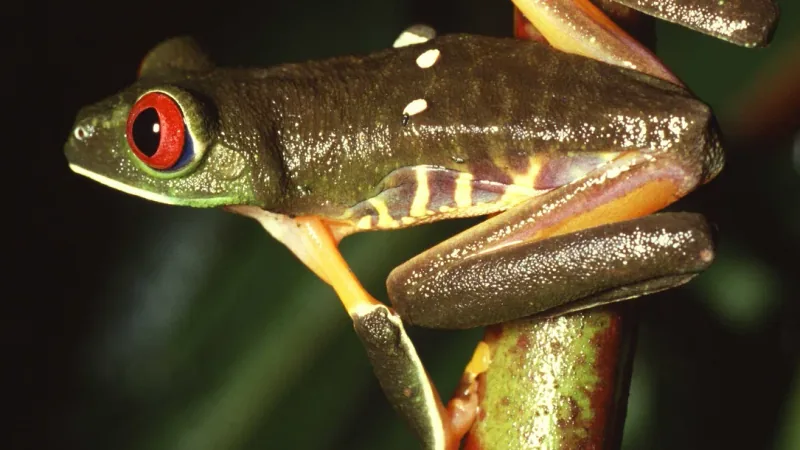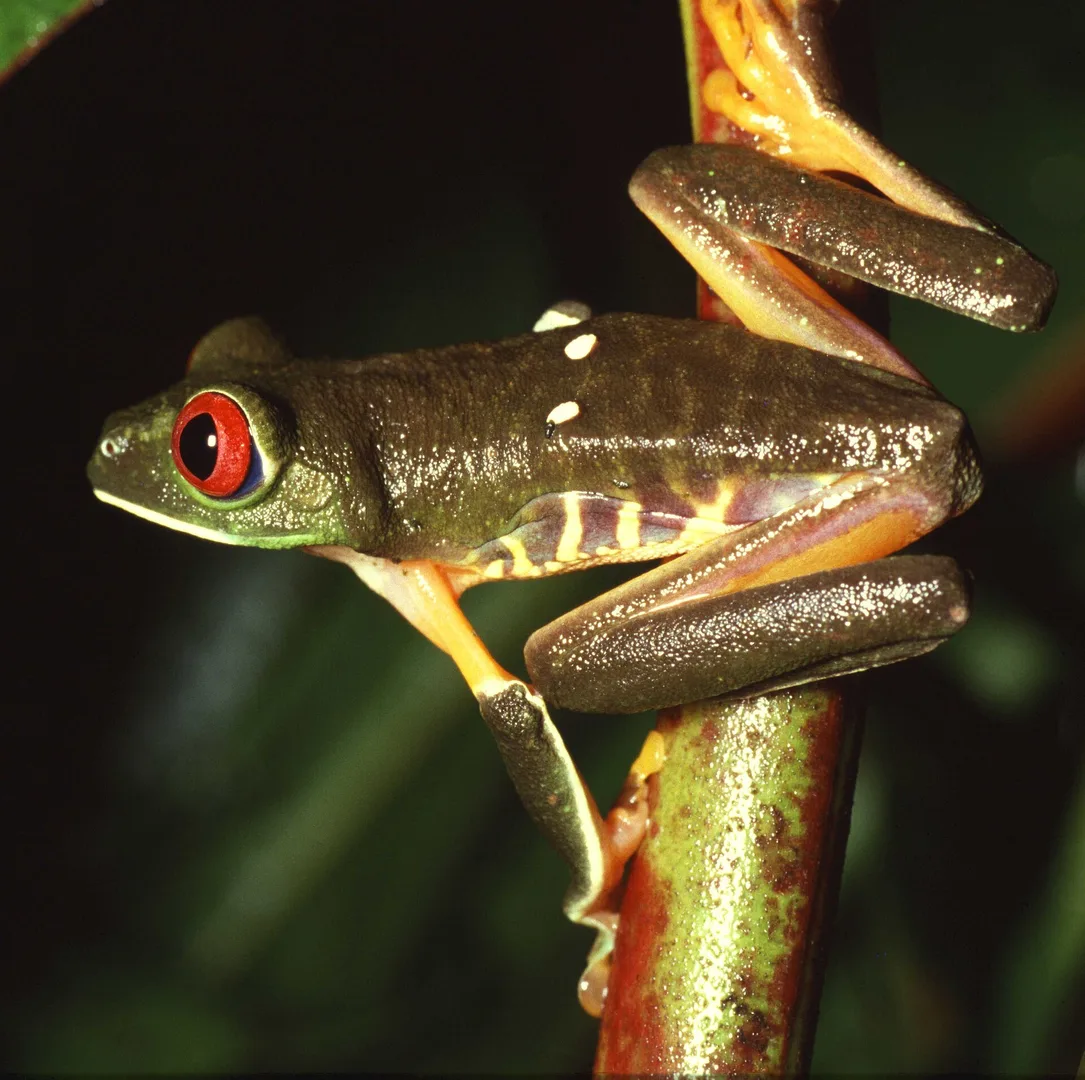
Red-eyed treefrog (female), photographed on Barro Colorado Island, Panama
Field
notes
Small, Green and Close to Water
Southern Mexico, Central America and northern South America are home to the red-eyed tree frog (Agalychnis callidryas). It lives mostly in humid rainforest close to ponds and other small bodies of fresh water, and a permanent body of water is essential for it to breed. It stays small: males measure about 5 centimeters and females 5 to 8, and it weighs 5 to 14 grams. In the wild it lives about five years on average.
The Startle That Buys an Instant
By day the frog sleeps stuck to the underside of a leaf, eyes closed and its bright markings covered. When disturbed, it flashes its bulging red eyes and reveals its huge, webbed orange feet and blue-and-yellow flanks. This is called startle coloration, and it may give a bird or snake pause, an instant in which the frog can spring to safety. Many of the animals that eat these frogs are nocturnal hunters with keen eyesight, and the shocking colors may overstimulate a predator’s eyes, leaving a confusing ghost image behind as the frog jumps away.
Chemistry in the Skin Despite its bright colors the frog carries no venom. Its skin is still a chemistry set: a 1997 analysis of skin extract found members of five peptide families, among them tachykinins and opioid peptides.
Ambush Feeding at Night
Red-eyed tree frogs feed mainly at night, hiding in the rainforest canopy to ambush crickets, flies and moths with a long, sticky tongue. Grasshoppers are on the menu too, and sometimes smaller frogs. Males croak to attract females, and rival males fight one another for a chance to mate. Males also have a shaking display called tremulation. Playback experiments with a robotic model frog and an electrodynamic shaker showed that the vibrations it sends through the plant are a signal, enough on their own to set off tremulation in reply. In contests between males, tremulation was the most frequent aggressive display.
Eggs That Can Hatch Days Early
Females typically lay their eggs under leaves hanging over water. Left undisturbed, the embryos often stay in the egg for five to seven days, but a predator attack or flooding can make them hatch rapidly, from as early as three or four days old. In an attack the cue is vibration; in a flood it is lack of oxygen. The response fits the threat: whole clutches hatch when a snake, which eats entire clutches, attacks, while a wasp, which takes single eggs, makes individual embryos hatch. Hatchlings fall into the water, and in a Panama study most embryos that hatched during wasp attacks escaped. The IUCN Red List rates the species Least Concern.
Published Updated
Traits
Intel
& FAQ
Guess
first
How big is a Red-Eyed Tree Frog, really? Slide, lock in, and see what the sources say. Every answer is a figure from this page, quoted from where it came from.
Sources
- 01Manjunath (2022). Agalychnis callidryas. Animal Diversity Web, University of Michigan.
- 02Red-Eye Leaf Frog. Henry Vilas Zoo.
- 03Red-Eyed Tree Frog. National Geographic.
- 04Agalychnis callidryas. The IUCN Red List of Threatened Species 2020: e.T55290A3028059.
- 05Warkentin (2000). Wasp predation and wasp-induced hatching of red-eyed treefrog eggs. Animal Behaviour.
- 06Güell & Warkentin (2018). When and where to hatch? Red-eyed treefrog embryos use light cues in two contexts. PeerJ.
- 07Salica, Vonesh & Warkentin (2017). Egg clutch dehydration induces early hatching in red-eyed treefrogs, Agalychnis callidryas. PeerJ.
- 08Mignogna et al. (1997). Tachykinins and Other Biologically Active Peptides From the Skin of the Costa Rican Phyllomedusid Frog Agalychnis callidryas.
- 09Caldwell et al. (2010). Vibrational Signaling in the Agonistic Interactions of Red-Eyed Treefrogs. Current Biology.
- 10Clark et al. (2022). Genetic isolation by distance underlies colour pattern divergence in red‐eyed treefrogs (Agalychnis callidryas). Molecular Ecology.
What the sources say: 49 claims checked word for word against these sources →