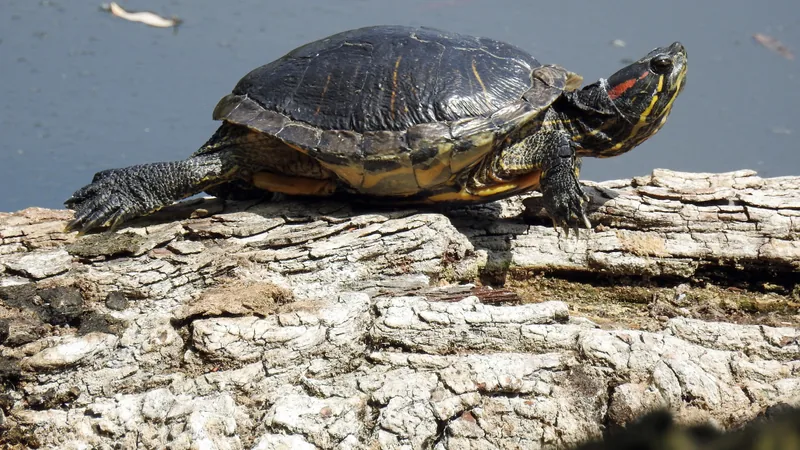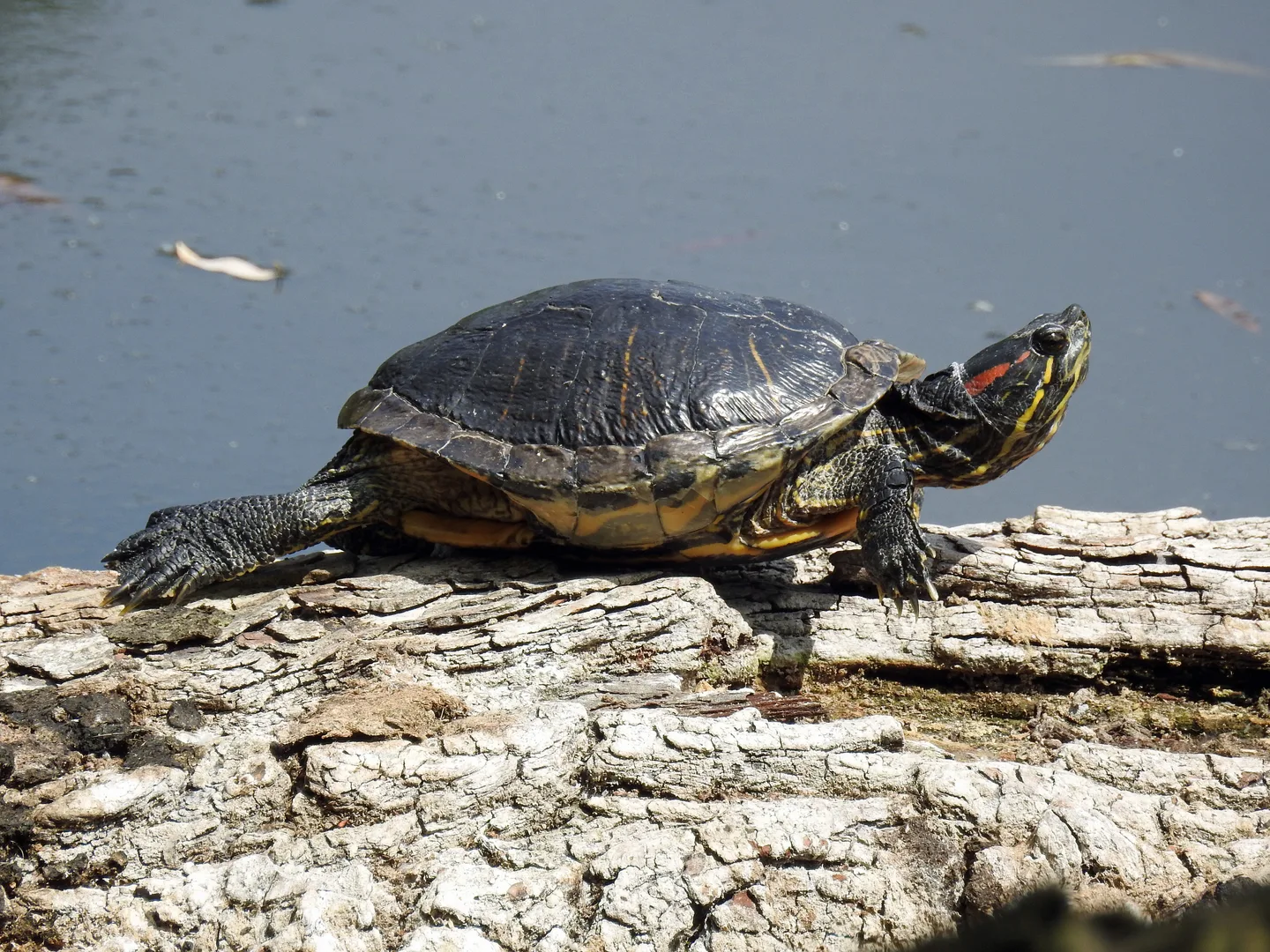
Basking on a log.
Field
notes
A nest that picks the sex
Sex in a slider egg depends on the heat of its nest. The pond slider (Trachemys scripta, the species that includes the red-eared slider) uses temperature-dependent sex determination: nests below 28.6 degrees Celsius hatch all males, and nests above 29.6 degrees Celsius hatch all females. In between you get a mix.
Temperature switch In red-eared sliders, a gene called Kdm6b changes its activity with temperature in the early embryo, and knocking it down at 26 degrees Celsius, a temperature that normally gives all males, turned more than 80 percent of surviving embryos female.
Built to sit in the sun
Sliders rarely leave the water except to bask. They live in shallow, slow water with varied plants and places to bask, and the red-eared subspecies wears a broad red or orange stripe behind each eye. Sliders’ bright yellow and red markings have been shown to be aposematic, which means they act as a warning. In Mississippi, a study concluded that largemouth bass avoid sliders because of their bright warning colors.
Sliders range from 10 to 29 cm long, and females tend to be the bigger sex. An average adult female shell is 25.4 cm, an average male shell is 17.78 cm, and females can reach 3,200 grams.
Sliders also handle running out of air. In a lab test, red-eared sliders spent 20 hours underwater at 5 degrees Celsius with no oxygen, and measured damage products showed minimal changes. Species-wide, they can live up to 30 years in the wild and up to 41.3 years in captivity.
Babies eat meat, adults eat salad
Young sliders are mostly carnivorous, eating insects, crayfish, tadpoles and snails. Grown sliders become omnivores and eat mostly plants from water and land, plus algae. Adult stomachs in a southern Illinois study held more than 40 percent plant material.
Their courtship is just as odd. A male uses his foreclaws to make underwater vibrations near a female’s eyes.
A pond turtle on nearly every continent
The red-eared slider is native from Alabama south to northern Mexico. Sliders spread mainly through pet releases and escapes, which peaked in the late 1980s and early 1990s during the Teenage Mutant Ninja Turtle craze. They have been introduced onto nearly every continent, where they compete with native species for food and basking sites. The pond slider species was rated Least Concern on the IUCN Red List in 2011.
Published
Traits
Intel
& FAQ
Guess
first
How big is a Red-Eared Slider, really? Slide, lock in, and see what the sources say. Every answer is a figure from this page, quoted from where it came from.
Sources
- 01Trachemys scripta (pond slider). Animal Diversity Web, University of Michigan.
- 02Trachemys scripta elegans (Red-eared Slider). USGS Nonindigenous Aquatic Species Database.
- 03AnAge entry for Trachemys scripta. AnAge: The Animal Ageing and Longevity Database, Build 15, Human Ageing Genomic Resources.
- 04Ge et al. (2018). The histone demethylase KDM6B regulates temperature-dependent sex determination in a turtle species. Science.
- 05Willmore & Storey (1997). Antioxidant systems and anoxia tolerance in a freshwater turtle Trachemys scripta elegans. Molecular and Cellular Biochemistry.
- 06Dijk, Harding & Hammerson (2011). Trachemys scripta. The IUCN Red List of Threatened Species 2011: e.T22028A97429935.
What the sources say: 46 claims checked word for word against these sources →