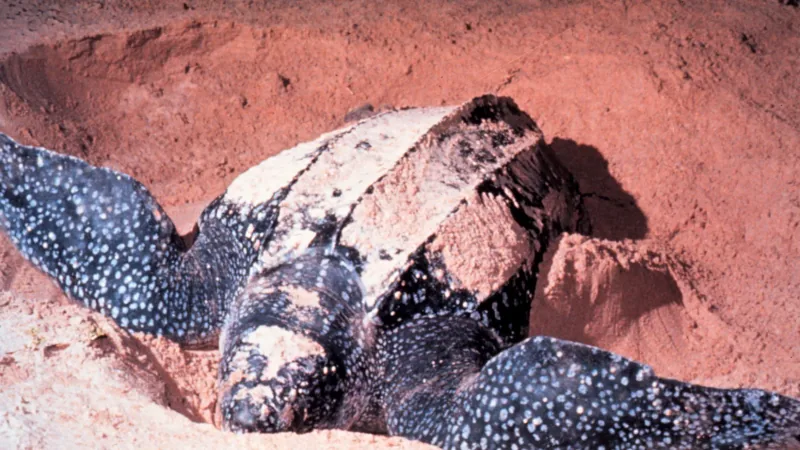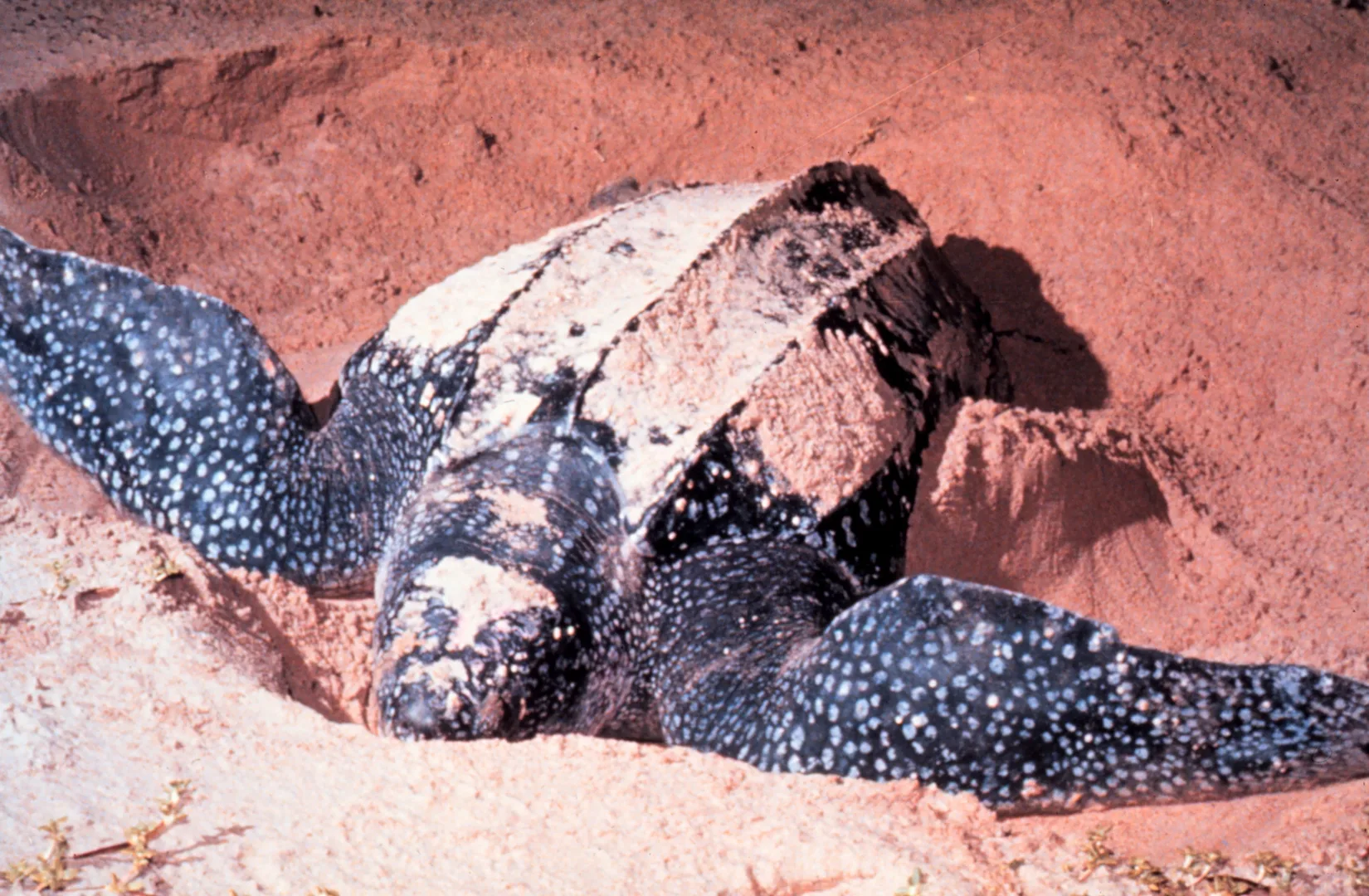
Adult Dermochelys coriacea, Leatherback Sea Turtle. In Las Baulas National Marine Park, Costa Rica.
Field
notes
The Biggest Turtle Alive
The leatherback sea turtle (Dermochelys coriacea) is the largest of all sea turtles and the fourth largest living reptile on Earth. NOAA Fisheries puts an adult at 750 to 1,000 pounds (about 340 to 450 kilograms) and 5 to 6 feet (1.5 to 1.8 meters) long, and a 2025 review gives an average adult shell length of 130 to 190 centimeters. The heaviest on record, a dead male stranded on a Welsh beach, was weighed at 916 kilograms in 1988, though a 2015 review argues that weight is probably inaccurate. Nobody knows exactly how long a leatherback lives: NOAA calls the lifespan unknown but estimates 50 years or more, and a DNA-based method reported in a 2025 review estimates up to 90 years, longer than the 50 to 60 years of other sea turtle species.
It is also the only sea turtle without scales or a hard shell. Its back is built from small, interlocking bony plates called osteoderms, sitting beneath tough, rubbery black skin and running in seven ridges that help water flow smoothly past.
Beating the Cold-Blooded Rule
No other sea turtle can keep its body warmer than the surrounding water. The leatherback can, and that lets it forage in the cold waters of the North Atlantic, the North Pacific and the Southern Ocean. A 2015 review of ocean giants explains how. Sheer bulk gives the turtle a low surface-area-to-volume ratio that slows heat loss and leaves room for a thick layer of blubber under its skin. Its blood vessels also work as heat exchangers that raise its internal temperature further. Researchers suggested a name for staying warm like this despite a low metabolic rate: gigantothermy.
Diving Past a Kilometer Down
That loose-jointed shell pays off underwater too. A 2015 materials-science study found that the flexible seams between the osteoderms let the leatherback’s body squeeze smaller than a hard-shelled sea turtle’s as it dives past 1,000 meters. NOAA reports that leatherbacks can dive to nearly 4,000 feet (about 1,200 meters), deeper than any other turtle, and stay down for up to 85 minutes.
Backward-pointing throat spikes These spines, called keratinous papillae, line the throat and esophagus and help hold jellyfish in place while the turtle pushes swallowed seawater back out.
A Diet of Jelly
Leatherbacks eat soft-bodied open-ocean prey such as jellyfish and salps, and a 2025 review says they consume about 73 percent of their own body weight a day. A leatherback may swallow floating balloons and plastic bags, mistaking them for food, and a 2013 global analysis found ocean-going leatherbacks and green turtles face the greatest risk of harm or death from swallowed debris.
The Long Haul
Leatherbacks make the longest migrations of any sea turtle, some swimming more than 10,000 miles (16,000 kilometers) a year between feeding grounds and nesting beaches that lie mainly in the tropics and subtropics. Their range stretches from Newfoundland and Norway to Argentina and South Africa. The leatherback is listed as endangered under the US Endangered Species Act and rated Vulnerable on the IUCN Red List, and NOAA estimates the global population has fallen 40 percent over the past three generations.
Published Updated
Traits
Intel
& FAQ
Guess
first
How big is a Leatherback Sea Turtle, really? Slide, lock in, and see what the sources say. Every answer is a figure from this page, quoted from where it came from.
Sources
- 01Leatherback Turtle. NOAA Fisheries.
- 02Dermochelys coriacea (leatherback sea turtle). Animal Diversity Web, University of Michigan.
- 03Wallace, Tiwari & Girondot (2013). Dermochelys coriacea. The IUCN Red List of Threatened Species 2013: e.T6494A43526147.
- 04McClain et al. (2015). Sizing ocean giants: patterns of intraspecific size variation in marine megafauna. PeerJ.
- 05Piboon et al. (2025). Biology, Nesting Behavior, Genetic Diversity, and Conservation of Leatherback Sea Turtles: Insights From Thailand and Global Perspectives. Ecology and Evolution.
- 06Chen, Yang & Meyers (2015). Leatherback sea turtle shell: A tough and flexible biological design. Acta Biomaterialia.
- 07Schuyler et al. (2013). Global Analysis of Anthropogenic Debris Ingestion by Sea Turtles. Conservation Biology.
What the sources say: 57 claims checked word for word against these sources →