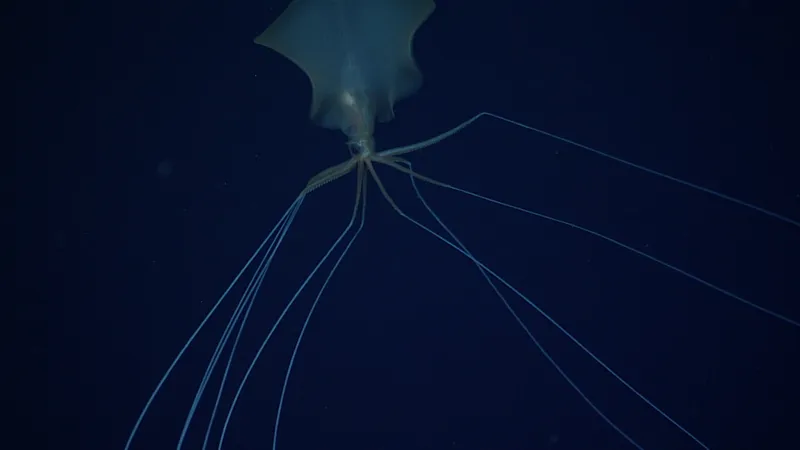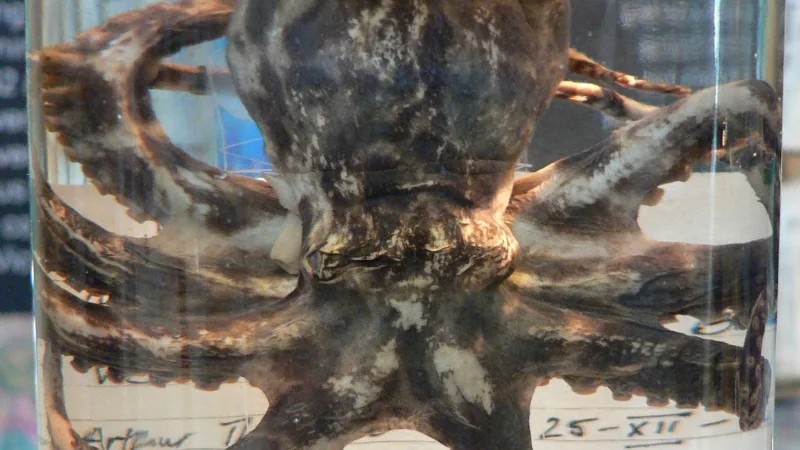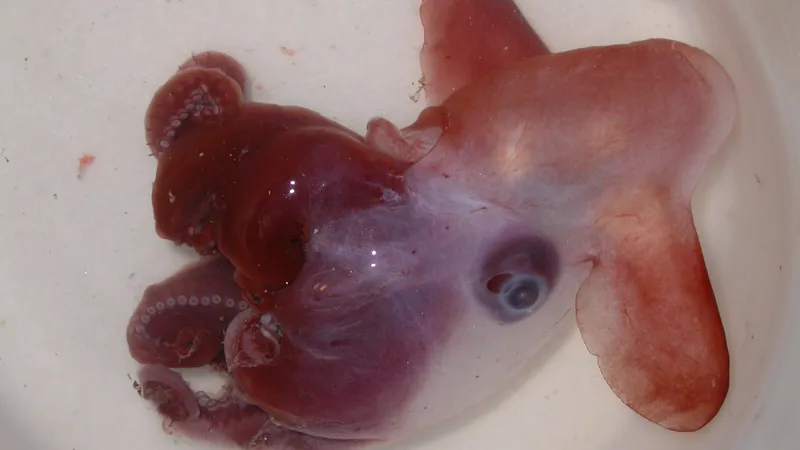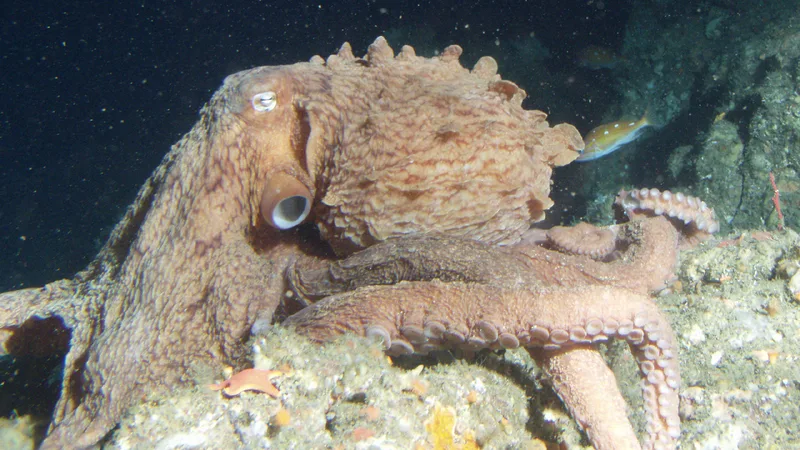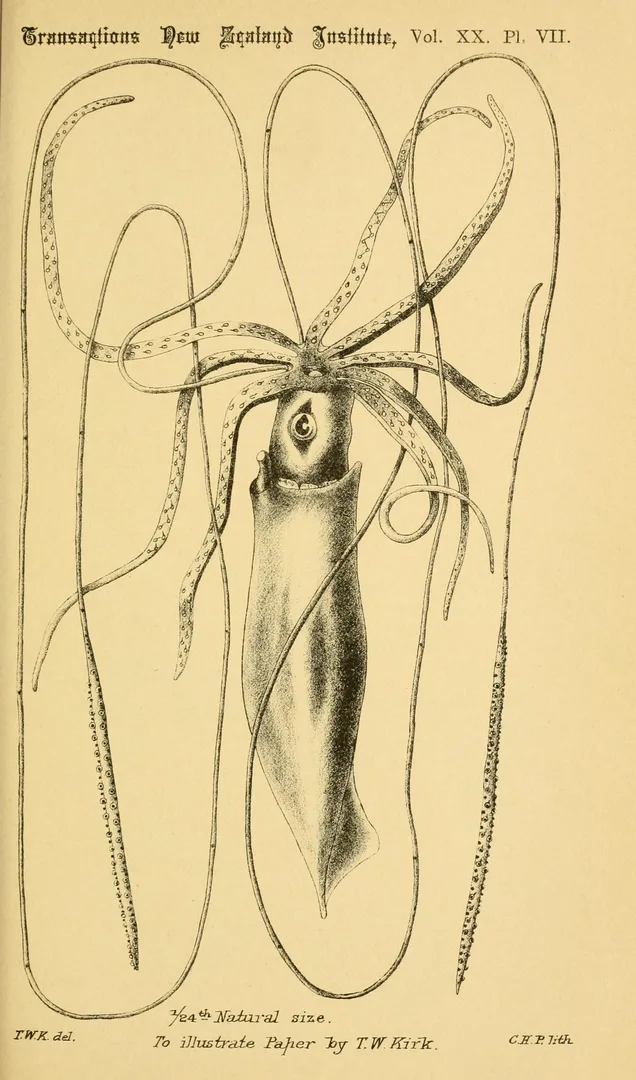
Architeuthis longimanus, now counted as A. dux, from Thomas Kirk's 1888 description. No freely licensed photograph of a living giant...
Field
notes
The longest cephalopod
A giant squid is the longest cephalopod, the group that holds squid, octopuses and cuttlefish. The longest one scientifically verified measured 12 m in total length. Longer lengths have been reported, but they were not first-hand measurements.
Modern studies report typical maximum weights of 200 to 280 kg. One old estimate of 907 kg is unlikely to be accurate. The colossal squid, a different species, is the heaviest cephalopod.
Giant squid live in all the world’s oceans, usually near continental and island slopes. Specimens are rare from tropical and high polar latitudes.
Photographed at last
Historically, most information came from stranded animals, dead or dying ones found floating at the surface, and the stomachs of sperm whales, sharks and predatory ocean fish.
Then a 2005 paper showed the first wild images of one in its natural environment. A camera and depth recorder photographed a giant squid attacking bait at 900 m off the Ogasawara Islands in the North Pacific. A severed tentacle confirmed the identification and showed the squid was over 8 m long. The authors wrote that it appears to be a much more active predator than previously suspected.
Tentacles built to strike
A giant squid has eight arms and two long feeding tentacles. The photographs suggested it uses them to strike and tangle prey. Their suckers are cups lined with sharp, finely serrated rings of chitin, a hard material.
The tongue carries a radula, a ribbon of small, file-like teeth that shreds food before it is swallowed. Some studies of dead giant squid showed they eat deep-sea fishes and other deep-sea squids. Sperm whales and other toothed whales are known or likely predators.
Lifespan mystery Scientists have not agreed on how long giant squid live. Some works estimate 2 to 3 years. Others estimate over 25.
A life mostly unseen
Small young giant squid have been caught in or near Japanese coastal waters. One had a mantle 140.8 mm long and weighed 44.81 g. Off southern Brazil in 1999, a mature female found dead, floating over 2,400 m of water, had a mantle 116 cm long. Three sperm cords were partly embedded in the skin of one arm.
The IUCN Red List rates the species Least Concern.
Published
Traits
Intel
& FAQ
Guess
first
How big is a Giant Squid, really? Slide, lock in, and see what the sources say. Every answer is a figure from this page, quoted from where it came from.
Sources
- 01McClain et al. (2015). Sizing ocean giants: patterns of intraspecific size variation in marine megafauna. PeerJ.
- 02Kubodera & Mori (2005). First-ever observations of a live giant squid in the wild. Proceedings of the Royal Society B: Biological Sciences.
- 03Architeuthis dux. Animal Diversity Web, University of Michigan.
- 04AnAge entry for Architeuthis dux. AnAge: The Animal Ageing and Longevity Database, Human Ageing Genomic Resources.
- 05Martins & Perez (2009). A new record of giant squid Architeuthis sp. (Cephalopoda: Oegopsida) in Brazilian waters. Zoologia (Curitiba).
- 06Wada et al. (2015). First records of small-sized young giant squid Architeuthis dux from the coasts of Kyushu Island and the south-western Sea of Japan. Marine Biodiversity Records.
- 07Allcock & Barratt (2014). Architeuthis dux. The IUCN Red List of Threatened Species 2014: e.T163265A991505.
What the sources say: 53 claims checked word for word against these sources →