A captive chambered nautilus at Pairi Daiza, Belgium, hood and tentacles extended.
Field
notes
A Shell Built Like a Submarine
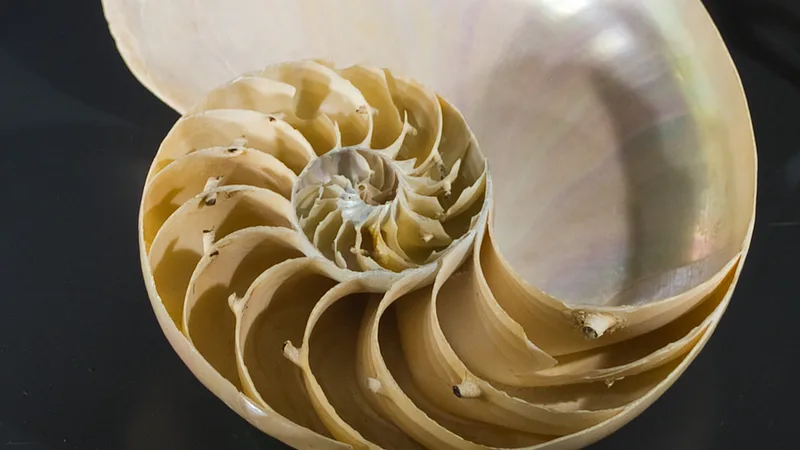
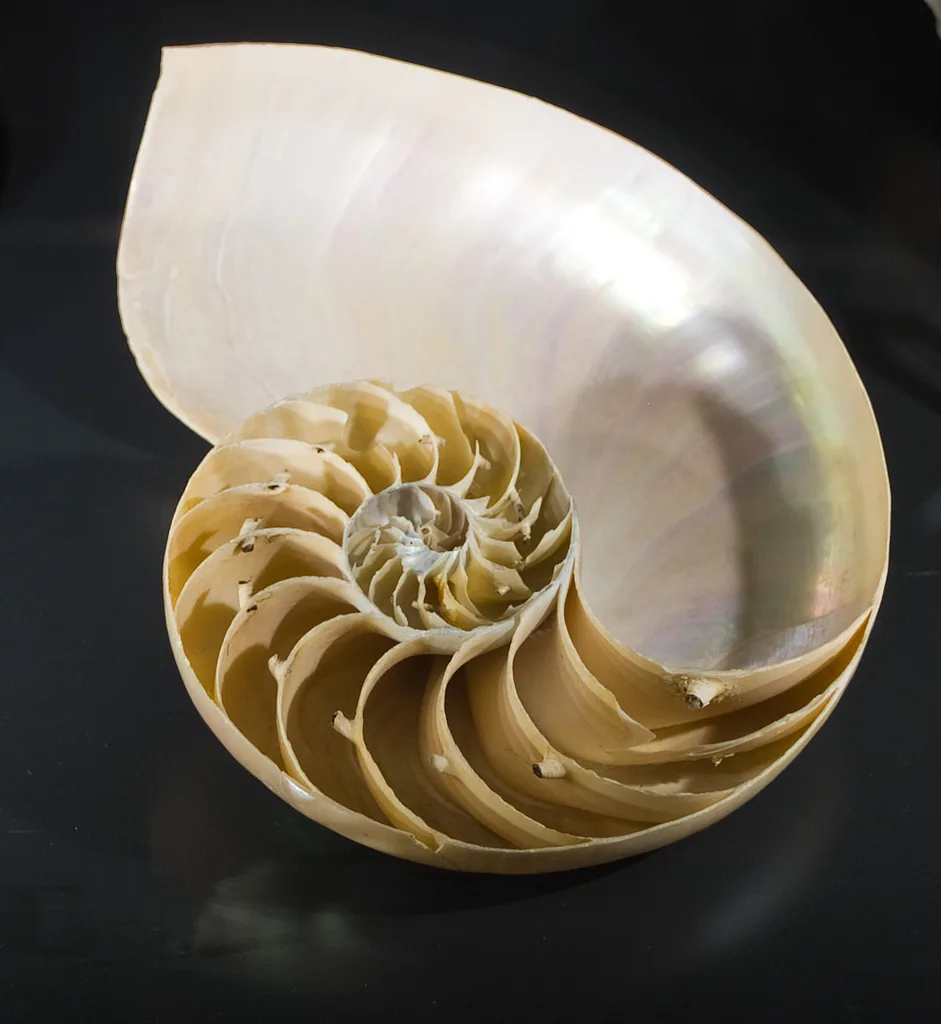
The chambered nautilus has a shell typically 5 to 9 inches long at maturity and weighs at least 2 pounds. It grows slowly, maturing at around 10 to 15 years old, and can live 15 to 20 years or more. An adult shell has over 30 chambers. The soft body sits in the outermost one, and the rest help keep it buoyant. Aragonite crystals, a form of calcium carbonate, are a major component of the shell, and the nautilus genome revealed new genes that help produce them.
The Ballast System A tube called the siphuncle runs down the center of the chambers, releasing gas to keep the nautilus buoyant and upright.
To swim, the nautilus contracts the muscles of its funnel. It steers mostly by sensing obstacles with its tentacles, or by bumping into them lightly before changing course.
An Eye With No Lens
Octopuses and squid have camera eyes with lenses. The nautilus’s pinhole eye has no lens and no cornea. Instead, an adjustable pupil creates a relatively dim image on the retina. Lenses are built mostly from proteins called crystallins. Scientists who sequenced the nautilus genome found fewer crystallin genes than in other molluscs with lenses, and none of the S-crystallin genes that octopuses and squid carry many copies of. These gene losses suggest the pinhole eye may have degenerated from a more complex organ. Its simple design also makes it an excellent model for studying how eyes evolved.
Hunting By Smell in the Dark
Nautiluses live mainly near the bottom, in waters up to 500 meters deep, and rise closer to the surface at night. They eat animals such as fish, crabs, and lobsters, plus carrion, using a sharp, beak-like mouth. Because their eyes are primitive, they rely on smell to find food. In tests in a flume, a channel of flowing water, nautiluses followed an odor plume back to its source from up to 10 meters away in the dark. The tracking depended on a pair of smell organs called rhinophores. With the rhinophores blocked, a nautilus could still detect the odor but could not follow the plume to its source. Its thin tentacles seemed to sense odor too, but could not guide it to a distant source.
Slow to Grow, Easy to Overfish
NOAA Fisheries says slow growth, late maturity, low reproductive output, and low mobility make the chambered nautilus particularly vulnerable to overfishing. The primary threat is commercial harvest for the international shell trade. The shells are sold as souvenirs to tourists and collectors and used in jewelry and home décor. In 2018, NOAA Fisheries listed the species as threatened under the U.S. Endangered Species Act, and the IUCN Red List rates it Vulnerable. Its predators include sharks, bony fish, and octopuses.
Published Updated
Traits
Intel
& FAQ
Sources
- 01Nautilus pompilius. Animal Diversity Web, University of Michigan.
- 02Chambered Nautilus. NOAA Fisheries.
- 03Zhang et al. (2021). The genome of Nautilus pompilius illuminates eye evolution and biomineralization. Nature Ecology & Evolution.
- 04Basil et al. (2000). Three-Dimensional Odor Tracking by Nautilus Pompilius. Journal of Experimental Biology.
- 05Allcock, Williams & Barord (2026). Nautilus pompilius. The IUCN Red List of Threatened Species 2026: e.T162636A933767.