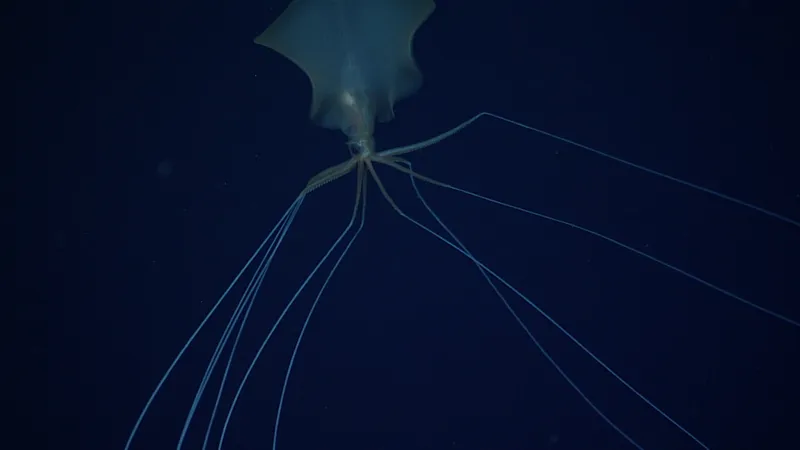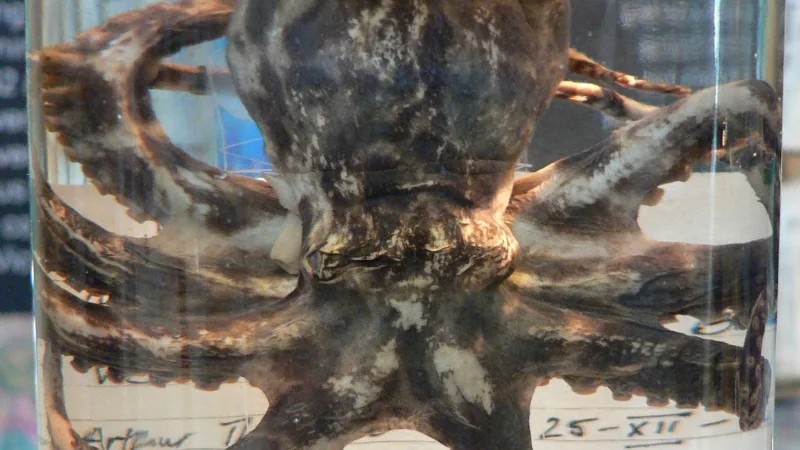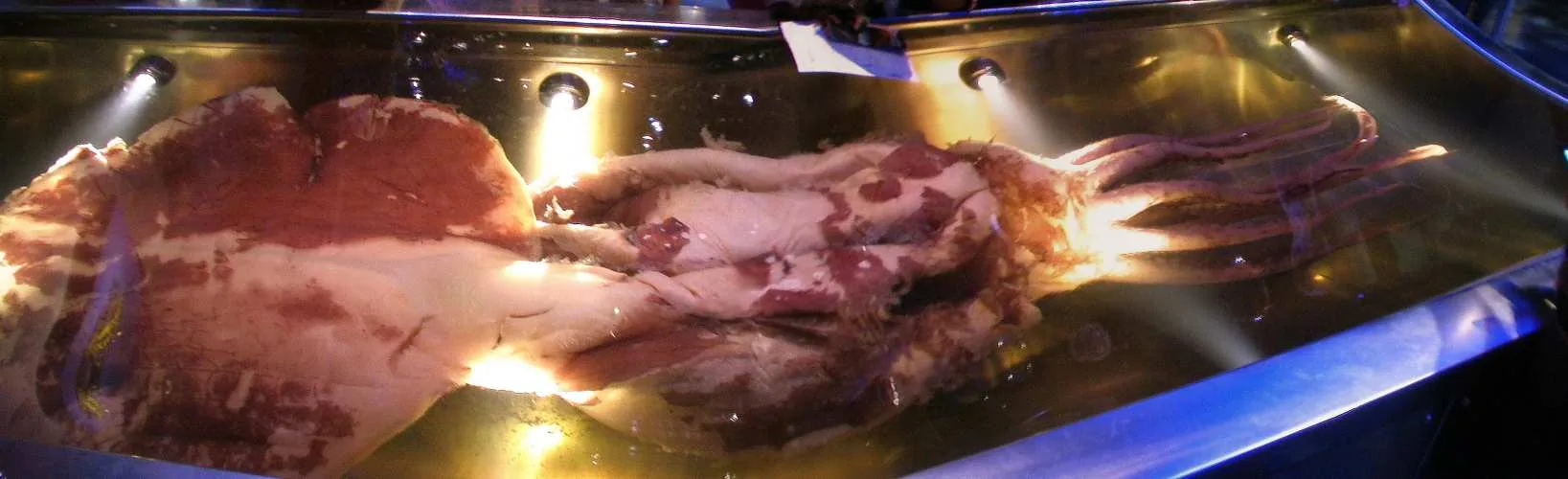
Colossal squid specimen preserved at Museum of New Zealand Te Papa
Field
notes
Measuring a Giant
The colossal squid (Mesonychoteuthis hamiltoni) is the heaviest invertebrate documented, yet by 2015 only 12 complete specimens were known. The best-preserved adult was caught by the New Zealand fishing vessel San Aspiring in the Ross Sea in 2007. Once it had thawed, scientists at Te Papa Museum measured it at 4.2 meters long, with a 2.5-meter mantle (its main body) and a weight of 495 kilograms. Early guesses had put it at eight to 10 meters. A squid caught in 2003 weighed only 300 kilograms yet measured a longer 5.4 meters overall. Te Papa says that suggests colossal squid vary a lot naturally, and that their size also changes a lot depending on how a body is treated after death.
Its lifespan is unknown. The usual way to age a squid is to count growth rings in a hard structure called a statolith, but a 2017 review found the colossal squid material collected so far was not enough to confirm how often those rings form.
A Hook-Armed Ambusher
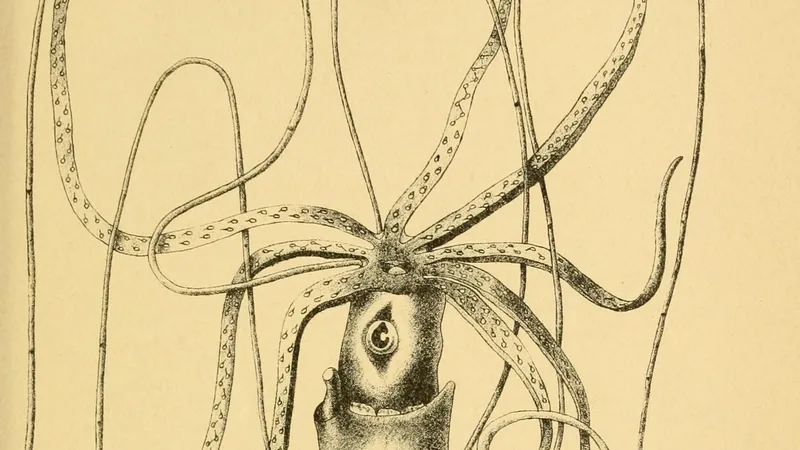
Each of its two long tentacles ends in a club with 22 to 25 hooks that can swivel 360 to 720 degrees to keep the best grip on prey. The hooks on its eight arms do not swivel. They sit in very muscular sheaths, most have a strong main claw plus two smaller points, and they likely help hold struggling prey still while it is eaten.
A Slow Pace of Life A 2010 study of its metabolism estimated that the colossal squid needs only about 0.03 kilograms of prey a day, and argued that it is not a voracious predator capable of high-speed chases. Instead it is an ambush or “sit-and-float” predator that uses the hooks on its arms and tentacles to snare prey that comes near without noticing it.
Eyes Suited to Spotting Whales
A living colossal squid’s eyeballs measure about 27 centimeters across, roughly the size of a soccer ball. Along with the giant squid, it has the largest eyes in the animal kingdom. A 2012 study photographed a giant squid eye of about 27 centimeters and predicted that, below 600 meters deep, an eye like that could detect a sperm whale more than 120 meters away. The study’s theory says eyes this big are unlikely to evolve for spotting mates or prey far off, and are instead uniquely suited to spotting very large predators such as sperm whales.
Predator and Prey
The colossal squid lives only in the Southern Ocean, in a ring around Antarctica. Small juveniles are mainly found between the surface and 500 meters deep, and older juveniles are thought to sink to around 2,000 meters as they grow. Colossal squid beaks turn up often in the stomachs of Patagonian toothfish, a fish it is thought to eat, and captured toothfish carry bites and hook scratches matching the squid’s. A 2017 review says this may suggest each hunts the other. Sperm whales are among its larger predators, yet nitrogen tests, which show where an animal sits in the food chain, place the colossal squid itself among the top predators of the Southern Ocean. It is rated Least Concern on the IUCN Red List.
Published Updated
Traits
Intel
& FAQ
Guess
first
How big is a Colossal Squid, really? Slide, lock in, and see what the sources say. Every answer is a figure from this page, quoted from where it came from.
Sources
- 01Mesonychoteuthis hamiltoni. Animal Diversity Web, University of Michigan.
- 02How big is the colossal squid on display? Museum of New Zealand Te Papa Tongarewa.
- 03The eyes of the colossal squid. Museum of New Zealand Te Papa Tongarewa.
- 04Colossal squid: Hooks and suckers. Te Papa Blog.
- 05McClain et al. (2015). Sizing ocean giants: patterns of intraspecific size variation in marine megafauna. PeerJ.
- 06Rosa et al. (2017). Biology and ecology of the world's largest invertebrate, the colossal squid (Mesonychoteuthis hamiltoni): a short review. Polar Biology.
- 07Rosa & Seibel (2010). Slow pace of life of the Antarctic colossal squid. Journal of the Marine Biological Association of the United Kingdom.
- 08Nilsson et al. (2012). A Unique Advantage for Giant Eyes in Giant Squid. Current Biology.
- 09Barratt & Allcock (2014). Mesonychoteuthis hamiltoni. The IUCN Red List of Threatened Species 2014: e.T163170A980001.
What the sources say: 43 claims checked word for word against these sources →