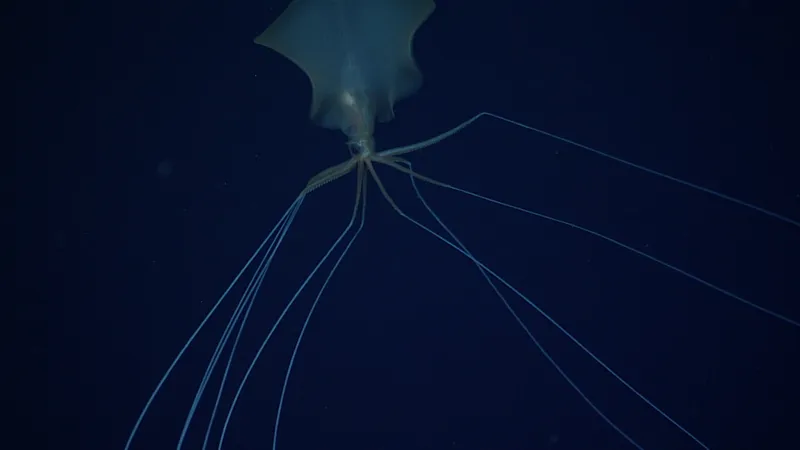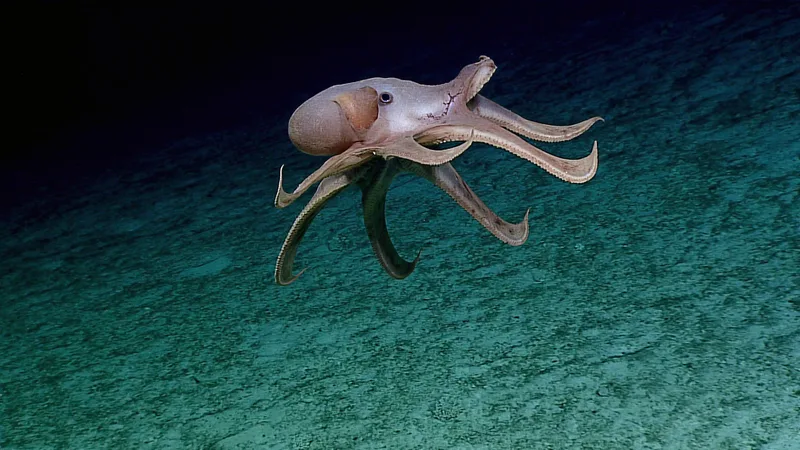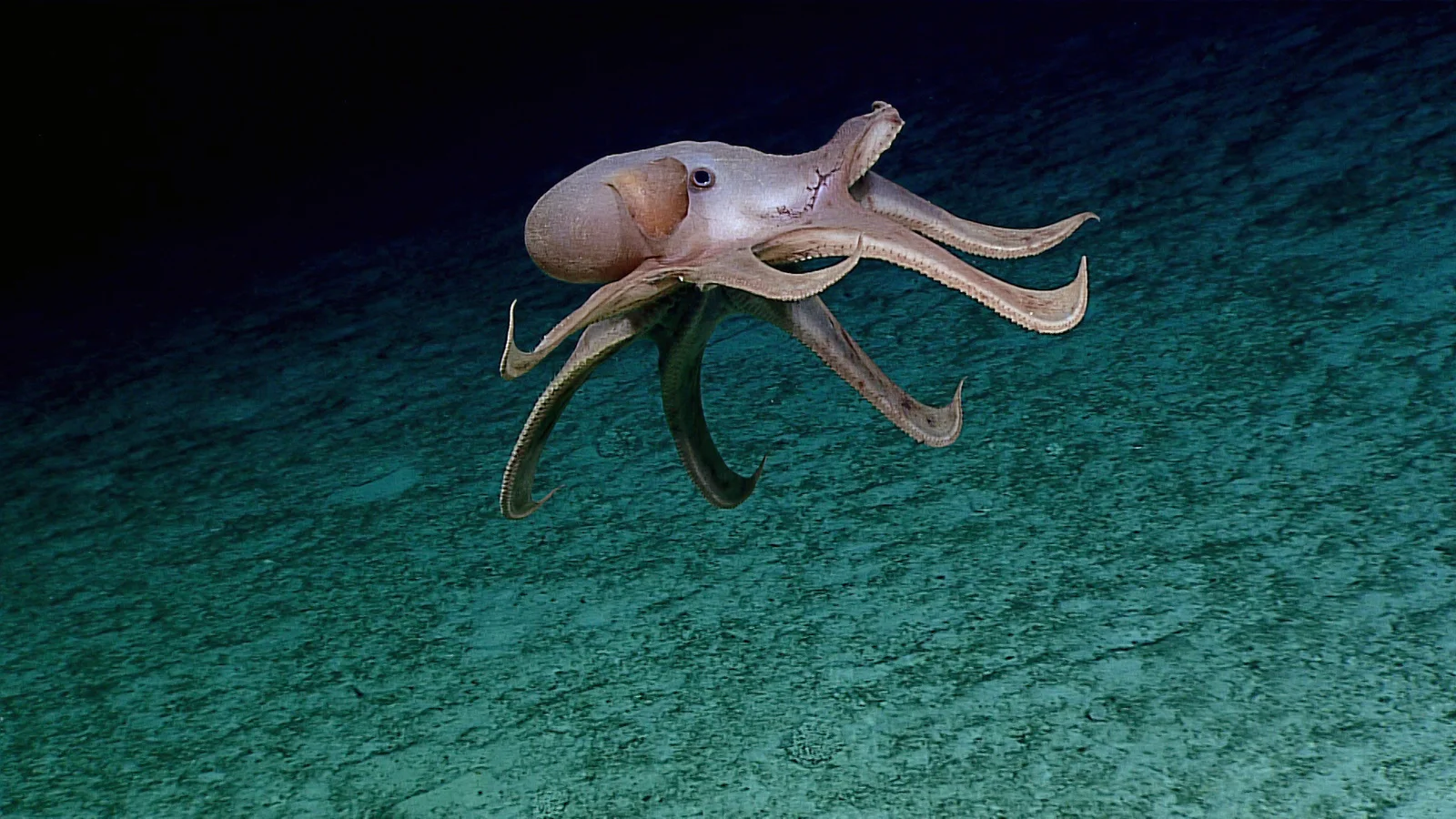
A Grimpoteuthis using the fins either side of its head to swim, filmed by NOAA.
Field
notes
Flying On Its Ears
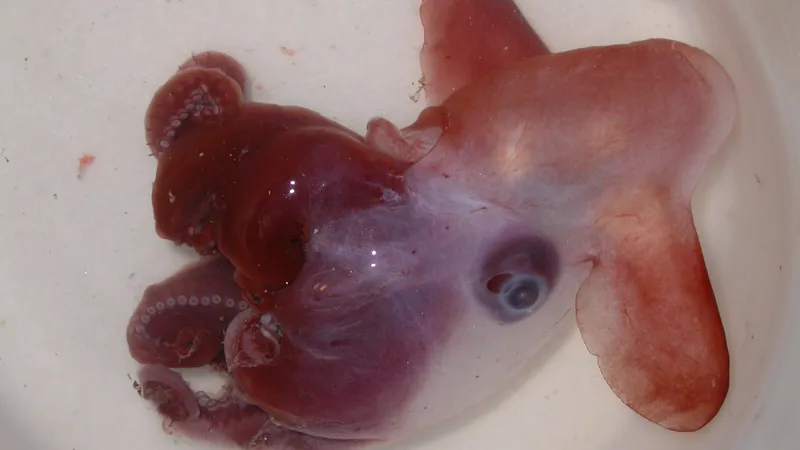
Meet the dumbo octopus, genus Grimpoteuthis: not one species but a whole genus of deep-sea octopuses, named for a pair of ear-like fins that stick out just above their eyes and flap like the cartoon elephant’s, propelling them around the ocean floor. They live on the bottom, or hovering just above it, across the world’s oceans, from about 100 to 7,000 meters (328 to 22,965 feet) down, typically staying in a narrower band between 3,000 and 4,000 meters. Among all known octopuses, they are some of the deepest-living.
Most dumbo octopuses average 20 to 30 centimeters (7.9 to 12 inches) in length. The largest found was far bigger: 1.8 meters (about 6 feet) and 5.9 kilograms (13 pounds). Octopuses typically rely on jet propulsion to move. A dumbo octopus flies instead, flapping those big fins to move with grace and ease. For a sudden thrust, useful for escaping a predator, it expands and contracts the webbing between its arms or shoots water through its funnel.
Swallowed Whole
A dumbo octopus has no proper beak, just an underdeveloped mouth opening, so instead of tearing food apart it pounces on isopods, amphipods, copepods, and bristle worms and swallows them whole. Much of that food drifts by in ocean currents or collects around deep-sea vents.
It also has no ink sac, the defense other octopuses use. Instead, when something threatens it, a dumbo octopus moves quickly to get away, and there are few predators for it in the deep ocean anyway, though it may be vulnerable to sharks, fur seals, fish, and sperm whales.
Blue blood carries oxygen better down here. A dumbo octopus’s blood is blue because of a high copper content, and blood with a high copper content is more efficient at carrying oxygen through the cold, low-oxygen water of the deep sea.
Egg-Laying Without a Season
Dumbo octopuses are solitary, so they have to make the most of any meeting with the opposite sex. Dissected females have shown eggs in various stages of maturation, meaning there is no breeding season: a female can lay eggs continuously under rocks or shells whenever the chance arises. A male delivers a sperm packet with a special bump on one arm, and it is thought the female can use the sperm to fertilize eggs at almost any time.
Known From One Dead Octopus
Dumbo octopuses are rarely seen, and some species are known only from a single recorded observation. In 2021, a study described a new species, Grimpoteuthis imperator, from a dead specimen collected in the North Pacific with a chain bag dredge, at a site in the Emperor Seamounts 3,913 to 4,417 meters deep. Rather than dissect it, the researchers combined MRI and CT scans with DNA barcoding, a minimally invasive approach chosen to avoid potentially harmful effects on the unique specimen. The first living hatchling to be filmed already had everything it needed to swim by flapping its fins and to capture prey. Dumbo octopuses hatch as competent juveniles, able to fend for themselves straight away. A 2020 study reported a Grimpoteuthis filmed by a video lander at 6,957 meters in the Indian Ocean, extending the known maximum depth range for cephalopods by 1,812 meters.
Published Updated
Traits
Intel
& FAQ
Guess
first
How big is a Dumbo Octopus, really? Slide, lock in, and see what the sources say. Every answer is a figure from this page, quoted from where it came from.
Sources
- 01Dumbo Octopus. Oceana, Marine Life Encyclopedia.
- 02Dumbo Octopus: The Whimsical Survivor of the Deep. Bureau of Ocean Energy Management, U.S. Department of the Interior, 2024.
- 03Dumbo Octopus. Aquarium of the Pacific, Online Learning Center.
- 04Ziegler & Sagorny (2021). Holistic description of new deep sea megafauna (Cephalopoda: Cirrata) using a minimally invasive approach. BMC Biology.
- 05Shea et al. (2018). Dumbo octopod hatchling provides insight into early cirrate life cycle. Current Biology.
- 06Jamieson & Vecchione (2020). First in situ observation of Cephalopoda at hadal depths (Octopoda: Opisthoteuthidae: Grimpoteuthis sp.). Marine Biology.
What the sources say: 51 claims checked word for word against these sources →