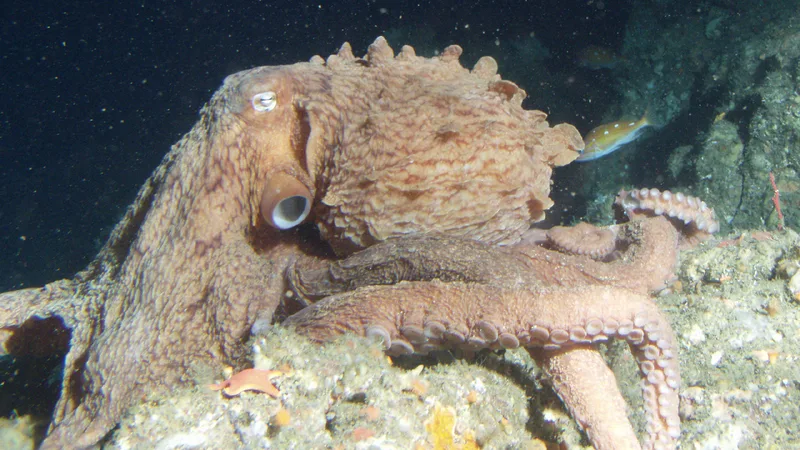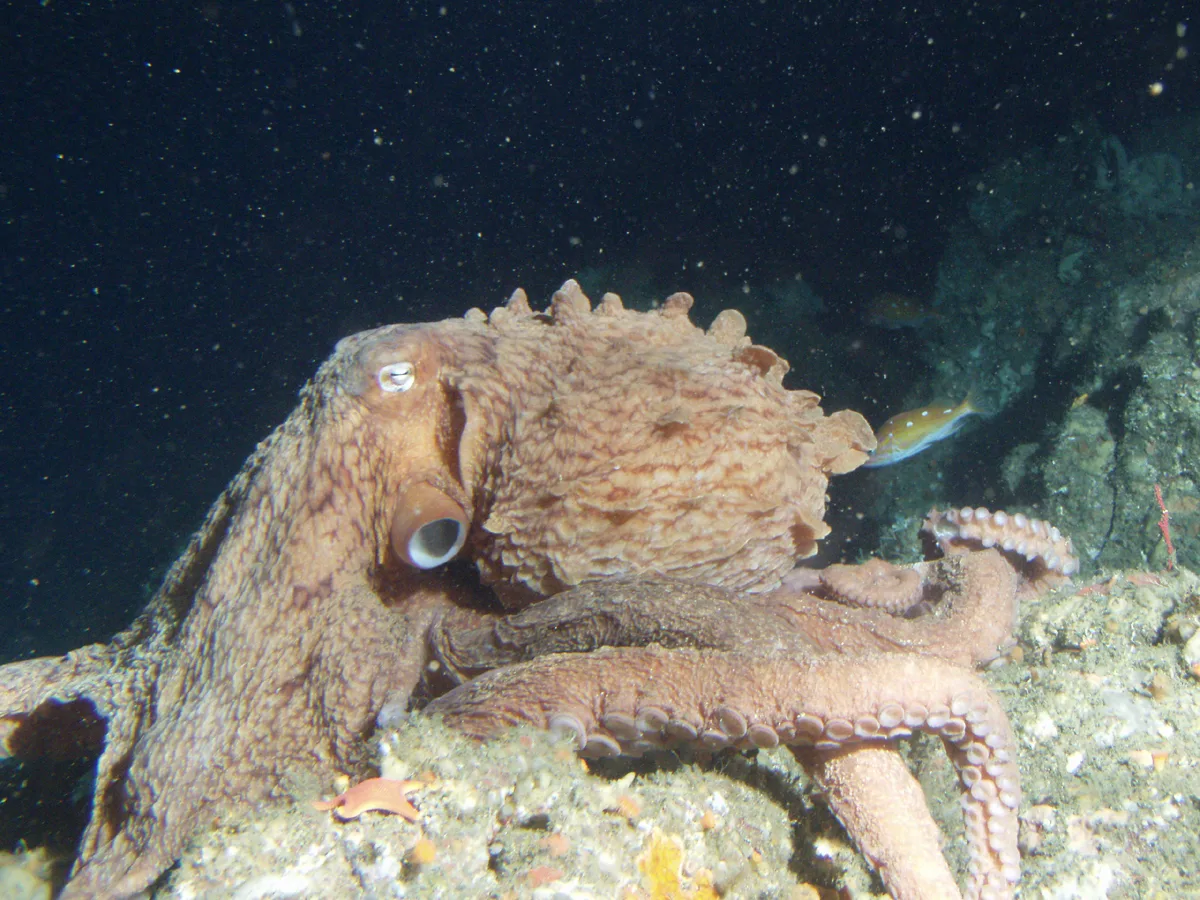
A giant Pacific octopus among boulders 115 metres down in Cordell Bank National Marine Sanctuary, California.
Field
notes
A Giant on a Five-Year Clock
The giant Pacific octopus (Enteroctopus dofleini) is the largest octopus species in the world. It weighs 22 to 110 pounds, averaging 45 to 65, though Canadian researchers once recorded one at 156 pounds, and it reaches that weight in about five years. Its arms can span up to 31 feet across. Its whole life is thought to last just 3 to 5 years.
It ranges through temperate Pacific waters, from southern Baja California north to Alaska, west to the Aleutian Islands and south again to Japan. It is generally found from shallow tide pools down to 110 meters (361 feet), though it has turned up more than 1,500 meters (4,921 feet) down. It spends most of its life alone, often in kelp fields, sheltering in dens and crevices floored with sand, mud or gravel. Shells from its meals pile up outside the den as a midden.
Three Hearts and No Bones
Two of its three hearts pump blood to its gills, and the third pumps it to the rest of the body. That blood is blue, from a copper-rich protein called hemocyanin. It has three brains, too. An adult’s eight arms carry about 2,140 to 2,240 suckers, which give it a powerful grip and a sense of taste and smell.
Its parrot-like beak is the only hard part of its body, and it can squeeze through any hole large enough for that beak: a 50-pound octopus can fit through a two-inch hole. Its suction discs are quite effective, and Alaska’s state wildlife agency notes that octopuses have been able to unscrew jar lids from inside the jar.
Built to Vanish Layered pigment cells called chromatophores let it shift between pale grey and dark red, and it can also change the texture of its skin to blend into its surroundings.
A Short, Strange Life
Its diet is mostly clams, crabs, fish and squid. In one study, it pulled apart mussels and Manila clams, the thinnest-shelled prey on offer, but got into littleneck clams by chipping the shell or drilling through it, presumably to inject a toxin. In another, eight octopuses were each exposed to two unfamiliar people, one who fed them and one who touched them with a bristly stick. After two weeks they showed a different body pattern and reached their arms differently toward each person, and the four larger ones changed how fast they breathed.
Females mate only once in their lives, and males die a few weeks after mating. About 40 days after mating, a female finds a rocky den and lays up to 100,000 eggs in long strands. She guards and cleans them without eating and slowly starves, dying around the time they hatch. Most octopus species go through extreme physical decline after a single breeding bout. In giant Pacific octopuses kept in US public aquariums, researchers found that this decline, called senescence, changes how they respond to light touch and painful stimuli, and that the arm tips of terminally senescent animals had a lower density of nerve and skin cells than those of healthy octopuses that had not yet bred.
The IUCN rates the species Least Concern. Oceana says scientists believe its numbers are stable, but little is known about its overall population size. Its short life and reclusive nature also make it hard to study.
Published Updated
Traits
Intel
& FAQ
Guess
first
How big is a Giant Pacific Octopus, really? Slide, lock in, and see what the sources say. Every answer is a figure from this page, quoted from where it came from.
Sources
- 01Giant Pacific Octopus (Enteroctopus dofleini) Species Profile. Alaska Department of Fish and Game.
- 02Enteroctopus dofleini (giant Pacific octopus). Animal Diversity Web, University of Michigan.
- 03Giant Pacific Octopus. Oceana Marine Life Encyclopedia.
- 04Anderson et al. (2010). Octopuses ( Enteroctopus dofleini ) Recognize Individual Humans. Journal of Applied Animal Welfare Science.
- 05Holst et al. (2022). Behavioral changes in senescent giant Pacific octopus (Enteroctopus dofleini) are associated with peripheral neural degeneration and loss of epithelial tissue. Comparative Biochemistry and Physiology Part A: Molecular & Integrative Physiology.
- 06Anderson & Mather (2007). The packaging problem: Bivalve prey selection and prey entry techniques of the octopus Enteroctopus dofleini. Journal of Comparative Psychology.
- 07Allcock, Taite & Allen (2018). Enteroctopus dofleini. The IUCN Red List of Threatened Species 2018: e.T162958A958049.
What the sources say: 49 claims checked word for word against these sources →