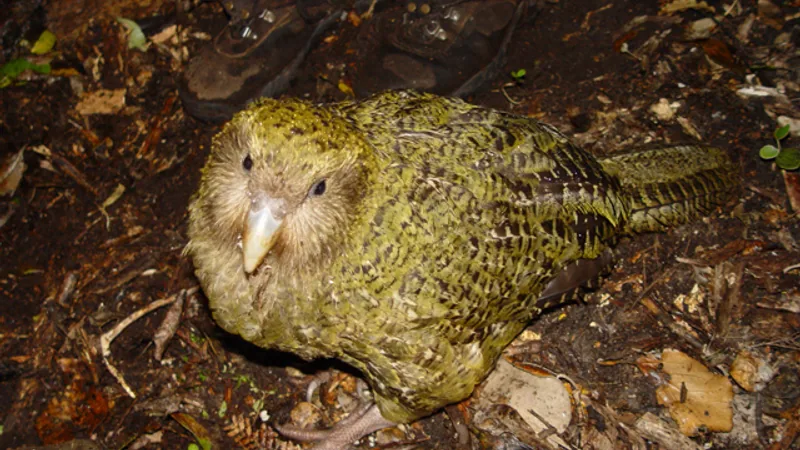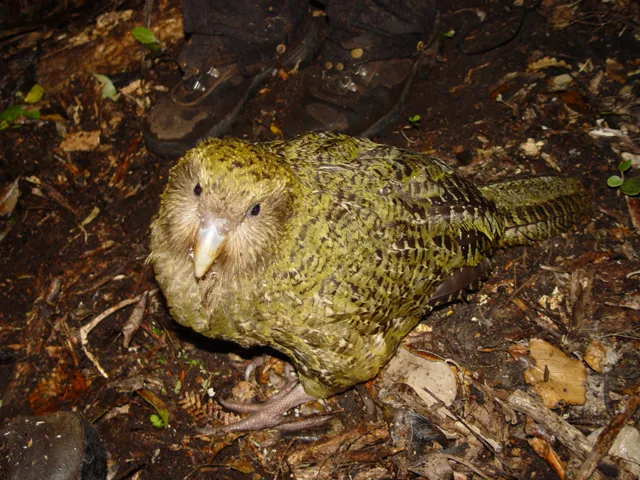
Kakapo Pura on Codfish Island.
Field
notes
The Parrot That Lost Its Flight
The kakapo (Strigops habroptilus) is the heaviest parrot in the world, with the smallest wings relative to its size of any parrot. It is 58 to 64 centimetres long; males weigh 2 to 4 kilograms and females 1 to 2.5. Its breastbone has only a vestigial keel, and its main breast muscles are greatly reduced.
It walks and climbs: lighter females can glide across gaps of 3 to 4 metres, strong claws take it up 20-metre rimu trees, and it can walk several kilometres at a time. It eats only plants and can live for more than 50 years; the maximum is unknown.
Built for the Dark
A kakapo’s eyes probably work well in dim light but see poorly in detail. Its eye sockets face further forward than other parrots’, suggesting more overlap between its two eyes’ views. Its eye shape fits nocturnal birds such as owls and nightjars but also falls within the range of daytime parrots, and some of its brain’s sight regions are relatively smaller than other parrots’.
Its sense of smell is believed to be well developed. Measured against its brain’s length, its smell-processing olfactory bulb is larger than in most non-passerine birds, parrots included, and comparable to a brown kiwi’s or a turkey vulture’s, two birds with a keen sense of smell. Whisker-like feathers near its eyes and beak, called rictal bristles, may help it avoid injury in the dark, much like a cat’s whiskers, and the lower ones touch the ground as it walks.
A Boom From an Inflated Chest During booming, a male kakapo inflates the air sac in his chest and gives a deep call below 100 hertz. It can be heard hundreds of metres away, and in ideal conditions up to 5 kilometres.
Breeding in Good Fruit Years
Kakapo are the only parrot species known to breed at a lek, where males display at fixed spots to attract females. In breeding years, each male forms a shallow bowl in the earth on a ridge, rock or hilltop and calls there for up to eight hours a night, every night for two or three months. Females can travel long distances to mate with the male or males they prefer, then raise the chicks alone.
On islands in southern New Zealand they breed when the rimu trees fruit, once every two to four years. Researchers found that 61% of kakapo eggs fail to hatch, and 73% of those show no sign of development. Undeveloped eggs were once blamed on male infertility, but 72% of the ones tested had been fertilised, so early embryo death, not infertility, drives the low hatching rate.
A Smell That Gave Them Away
Kakapo evolved without mammals. Freezing and relying on camouflage worked when the main predators were birds that hunted by sight, such as the now-extinct Haast’s eagle. It is completely ineffective against mammals that hunt by smell, like introduced cats and stoats, and a kakapo has a strong body odour.
Before humans arrived, kakapo were common throughout New Zealand’s forests, until introduced predators brought them down to 51 birds in 1995. Moving the whole population to predator-free islands and managing every stage of life has brought a steady increase: there were 248 kakapo in July 2023, when four males moved to a fenced mainland sanctuary, the first on the mainland in nearly four decades. It is still Critically Endangered.
Published Updated
Traits
Intel
& FAQ
Guess
first
How big is a Kakapo (Owl Parrot), really? Slide, lock in, and see what the sources say. Every answer is a figure from this page, quoted from where it came from.
Sources
- 01Kākāpō | Kakapo. New Zealand Birds Online.
- 02Kākāpō behaviour. New Zealand Department of Conservation.
- 03Kākāpō return to mainland in historic translocation. New Zealand Department of Conservation, 2023.
- 04Kākāpō habitat and islands. New Zealand Department of Conservation.
- 05Powlesland, Merton & Cockrem (2006). A parrot apart: the natural history of the kakapo (Strigops habroptilus), and the context of its conservation management. Notornis.
- 06Corfield et al. (2011). Anatomical Specializations for Nocturnality in a Critically Endangered Parrot, the Kakapo (Strigops habroptilus). PLoS ONE.
- 07Livezey (1992). Morphological corollaries and ecological implications of flightlessness in the kakapo (Psittaciformes: Strigops habroptilus). Journal of Morphology.
- 08Savage et al. (2021). Low hatching success in the critically endangered kākāpō is driven by early embryo mortality not infertility. Animal Conservation.
- 09Strigops habroptila. The IUCN Red List of Threatened Species 2018: e.T22685245A129751169.
What the sources say: 66 claims checked word for word against these sources →