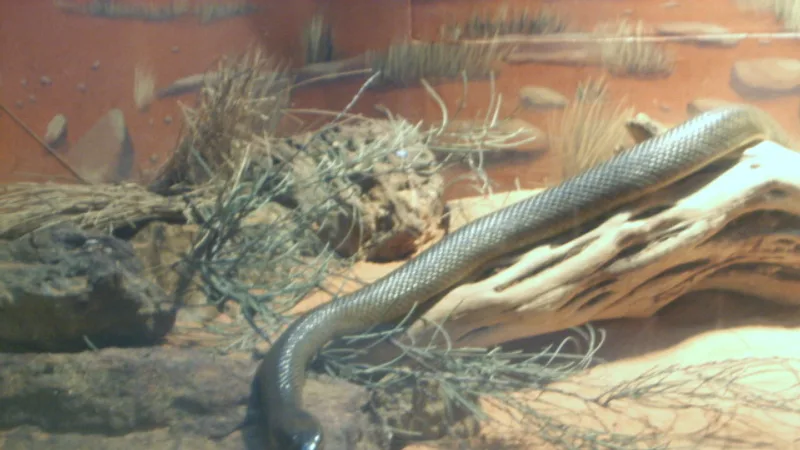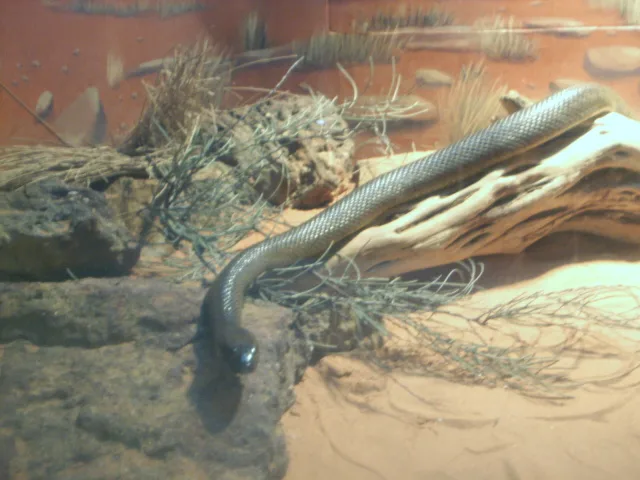
An inland taipan near Birdsville, Queensland.
Field
notes
Top of the Toxicity Tests
The venom of the inland taipan (Oxyuranus microlepidotus) is rated the most toxic of any snake’s in LD50 tests on mice. LD50 is the standard lab measure of how little venom it takes to kill half a group of test mice: the smaller the number, the more toxic the venom. Billabong Sanctuary, a Queensland wildlife park, gives the inland taipan’s LD50 as 0.025 milligrams per kilogram. One of its toxins is paradoxin, a presynaptic neurotoxin, meaning it acts on the nerve ending: it stops the nerve releasing the chemical signal that makes a muscle contract. Researchers who tested it in 2007 wrote that it appears to be one of the most potent toxins of its kind yet discovered, if not the most potent.
Life in the Channel Country
Inland taipans average around 2 metres in total length, and the largest on record reached 250 centimetres. Sydney Zoo gives their weight as 1.5 to 3 kilograms and their lifespan as 12 to 20 years, and one at Australia Zoo lived past 20. The species lives on the deep cracking-clay floodplains of the Channel Country, in south-west Queensland and north-east South Australia, and ventures onto nearby stony gibber plains and dunes where there is cover. It shelters in soil cracks, holes and mammal burrows.
Cornering Rats in Their Burrows
In the wild the inland taipan appears to feed entirely on small to medium-sized mammals, particularly the long-haired rat, along with house mice and small carnivorous marsupials such as the kultarr. It usually corners prey in a burrow or soil crack before biting several times in quick succession; the venom acts so rapidly that the snake can afford to hold on instead of releasing its prey and waiting for it to die. In lab tests on chick muscle, inland taipan venom stopped nerve-driven twitches faster than coastal or Papuan taipan venom, mainly by blocking the muscle’s own receptors for the nerve’s signal. In test tubes the venom also activates prothrombin, a blood-clotting protein, without the helper molecules some other Australian snake venoms need, and a “spreading factor” enzyme speeds up how fast the venom is absorbed. In years when plague rats are plentiful the snakes grow quite fat; when the rats are scarce, they lose weight or switch to other prey.
Its bite carries enough venom, by one calculation, to kill more than 100 average-sized men, yet no one it is known to have bitten has died.
Rarely Seen, Rarely Aggressive
Despite that venom, the inland taipan is shy. Provoked, it raises the front of its body into a low S-shaped curve as a warning display, and will strike if the warning is ignored; many reptile keepers regard it as a placid snake to handle. Its colour darkens in winter and fades in summer, presumably helping it warm up quickly in the cold and avoid overheating in the heat. A 2004 Queensland government newsletter put the inland taipan’s venom at almost four times as toxic as the coastal taipan’s, yet placed the coastal taipan at the top of Australia’s most dangerous snakes, because the inland taipan lives in a sparsely populated area, is shy and lacks long fangs.
Published Updated
Traits
Intel
& FAQ
Guess
first
How big is a Inland Taipan, really? Slide, lock in, and see what the sources say. Every answer is a figure from this page, quoted from where it came from.
Sources
- 01Inland Taipan, Oxyuranus microlepidotus. Australian Museum.
- 02Inland Taipan. Sydney Zoo.
- 03Inland Taipan. Billabong Sanctuary.
- 04Martin, Stella (ed.) (2004). Very venomous but ... not necessarily deadly (Tropical Topics, No. 80). Queensland Environmental Protection Agency.
- 05Hodgson, Dal Belo & Rowan (2007). The neuromuscular activity of paradoxin: A presynaptic neurotoxin from the venom of the inland taipan (Oxyuranus microlepidotus). Neuropharmacology.
- 06Crachi, Hammer & Hodgson (1999). The effects of antivenom on the in vitro neurotoxicity of venoms from the taipans Oxyuranus scutellatus, Oxyuranus microlepidotus and Oxyuranus scutellatus canni. Toxicon.
- 07Chester & Crawford (1982). In vitro coagulant properties of venoms from Australian snakes. Toxicon.
- 08Wilson et al. (2018). Oxyuranus microlepidotus. The IUCN Red List of Threatened Species 2018: e.T42493150A42493160.
What the sources say: 46 claims checked word for word against these sources →