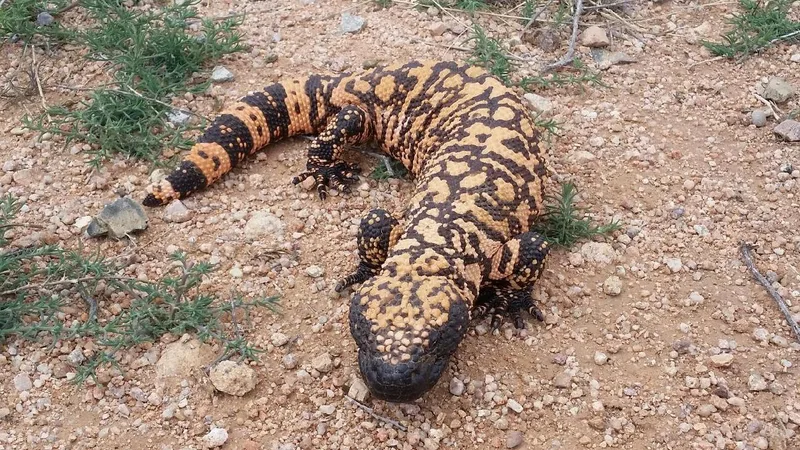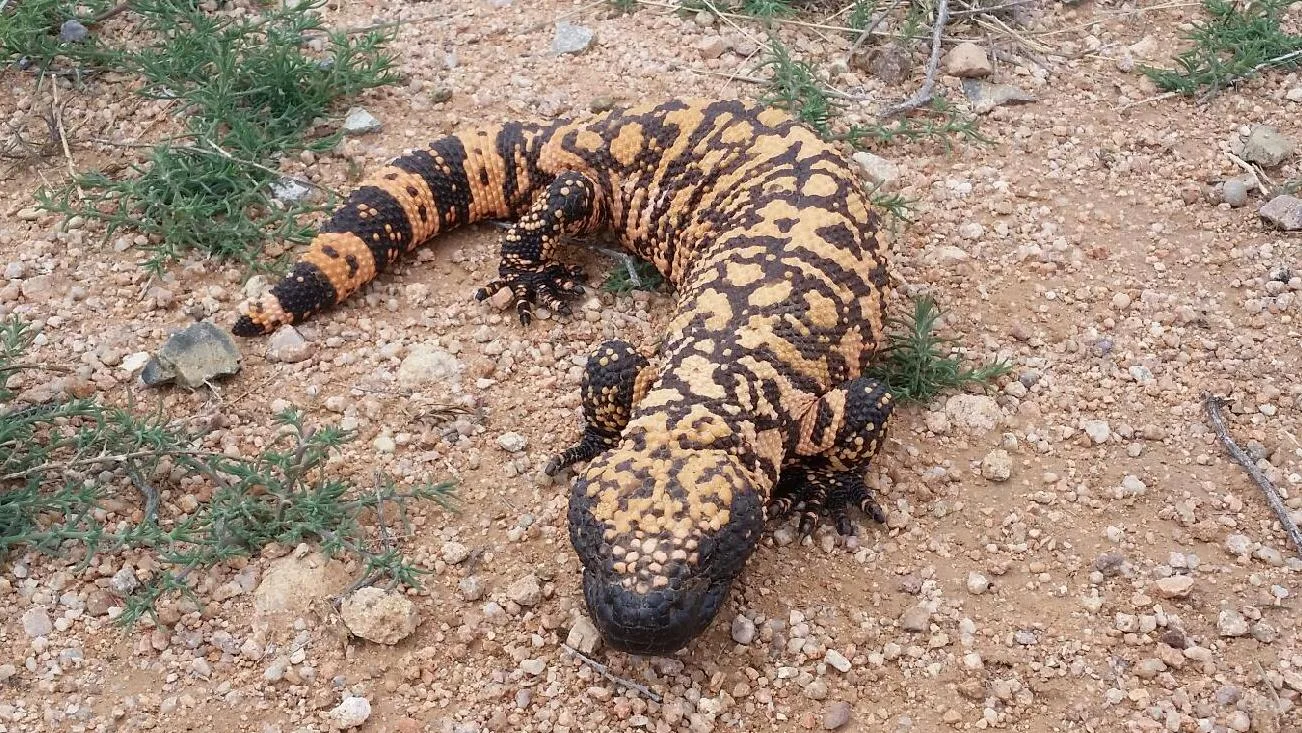
Gila monster found in southeastern Arizona
Field
notes
Heavy Body, Beaded Armor
The Gila monster (Heloderma suspectum) is the largest lizard native to the United States, reaching up to about 22 inches (56 centimeters) long and weighing as much as 3 pounds (1.4 kilograms). It lives mainly in Arizona and Mexico, and its range reaches into the edges of California, Nevada, Utah and New Mexico. It can live up to 20 years in the wild and more than 30 in expert care.
Bead-like scales called osteoderms cover its whole body except the belly. The beads get their texture from tiny nodules of bone inside the skin, and the pattern is different on every Gila monster. It is black, with pink or orange markings along its back. In the northern subspecies those markings usually form unbroken bands. In the southern subspecies they break up into a net-like pattern.
A Bite That Chews
Venomous snakes inject venom through hollow fangs. A Gila monster chews it in. Glands in its lower jaw make the venom, which mixes with saliva and is pulled into the wound along grooved teeth by capillary action. For a person, a bite is painful but rarely deadly, though the venom can cause shock, a rapid drop in blood pressure.
A Grip That Hangs On A Gila monster can bite quickly and hold on stubbornly, sometimes keeping hold of a predator for more than ten minutes. The longer it hangs on and chews, the more venom gets into the wound.
Slow Hunter, Big Meals
A Gila monster’s top speed is only 1.5 miles per hour (2.4 km/h), so it has to sneak up on prey and bite before it gets away. It raids nests for eggs and nestling birds, and eats newborn or young rabbits, young packrats and other rodents still in the nest, along with lizards and, occasionally, small snakes. It can eat up to a third of its own body weight in one meal and store fat in its tail and body. That, plus a slow metabolism, means it doesn’t need to search for food often, so it spends most of its life hidden underground, sheltered from hot, dry desert conditions. It may get all the calories it needs for a year from three or four large meals.
Lizard Spit and Diabetes Medicine
A drug for type 2 diabetes is based on a protein from Gila monster saliva. People sometimes call the drug lizard spit. The venom contains exendin-4, a peptide (a short chain of amino acids) that mimics a gut hormone called GLP-1, which increases insulin secretion. GLP-1 breaks down fast in the body, but exendin-4 is far more stable, so scientists built a synthetic copy and sold it as the diabetes drug Byetta starting in 2005.
Gila monsters became the first venomous wildlife in North America to get legal protection, back in 1952. Today every US state where they live protects them by law, and so does Mexico. People are their main threat, through habitat loss to development, illegal poaching and roadkill. The IUCN last assessed the species in 2007, as Near Threatened.
Published Updated
Traits
Intel
& FAQ
Guess
first
How big is a Gila Monster, really? Slide, lock in, and see what the sources say. Every answer is a figure from this page, quoted from where it came from.
Sources
- 01Gila monster. Smithsonian's National Zoo and Conservation Biology Institute.
- 02Gila Monster. San Diego Zoo Wildlife Alliance.
- 03Gila Monster. Saguaro National Park, National Park Service.
- 04Furman (2012). The development of Byetta (exenatide) from the venom of the Gila monster as an anti-diabetic agent. Toxicon.
- 05Hammerson, Frost & Gadsden (2007). Heloderma suspectum. The IUCN Red List of Threatened Species 2007: e.T9865A13022716.
What the sources say: 51 claims checked word for word against these sources →