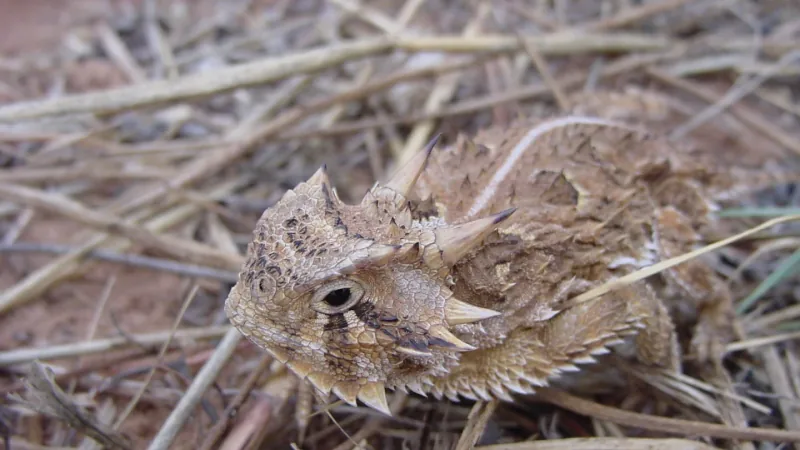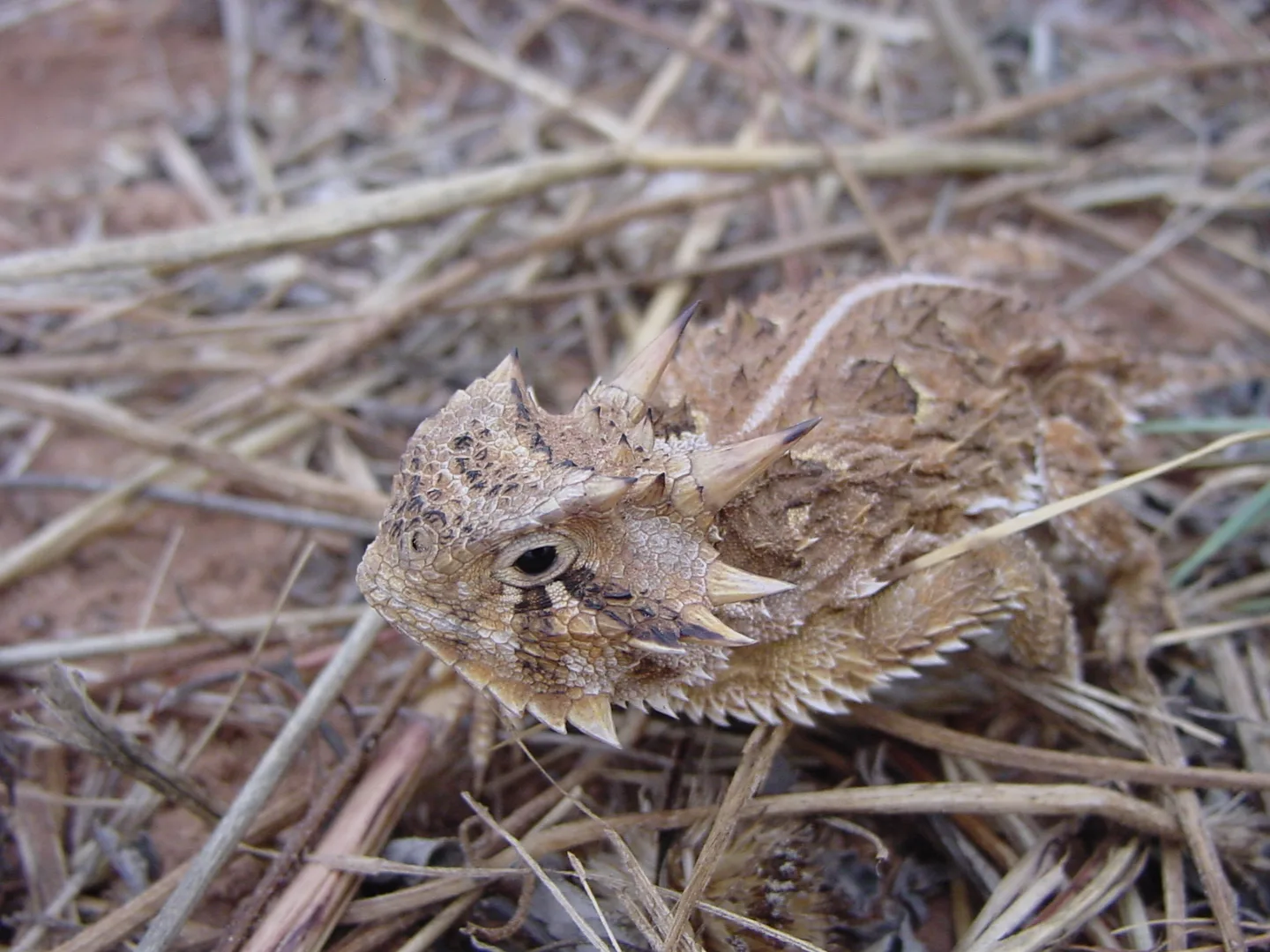
A Texas horned lizard.
Field
notes
The Desert Tank That Shoots Blood From Its Eyes
The Texas horned lizard (Phrynosoma cornutum) is a round-bodied, spike-crowned lizard of the arid prairies, dunes and deserts running from southeastern Colorado and southwestern Missouri down through Oklahoma and Texas into northern Mexico. It is small: a lizard is sexually mature once it measures at least 69 millimeters (2.7 inches) from snout to vent, females grow larger than males, and body mass runs between 25 and 90 grams (0.9 to 3.2 ounces). Two brow horns crown its head, more spikes run along its jaw, and two rows of spines line its flanks, and it can inflate itself with air so the spikes stand out, making it harder for a predator to eat. When spikes are not enough, it has a stranger option.
Blood Cannons Behind the Eyes
If a threat keeps coming, the lizard hisses and lunges, and it can also raise the blood pressure inside its sinus orbitalis, a sinus in the eye socket, until a blood vessel ruptures and a passage opens into the conjunctival sac, so blood sprays out at the predator. One individual studied by Burleson in 1942 squirted blood from its left eye across nearly a meter.
Not a Wound, a Weapon The lizard builds the pressure itself until the vessel gives way, then sprays the blood at predators.
Ants for Breakfast, Horns for Backup
Its diet is mainly harvester ants. When Pianka and Parker opened the stomachs of 351 of these lizards, 69.0% of the prey items were ants. A single lizard can take from about 30 to more than 100 ants a day, waiting at a colony entrance, tilting its head sideways and down, and lapping them up with a sticky tongue. Its horns are thought to be a defense: they have been found puncturing the throats of canids (the dog family), rattlesnakes, whipsnakes, falcons and hawks that preyed on it. The greater roadrunner is the listed exception: it crushes the lizard’s skeleton against a rock, then eats it head first.
Skin With Built-In Plumbing
Its skin also collects water from sources such as moist sand and dew. A honeycomb-shaped microstructure on its scales makes the skin superhydrophilic, so a droplet spreads almost instantly and soaks into a network of capillary channels running between the scales. In the Texas horned lizard those channels are wired to favor one direction: in lab tests, water moving toward the mouth flowed at about 3.15 millimeters a second, against roughly 1.6 to 1.8 millimeters a second sideways or toward the tail. No muscles or pumping are involved, just channels that narrow and widen along the way, so the lizard effectively carries its own plumbing.
The IUCN Red List rates the Texas horned lizard Least Concern. Within Texas, though, urban growth over its habitat, collection as pets and pesticides reducing the harvester ants it eats have all contributed to its decline, and it has declined throughout central Oklahoma and Texas since the 1960s.
Published Updated
Traits
Intel
& FAQ
Guess
first
How big is a Texas Horned Lizard, really? Slide, lock in, and see what the sources say. Every answer is a figure from this page, quoted from where it came from.
Sources
- 01Phrynosoma cornutum (Texas horned lizard). Animal Diversity Web, University of Michigan.
- 02Hammerson (2007). Phrynosoma cornutum. The IUCN Red List of Threatened Species 2007: e.T64072A12741535.
- 03Comanns et al. (2011). Moisture harvesting and water transport through specialized micro-structures on the integument of lizards. Beilstein Journal of Nanotechnology.
- 04Comanns et al. (2015). Directional, passive liquid transport: the Texas horned lizard as a model for a biomimetic 'liquid diode'. Journal of The Royal Society Interface.
- 05Sherbrooke & Kimball (2024). Antipredator Blood-Squirting Defense in Horned Lizards (Phrynosoma): Chemical Isolation of Plasma Component(s), Pogonomyrmex Ant Dietary Origin, and Evolution. Ichthyology & Herpetology.
- 06Lara-Reséndiz et al. (2015). Thermoregulation of two sympatric species of horned lizards in the Chihuahuan Desert and their local extinction risk. Journal of Thermal Biology.
What the sources say: 47 claims checked word for word against these sources →