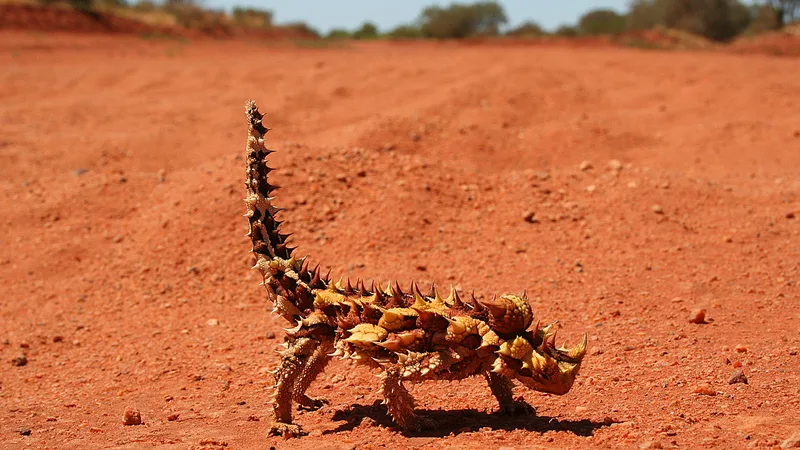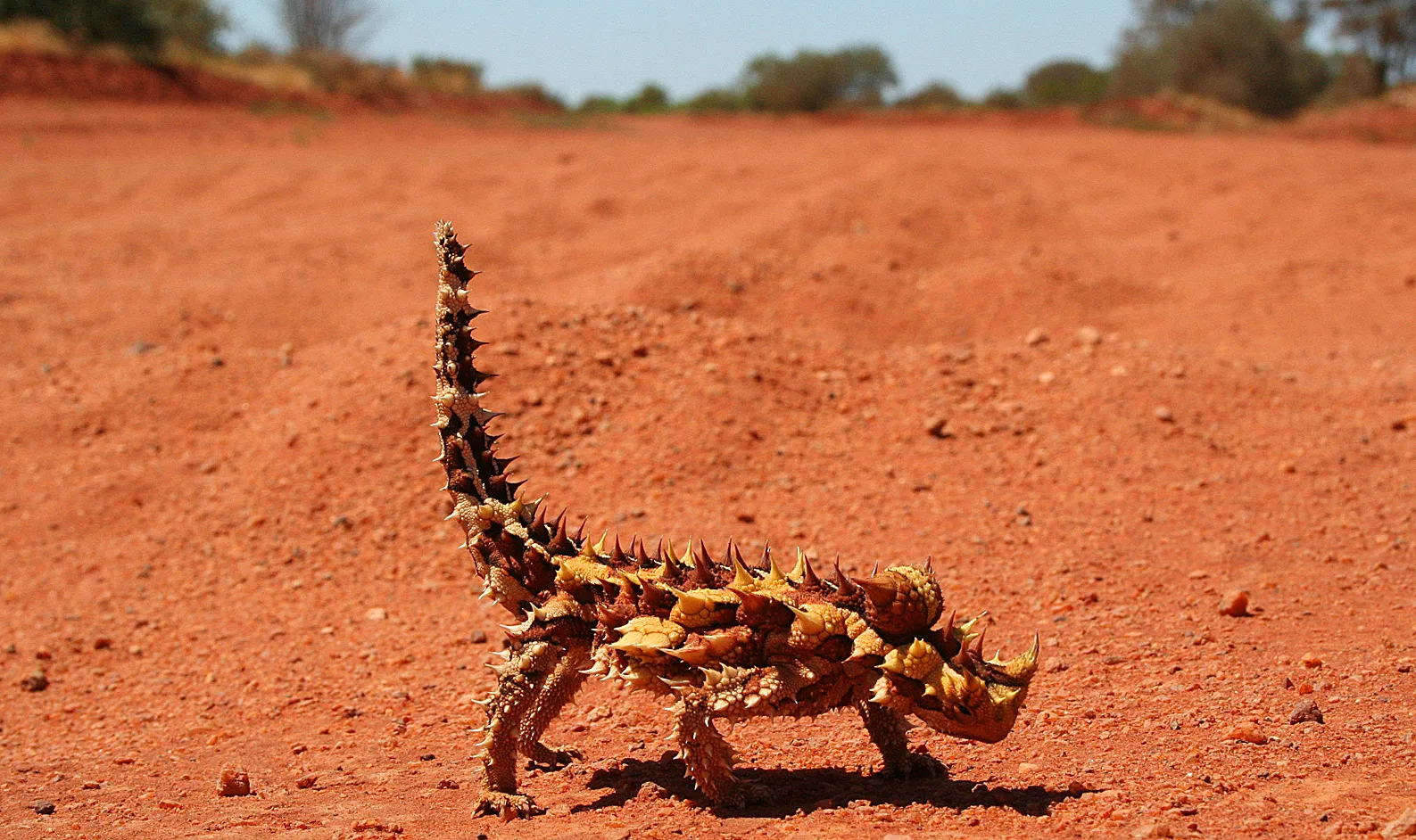
Thorny devil at Great Central Road, Western Australia
Field
notes
A Lizard Built Like a Pinecone
The thorny devil (Moloch horridus) is a small, thorn-covered lizard of the Australian deserts, growing up to about 20 centimetres long. Females are larger than males, averaging 45.5 grams and reaching as much as 88.7 grams, while males average 31.2 grams. In the wild it can live up to 20 years. It ranges across large parts of Western Australia, the southern Northern Territory, South Australia and western Queensland, in sand country, spinifex grasslands and mulga scrub.
A Sit-and-Wait Ant Eater
A thorny devil eats only ants, mainly two groups, Iridomyrmex and Crematogaster. It finds a feeding site that has cover and waits for ants to pass along their trails, lapping them up with its short, sticky tongue. In a 2005 study its prey capture stood out, with no body lunge, a faster tongue, less handling of each ant and control over the slow opening of its jaws. Together these made a single feeding event faster than in any other iguanian lizard, its own lizard group, studied to that date.
Skin That Carries Water
Its scales carry a honeycomb-like micro-texture that lets it collect moisture over its entire body surface, and a complex system of capillary channels runs between them, moving water along passively, with no effort from the lizard. A droplet set on the skin of a live thorny devil spread evenly outward over more than 9.2 millimetres within about ten seconds, moving through roughly 1,600 channels. The channels are built in levels: a wide main channel between the scales, divided by protrusions into smaller channels that stretch the water’s travel distance by about 39 percent.
Water that climbs its legs The grooves around its spines link up, letting water move along its body by capillary action, even against gravity as on the legs. They continue onto the head and empty into the corners of its mouth for drinking.
Filling that whole system takes a volume of water equal to about 3.19 percent of the lizard’s body mass, and standing in water it can then drink from that skin-held water at roughly 0.7 microlitres per jaw movement. Condensation from warm, moist air onto a cool thorny devil provided water equal to about 0.22 percent of its body weight, which was not enough for drinking, and standing on nearly saturated moist sand could only fill the channels to 59 percent of capacity, with no drinking recorded. The researchers suggest that rain and moist sand seem to be its likely regular water sources.
A Fake Head and Boneless Spikes
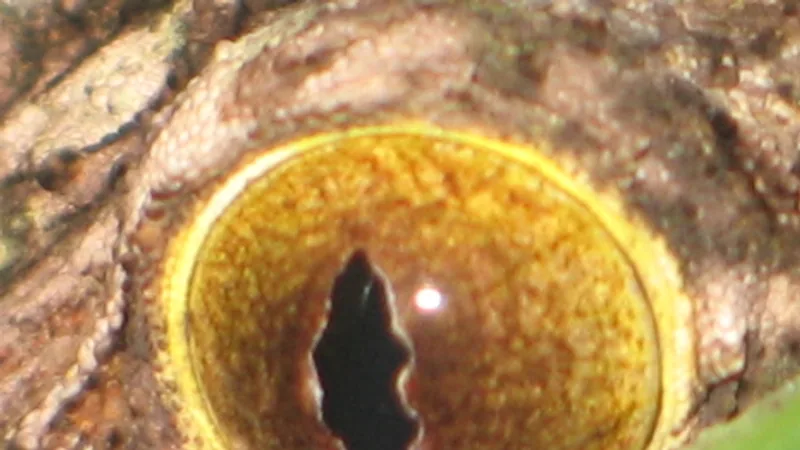
Golden and brown patches camouflage a thorny devil so well that it can escape detection even at close quarters, and it can change colour to blend into its surroundings. Its large spines are entirely boneless; only two, on the skull, sit on small bony bumps. Its slow, rocking walk might confuse predators that spot it in the open. If a predator such as a goanna, an Australian bustard or a black-breasted buzzard closes in, the thorny devil tucks its real head down between its front legs and presents a spiny false head on the back of its neck instead, making it difficult for anything to swallow it. When threatened, it can also puff itself up with air, making it harder to handle.
Published Updated
Traits
Intel
& FAQ
Guess
first
How big is a Thorny Devil, really? Slide, lock in, and see what the sources say. Every answer is a figure from this page, quoted from where it came from.
Sources
- 01Moloch horridus (thorny devil). Animal Diversity Web, University of Michigan.
- 02Thorny Devils. Bush Heritage Australia.
- 03Comanns et al. (2017). Adsorption and movement of water by skin of the Australian thorny devil (Agamidae: Moloch horridus). Royal Society Open Science.
- 04Comanns et al. (2011). Moisture harvesting and water transport through specialized micro-structures on the integument of lizards. Beilstein Journal of Nanotechnology.
- 05Comanns et al. (2016). Cutaneous water collection by a moisture-harvesting lizard, the thorny devil (Moloch horridus). Journal of Experimental Biology.
- 06Meyers & Herrel (2005). Prey capture kinematics of ant-eating lizards. Journal of Experimental Biology.
- 07Doughty et al. (2017). Moloch horridus. The IUCN Red List of Threatened Species 2017: e.T83492011A83492039.
What the sources say: 57 claims checked word for word against these sources →