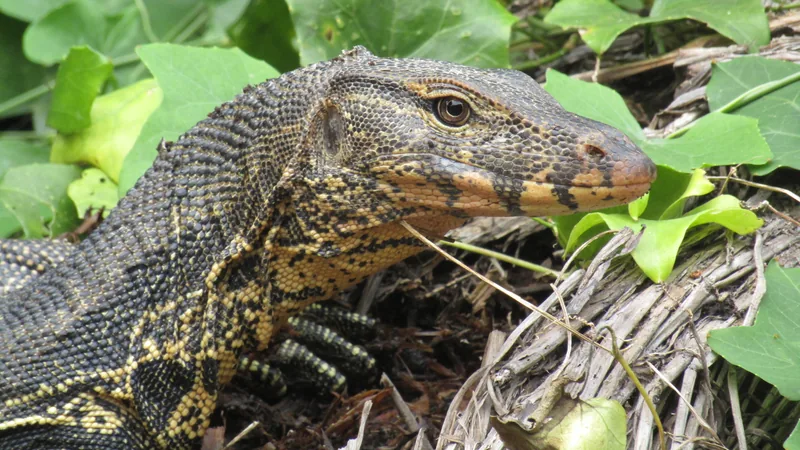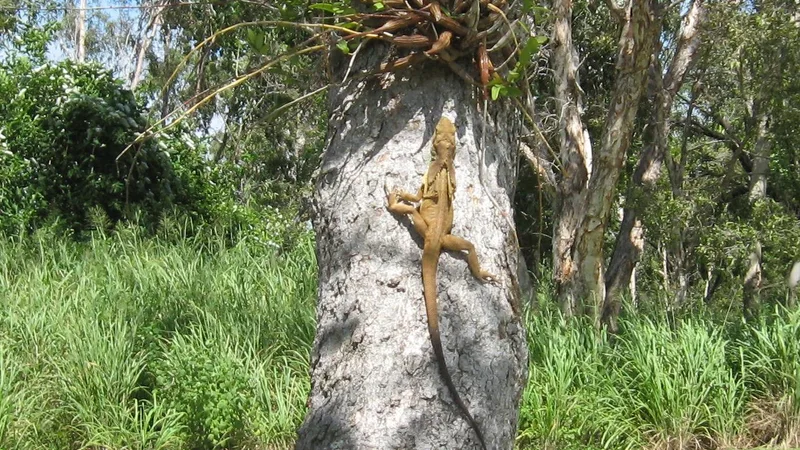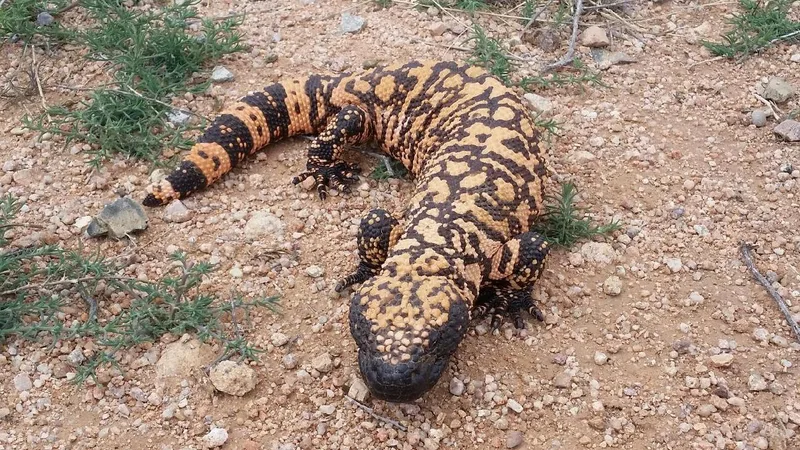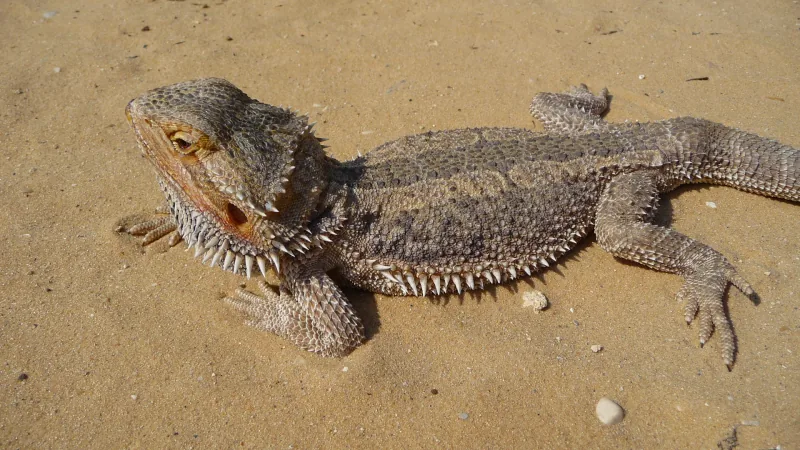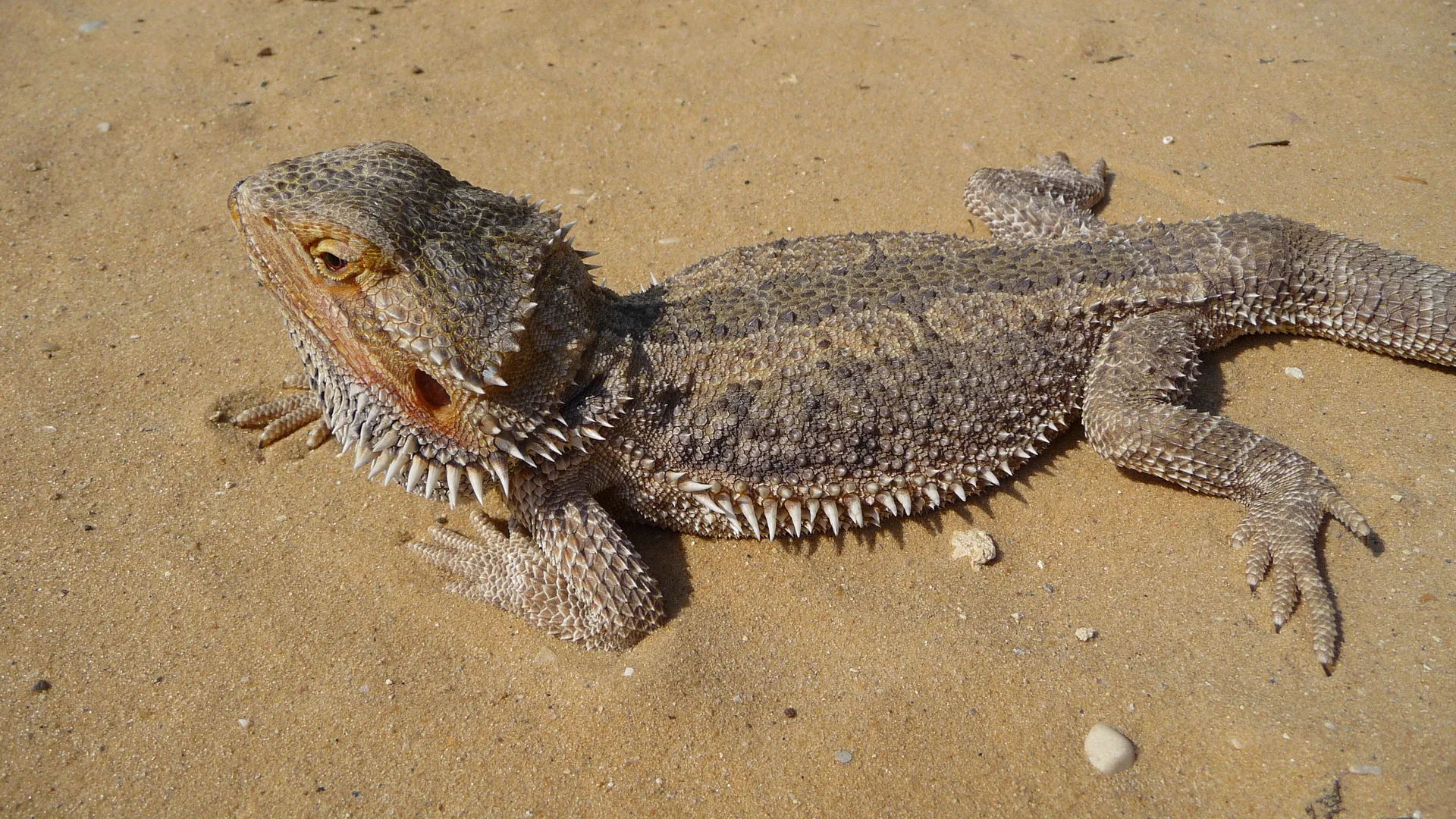
A central bearded dragon with its beard flared and mouth gaping, Parachilna, South Australia.
Field
notes
When Heat Beats Genetics
A central bearded dragon’s sex is normally set by its chromosomes: two Z chromosomes make a male, and a Z paired with a W makes a female. In 2005, researchers first identified these tiny W and Z chromosomes in this species, the first such micro sex chromosomes shown in any agamid, the dragon lizard family. Heat can overrule that code: high-temperature egg incubation turns genetically male (ZZ) individuals into functional females. In 2015, scientists made the first report of a reptile’s sex reversing in the wild, in this species. They then mated sex-reversed females with normal males. The offspring’s sex was set solely by temperature, and the W chromosome was eliminated from this family line in the first generation.
Outback Life, By the Numbers
Adults average 288 grams, grow 33 to 61 centimetres from nose to tail, and may live 10 to 15 years. They are found in arid and semi-arid habitats across the interior of Queensland, New South Wales, Victoria, South Australia and the Northern Territory, from eucalypt woodland and acacia scrub to sandridge desert. They perch on fallen timber, fence posts and large rocks. When scientists flushed the stomachs of 14 wild dragons, 61 percent of the food by dry weight was animal matter. Most of it was winged termites: one kind made up 95 percent of the prey items and more than half of the total. Plants made up 16 percent.
More Bluff Than Bite
The “beard” sits under the lower jaw. Long scales around the back of the jaw and along the sides look very spiky, but they are actually quite rubbery. The Australian Museum says the dragon relies on more bluff than bite, trying to look larger and spikier than it really is to predators. When alarmed, it faces the intruder with its mouth wide open and its beard puffed out, and sucks in air fast to swell its body so it seems bigger. Under direct attack, it shows the yellow lining of its mouth, darkens its skin, flattens its body, hisses and makes small jumps at the attacker. Its colour can change fast: one dragon went from mostly yellow to almost completely black in no more than a few minutes.
Usually solitary, dragons gather at the best basking spots, where a clear pecking order shows. A male signals dominance with a fast head bob and an inflated, blackened beard. Waving a front leg signals submission, which generally calms the clash. If one won’t back down, the two circle each other, and a stand-off or fight follows.
Sleep Waves in a Lizard’s Brain
Scientists thought the brain-wave patterns of sleep, such as slow-wave and REM (rapid eye movement) sleep, were restricted to mammals and birds. Recordings from a dragon’s brain found both. That pushes their probable origin back at least to the first amniotes, the group that includes reptiles, birds and mammals.
A Sleep Rhythm of About 80 Seconds The dragons’ slow-wave and REM patterns swung back and forth continuously for 6 to 10 hours, with each full swing taking about 80 seconds.
Published Updated
Traits
Intel
& FAQ
Sources
- 01Pest Risk Assessment: Central Bearded Dragon (Pogona vitticeps). Department of Primary Industries, Parks, Water and Environment, Tasmania, 2011.
- 02Central Bearded Dragon. Australian Museum.
- 03Holleley et al. (2015). Sex reversal triggers the rapid transition from genetic to temperature-dependent sex. Nature.
- 04Li et al. (2016). The behavioural consequences of sex reversal in dragons. Proceedings of the Royal Society B: Biological Sciences.
- 05Ezaz et al. (2005). The dragon lizard Pogona vitticeps has ZZ/ZW micro-sex chromosomes. Chromosome Research.
- 06Shein-Idelson et al. (2016). Slow waves, sharp waves, ripples, and REM in sleeping dragons. Science.
- 07Oonincx et al. (2015). The diet of free-roaming Australian Central Bearded Dragons (Pogona vitticeps): Bearded Dragon Diet. Zoo Biology.
- 08Nishimura (2020). The Parietal Eye of Lizards (Pogona vitticeps) Needs Light at a Wavelength Lower than 580 nm to Activate Light-Dependent Magnetoreception. Animals.
- 09Melville & Wilson (2018). Pogona vitticeps. The IUCN Red List of Threatened Species 2018: e.T83494364A83494440.
What the sources say: 1 claim checked word for word against these sources →