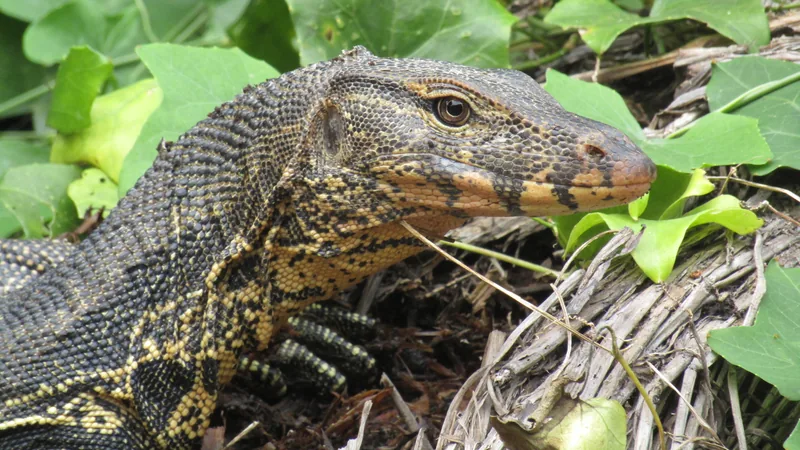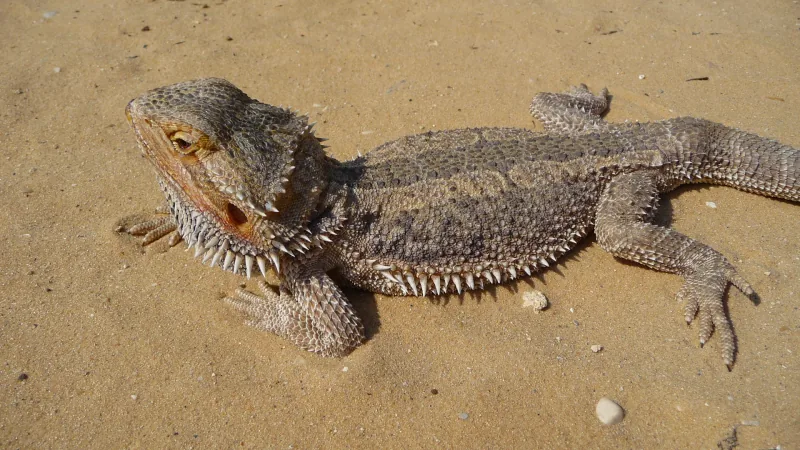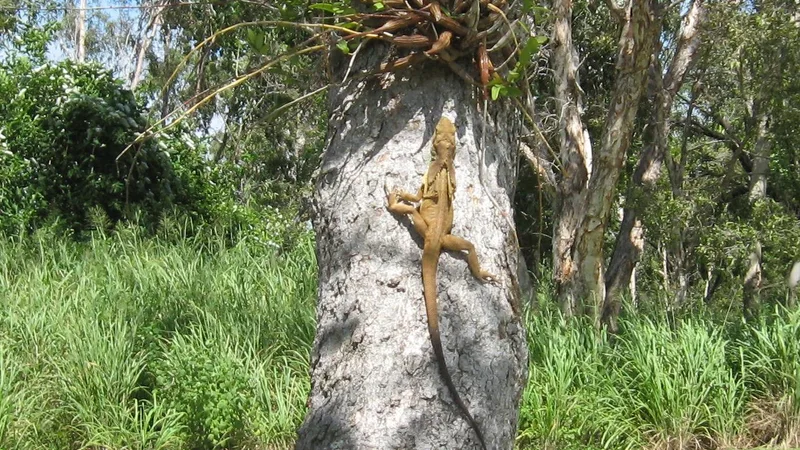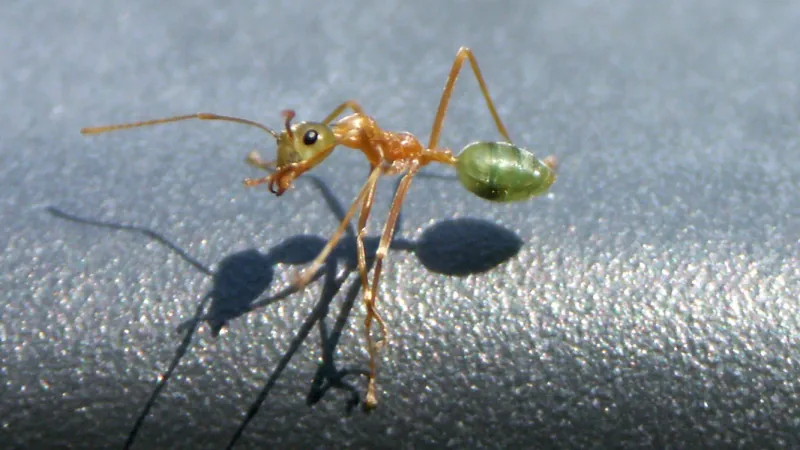
Wild veiled chameleon (Chamaeleo calyptratus calcarifer) crossing a road in Asir, Saudi Arabia
Field
notes
A Helmet on Its Head
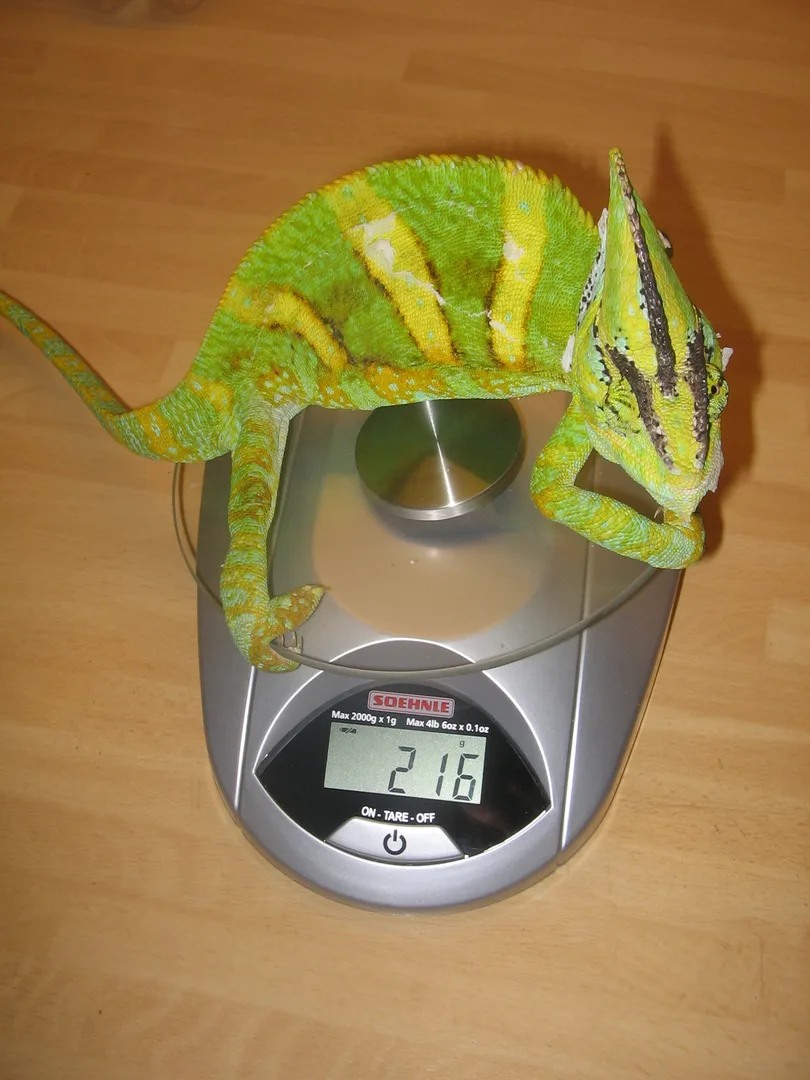
The veiled chameleon (Chamaeleo calyptratus) carries a very high, triangular casque, a helmet-like crest on top of its head. The casque starts as a tiny swelling on a hatchling and grows to two inches tall, and mature males have a larger casque and body. Nose to tail-tip, adults reach 12 to 18 inches long.
Chameleons can grow up to 100 times heavier within a year of hatching. One study filmed 12 veiled chameleons of different sizes, from about 1 gram to 200 grams. A veiled chameleon can live four to eight years.
Its native home is southwestern Saudi Arabia and Yemen, where it lives on high, dry plateaus and in forests and river valleys. These are mountain regions with very little water. It prefers to live high up in trees or lower down in bushes and shrubs.
A Head That Catches Its Own Water At night, droplets of moisture roll down the casque and into the chameleon’s open mouth.
A Spring-Loaded Tongue
Chameleons do not fire their tongues with muscle power alone. They stretch elastic tissue and use its recoil, which releases energy more rapidly than muscles contracting directly could. A 2016 study that filmed 20 chameleon species measured the veiled chameleon’s tongue accelerating at up to 514 meters per second squared, more than 50 times the pull of gravity, and reaching full length in as little as 26 milliseconds. In chameleons, the tip of the tongue is a ball of muscle that rapidly forms a small suction cup as it hits its prey. Once the prey sticks, the chameleon draws it back into its mouth.
Eyes on Two Targets at Once
Like other chameleons, it can rotate and focus each eye separately to look at two different things at the same time, giving it a full 360-degree view around its body. When it sees prey, both eyes can focus in the same direction for a clearer view.
Shy, but Aggressive to Its Own Kind
A veiled chameleon eats mainly insects, but it is one of the few chameleons that also eats plants, taking leaves and flowers. It adapted to eating leaves as a source of water in the dry seasons. Veiled chameleons are shy by nature: when startled or threatened, one may curl up tightly, darken in color, and play dead. Toward each other they are very aggressive, and they prefer to live alone. Males are very territorial. Males and females only tolerate each other when ready to breed.
The IUCN lists the species as Least Concern. Carried abroad by the pet trade, it is known to live in isolated populations in southern Florida and on the Hawaiian island of Maui.
Published Updated
Traits
Intel
& FAQ
Guess
first
How big is a Veiled Chameleon, really? Slide, lock in, and see what the sources say. Every answer is a figure from this page, quoted from where it came from.
Sources
- 01Chamaeleo calyptratus (veiled chameleon). Animal Diversity Web, University of Michigan.
- 02Maddox, Beloyan, Claunch & Johnson (2022). Florida's Nonnative Herpetofauna: Veiled Chameleon (Chamaeleo calyptratus), Oustalet's Chameleon (Furcifer oustaleti), and Panther Chameleon (Furcifer pardalis). EDIS.
- 03Veiled Chameleon. Hawaii Invasive Species Council, Department of Land and Natural Resources.
- 04Chameleon. San Diego Zoo Wildlife Alliance.
- 05Anderson (2016). Off like a shot: scaling of ballistic tongue projection reveals extremely high performance in small chameleons. Scientific Reports.
- 06Herrel et al. (2014). The scaling of tongue projection in the veiled chameleon, Chamaeleo calyptratus. Zoology.
- 07Wilms, Sindaco & Shobrak (2012). Chamaeleo calyptratus. The IUCN Red List of Threatened Species 2012: e.T176306A1437838.
What the sources say: 49 claims checked word for word against these sources →