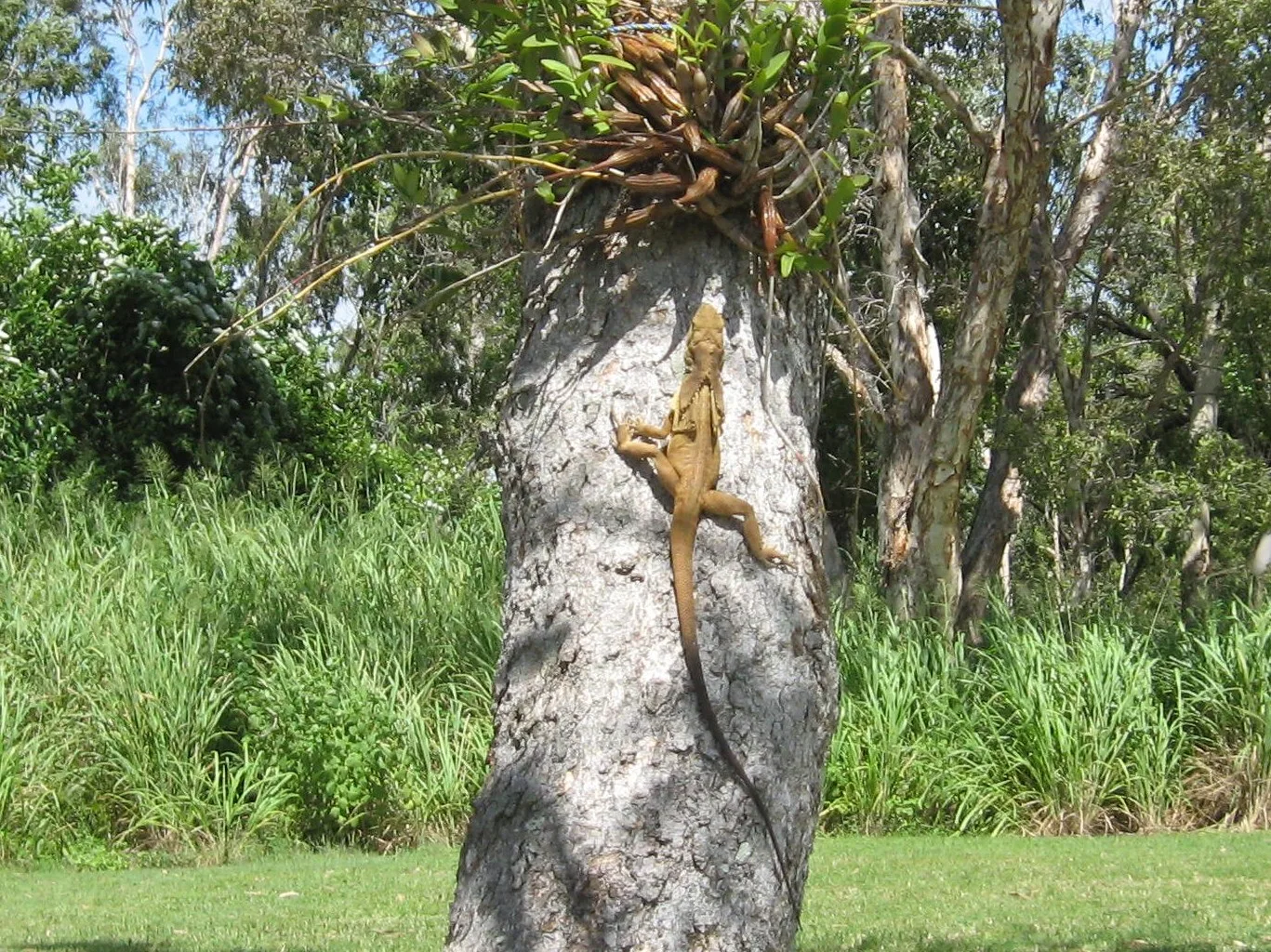
Frilled lizard (Chlamydosaurus kingii) in a threat display
Field
notes
A Frill Built to Startle
The frilled lizard (Chlamydosaurus kingii) is an Australian dragon lizard known for the cape of skin that lies over its shoulders until something threatens it. Cornered, it usually turns to face its attacker and opens its pink or yellow mouth, and the frill rises around its neck, measuring almost 12 inches (about 30 cm) across when fully raised. Researchers tested the display against a model bird of prey and found it fits deimatic display theory. A deimatic display startles a predator for a moment, resulting in a pause or retreat. The frill reveals patches of white and red-orange skin plus a yellow mouth lining, and to a bird of prey’s eyes the lizard switches from camouflaged to conspicuous. The display is performed with movements that amplify its effect. The frill is larger in males than females, hinting it might double as a signal in contests between rival males too.
Two Bones and Two Cartilages The hyoid is the bony frame at the base of the tongue. Two of its bones support the lower sides of the frill, and a pair of cartilages holds the upper sides. The frill goes up when these move together, and it needs the mouth open.
Size and Home
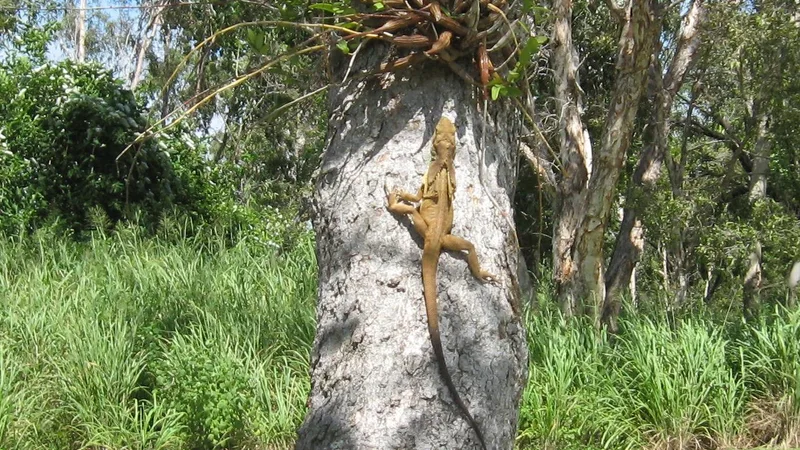
Adult males reach a snout-to-vent length (nose to the vent under the tail’s base, tail not counted) of 290 millimeters and weigh at least 870 grams; females are much smaller, at 235 millimeters and 400 grams. Its average length is 85 centimeters (33 inches). The longest-lived frilled lizard in the AnAge ageing database reached 9.9 years, in captivity. It lives in grassy woodland and dry forest across northern Australia and southern New Guinea, spending 90 percent of its time in trees. It is well camouflaged there, and is usually noticed only after rain or when it comes down to feed.
A Taste for Termites
A two-year study of a wild population in Kakadu National Park found harvester termites of the genus Drepanotermes were a major part of its diet, which the study calls unusual for a sedentary forager (one that waits for food rather than roaming after it) in a tropical environment. It eats a diverse range of other invertebrates too, and has been known to take small mammals and pieces of meat. Growth is restricted to the wet season, when food is plentiful, and is minimal in the dry season, when food is scarce.
Plan B: Run on Two Legs
Flaring the frill makes the lizard look much bigger than it really is, and a predator may decide to look for smaller prey. If the bluff fails, the lizard usually runs up the nearest tree, and it is well known for running on its hind legs alone. The IUCN Red List rates the frilled lizard Least Concern.
Published Updated
Traits
Intel
& FAQ
Guess
first
How big is a Frilled Lizard, really? Slide, lock in, and see what the sources say. Every answer is a figure from this page, quoted from where it came from.
Sources
- 01Chlamydosaurus kingii (Frilled Lizard). Animal Diversity Web, University of Michigan.
- 02Lizard. San Diego Zoo Wildlife Alliance.
- 03AnAge entry for Chlamydosaurus kingii. AnAge: The Animal Ageing and Longevity Database, Human Ageing Genomic Resources.
- 04Griffiths & Christian (1996). Diet and habitat use of frillneck lizards in a seasonal tropical environment. Oecologia.
- 05Montandon, Fofonjka & Milinkovitch (2019). Elastic instability during branchial ectoderm development causes folding of the Chlamydosaurus erectile frill. eLife.
- 06Perez-Martinez, Riley & Whiting (2019). Uncovering the function of an enigmatic display: antipredator behaviour in the iconic Australian frillneck lizard. Biological Journal of the Linnean Society.
- 07Ujvari, Dowton & Madsen (2007). Mitochondrial DNA recombination in a free-ranging Australian lizard. Biology Letters.
- 08Ujvari, Dowton & Madsen (2008). Population genetic structure, gene flow and sex-biased dispersal in frillneck lizards (Chlamydosaurus kingii). Molecular Ecology.
- 09O'Shea et al. (2017). Chlamydosaurus kingii. The IUCN Red List of Threatened Species 2017: e.T170384A21644690.
What the sources say: 44 claims checked word for word against these sources →