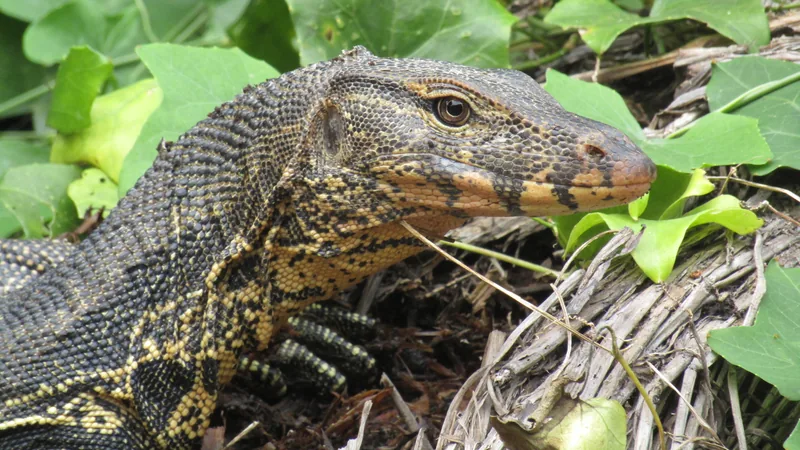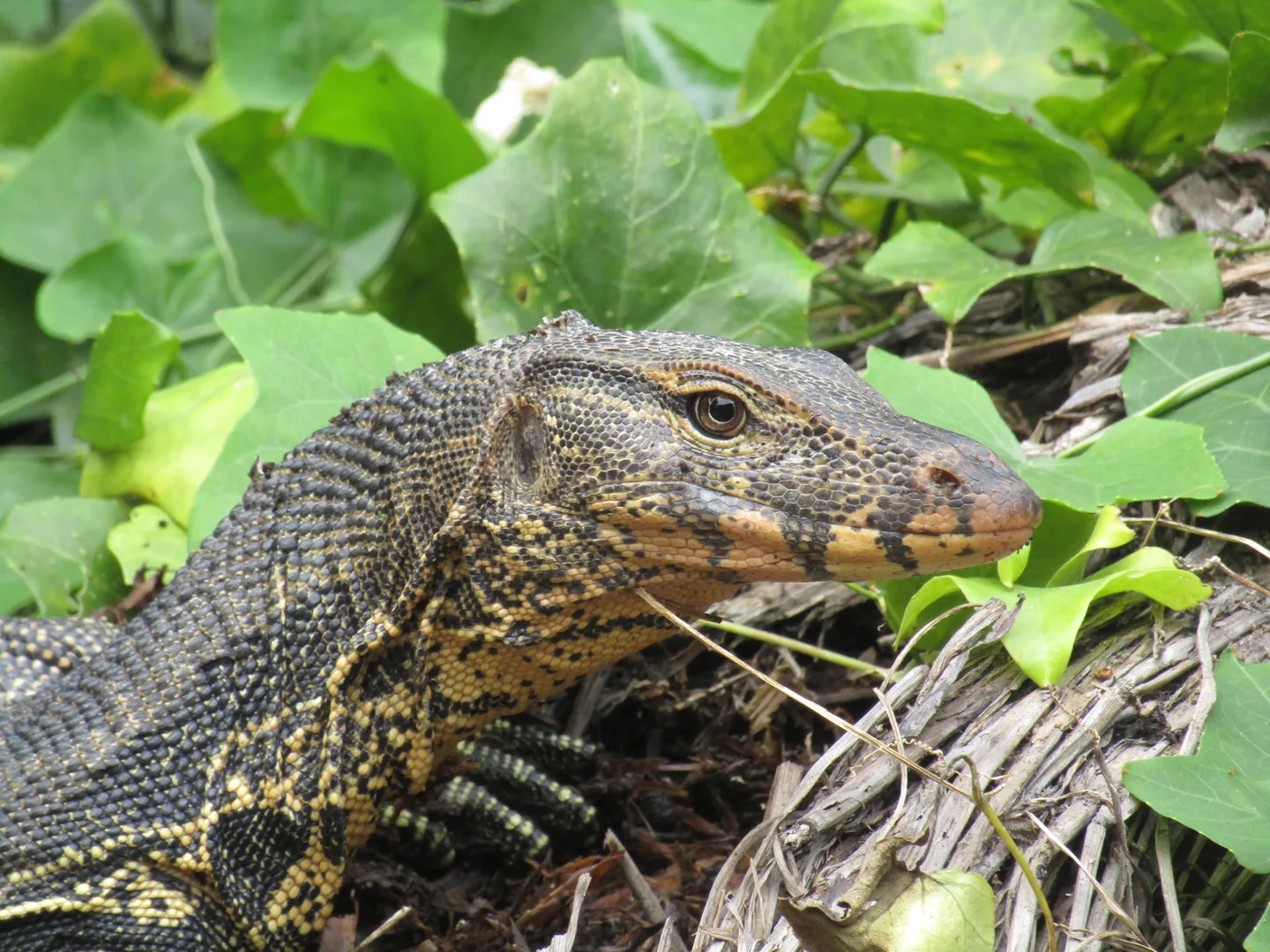
The Asian water monitor ( Varanus salvator ) is a large varanid lizard native to South and Southeast Asia.
Field
notes
A Nose That Reads the Trail
The Asian water monitor (Varanus salvator) can follow a scent trail and pick up a rotten carcass from up to 100 m away, a U.S. government risk summary reports. When its genome was compared with five other reptiles, 234 gene families were specific to the water monitor. Among them, genes for vomeronasal type 2 receptors, a family tied to the response to pheromones (chemical signals that animals give off), came out as significant in the analysis.
Southeast Asia’s Biggest Monitor
Scientists who sequenced its genome call it the largest monitor in Southeast Asia and the second largest lizard globally, after the Komodo dragon. It may reach a total length of 2.5 m, which is more than 8 ft. Males are typically larger than females. The AnAge database gives an average adult weight of 4,345 g.
It is extremely widespread, living across southern and Southeast Asia, from eastern India, Sri Lanka and Bangladesh through Thailand and Malaysia to Indonesia and the Philippines. It prefers habitats near water: beaches, mangrove swamps, peat swamps, lakes, streams and rivers. It sleeps in burrows it digs itself and uses water and burrows to cool off in the heat of the day.
An extremely broad diet Insects, crabs, fish, freshwater turtles, birds and their eggs, lizards and rats are on the menu, along with crocodiles, sea turtles and carrion. Research has found that it will also scavenge food leftovers from residents and tourists.
A Pace It Can Hold
Researchers put lizards on a treadmill. A water monitor ran for 45 minutes at a pace that needed 85% of its maximum oxygen use. For the first 10 minutes it also drew on supplementary anaerobic metabolism (energy made without enough oxygen), shown by a 16 mmol/l rise in blood lactate. Half of that lactate was cleared by the end, and its blood pH was back to resting levels. In a harder test, all three lizard species tested (the water monitor, another monitor and an iguana) were exhausted after 5 to 10 minutes.
Eggs, Skins and Survival
A clutch holds 5 to 30 eggs, and incubation lasts 171 to 327 days. Hatchlings are 250 to 390 mm long. In captivity the average lifespan is 10.6 years.
The species is one of the most heavily exploited monitor lizards in the world. It is hunted mainly for its skin, used in the leather trade, as well as for its meat and its fat, used in traditional medicine. A 1999 estimate put the trade at 1.5 million skins a year, though the skin trade has decreased slightly since the 1990s. The IUCN Red List rates it Least Concern.
Published
Traits
Intel
& FAQ
Guess
first
How big is a Asian Water Monitor, really? Slide, lock in, and see what the sources say. Every answer is a figure from this page, quoted from where it came from.
Sources
- 01Ecological Risk Screening Summary: Common Water Monitor (Varanus salvator). U.S. Fish and Wildlife Service.
- 02Varanus salvator. AnAge: The Animal Ageing and Longevity Database.
- 03Chetruengchai et al. (2022). Genome of Varanus salvator macromaculatus (Asian Water Monitor) Reveals Adaptations in the Blood Coagulation and Innate Immune System. Frontiers in Ecology and Evolution.
- 04Gleeson & Bennett (1982). Acid-Base Imbalance in Lizards During Activity and Recovery. Journal of Experimental Biology.
- 05Quah et al. (2021). Varanus salvator. The IUCN Red List of Threatened Species 2021: e.T178214A113138439.
What the sources say: 48 claims checked word for word against these sources →