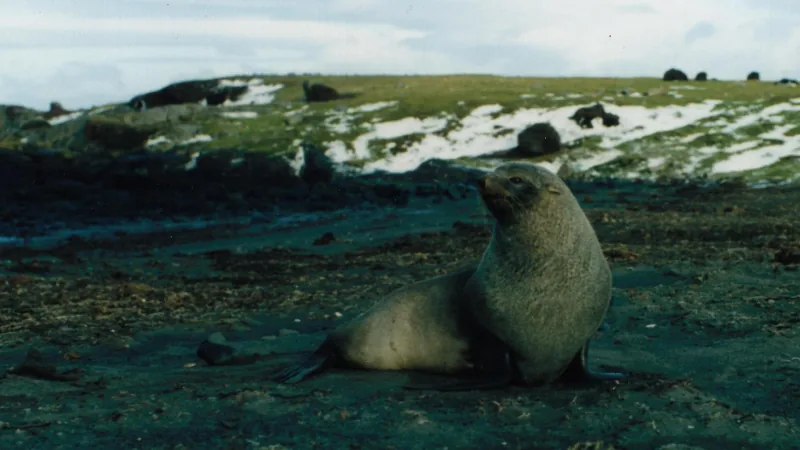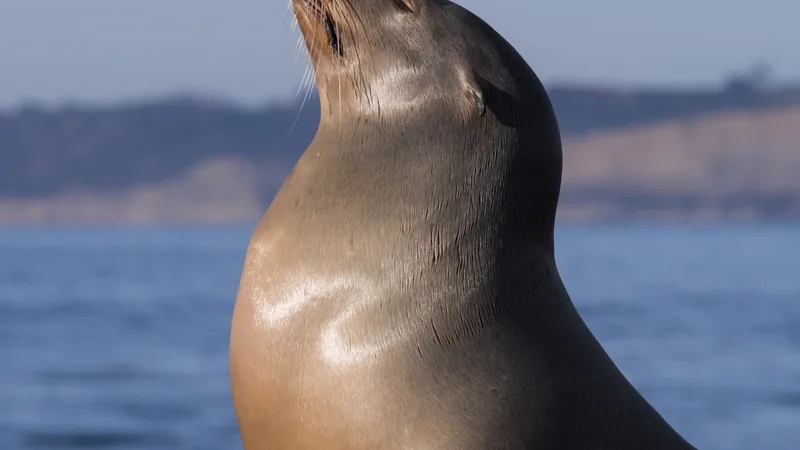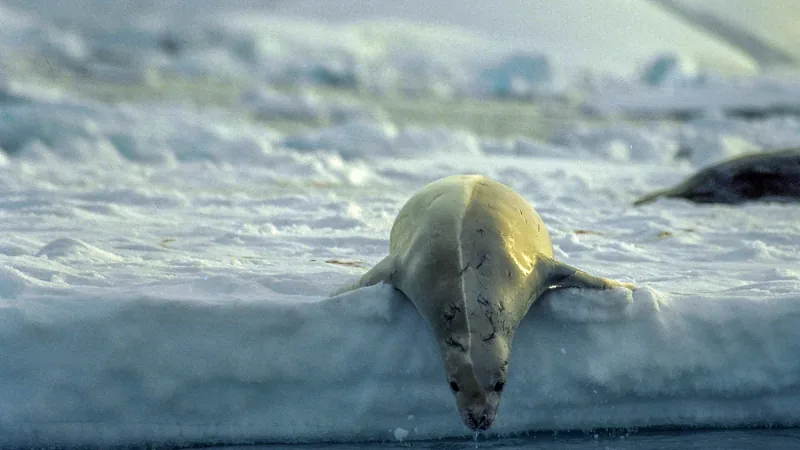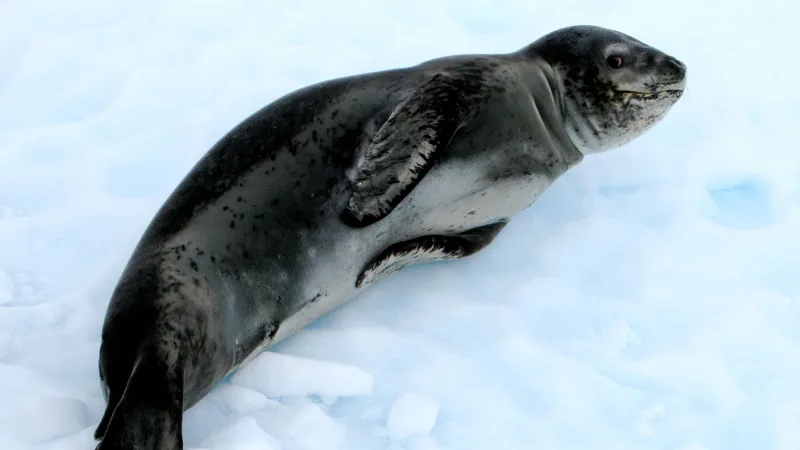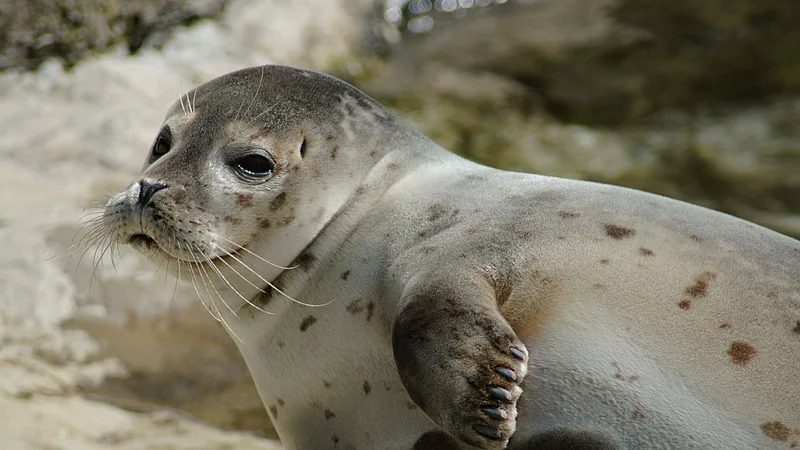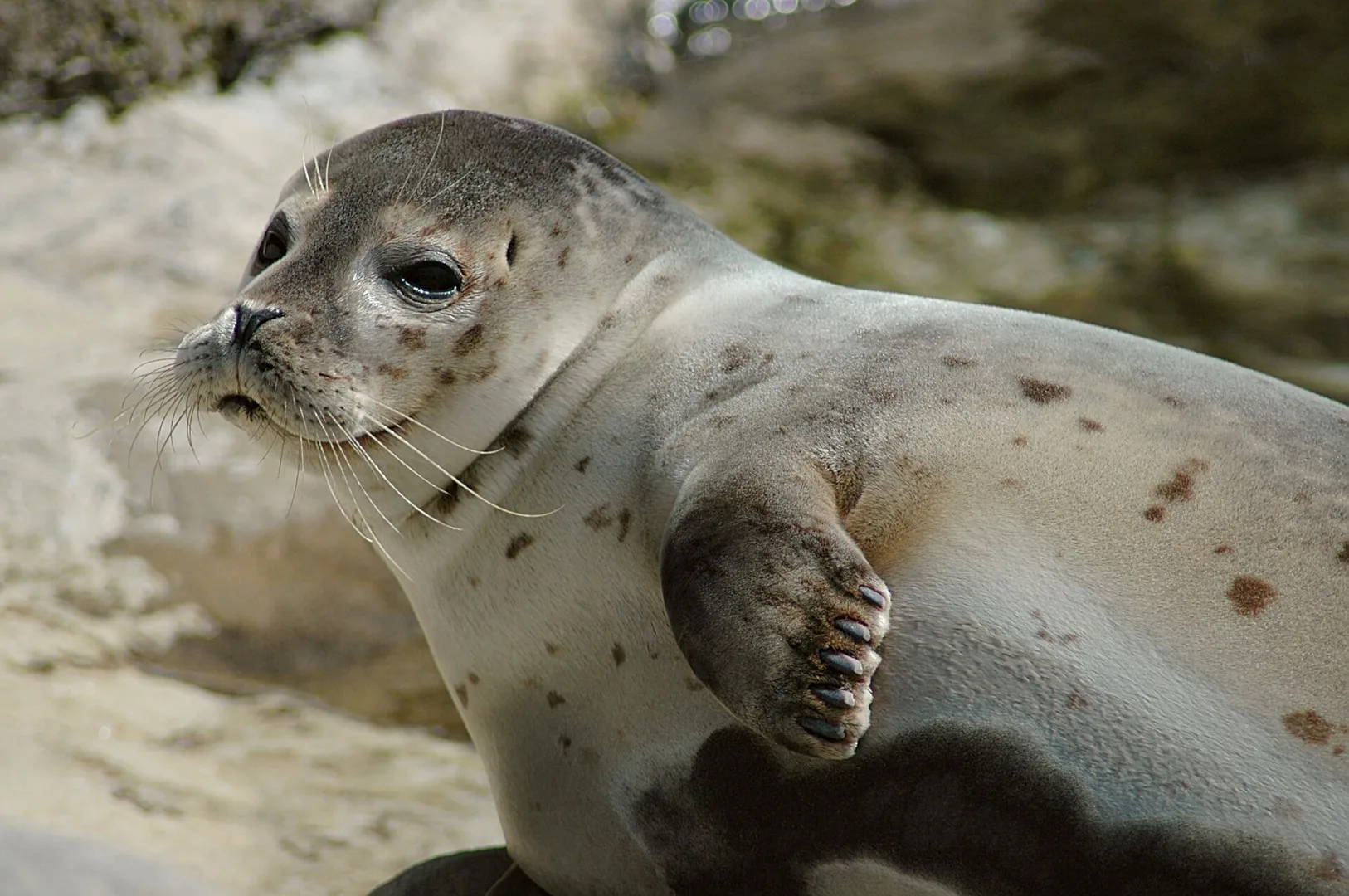
A wild harbor seal hauled out on a sandstone ledge in La Jolla, California
Field
notes
The Seal That Can’t Walk Like a Sea Lion
The harbor seal (Phoca vitulina) is a true seal. It has no external ear flaps, just a small hole on each side of its head, and its pelvic bones are fused, so it can’t tuck its hind flippers under its body to walk the way a sea lion does. On land it gets around by undulating like a caterpillar instead. A harbor seal weighs up to 285 pounds and measures up to 6 feet long; males are slightly larger than females, and seals in Alaska and the Pacific are generally larger than those in the Atlantic. It has the widest range of any seal: along North America’s west coast from Baja California to the Bering Sea, its east coast from the Canadian Arctic to the Mid-Atlantic, and the northern coasts of Europe and Asia. A wild harbor seal can live 25 to 30 years, and more than 30 in human care.
Whiskers That Feel a Fish’s Wake
In dark or murky water, dolphins hunt using echolocation. Seals apparently don’t have that sense, but a seal’s highly sensitive whiskers can detect the water movements a fish makes, and those movements persist in its wake for several minutes. Researchers once blindfolded harbor seals and had them track the wake of a miniature submarine with their whiskers; the seals followed it accurately, showing that water movements like these can be used to locate prey at long distance. A harbor seal eats mainly fish, such as rockfish, herring, cod, mackerel, flounder and salmon, plus squid, octopus, crabs and shrimp when available, aiming to keep its foraging effort low by eating what is abundant and easily caught.
Three or Four Beats a Minute
A heart that idles underwater Before a deep dive, a harbor seal exhales to cut the oxygen in its lungs and relies on oxygen stored in its blood and muscle instead. Blood is shunted away from its extremities toward its brain, heart and lungs, and its heart rate slows from upwards of 80 to 120 beats a minute to as few as three or four.
It can stay under for up to 30 minutes, though the average dive lasts under three. It can generally dive to about 500 feet, but dives as deep as 1,460 feet have been recorded. Its body burns energy faster than other mammals its size, which generates heat to keep it warm, and in winter its insulating blubber can make up as much as 30 percent of its body mass.
Ready to Swim From Day One
A harbor seal pup sheds its downy lanugo coat well before birth and is born with fur the same texture as an adult’s, which lets it safely enter cooler water. It’s ready to swim within minutes of birth, can dive for up to 2 minutes by the time it’s 2 or 3 days old, and by the end of its first month may set off on journeys of more than 100 miles from its birth site. It nurses for 4 to 6 weeks on milk that’s 50 percent fat. Harbor seals stay alert for predators such as polar bears, orcas and sharks. A seal that senses danger gives an alarm call and usually dives for the water, and seals that haul out in groups spend less time watching for predators than those that haul out alone. The IUCN lists the harbor seal as Least Concern.
Published Updated
Traits
Intel
& FAQ
Guess
first
How big is a Harbor Seal, really? Slide, lock in, and see what the sources say. Every answer is a figure from this page, quoted from where it came from.
Sources
- 01Harbor Seal. NOAA Fisheries.
- 02Harbor seal. Smithsonian's National Zoo and Conservation Biology Institute.
- 03Phoca vitulina (harbor seal). Animal Diversity Web, University of Michigan.
- 04Dehnhardt et al. (2001). Hydrodynamic Trail-Following in Harbor Seals ( Phoca vitulina ). Science.
- 05Russell (2025). Phoca vitulina. The IUCN Red List of Threatened Species 2025: e.T17013A225215605.
What the sources say: 40 claims checked word for word against these sources →