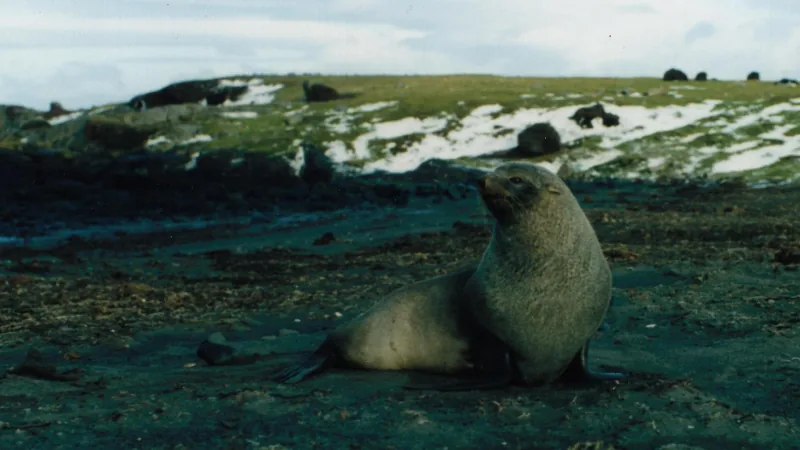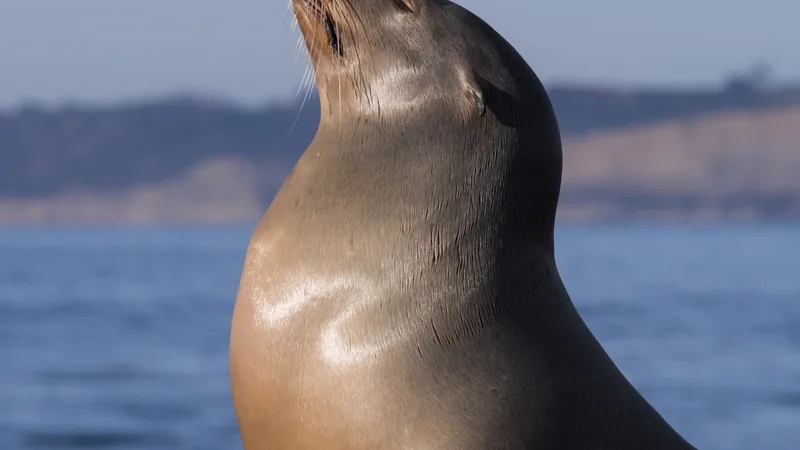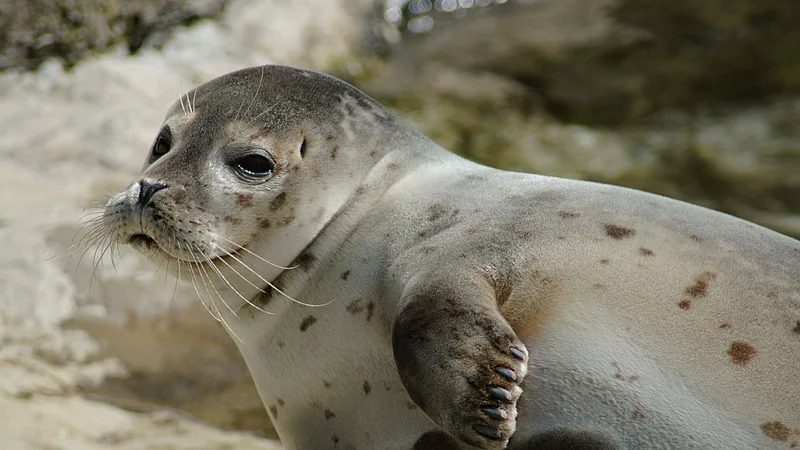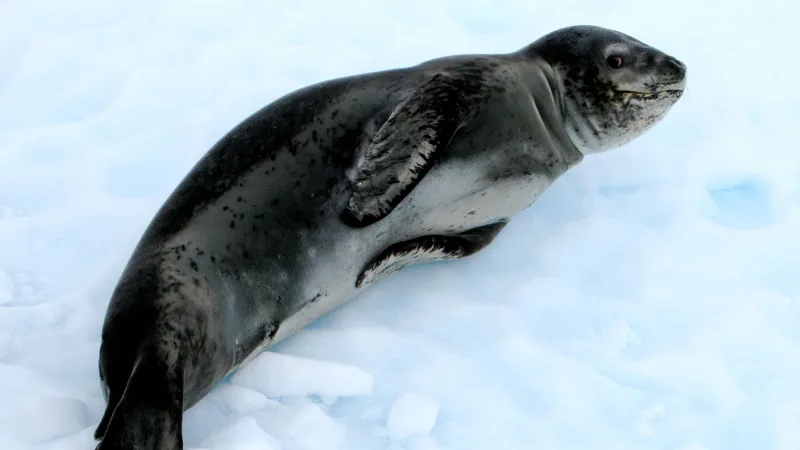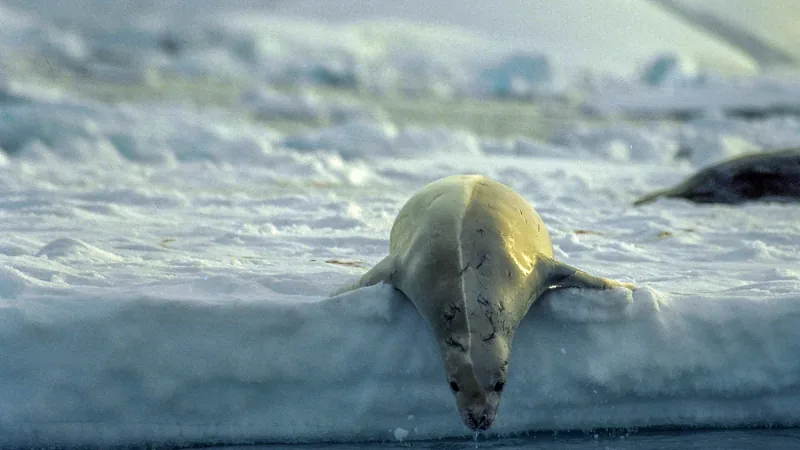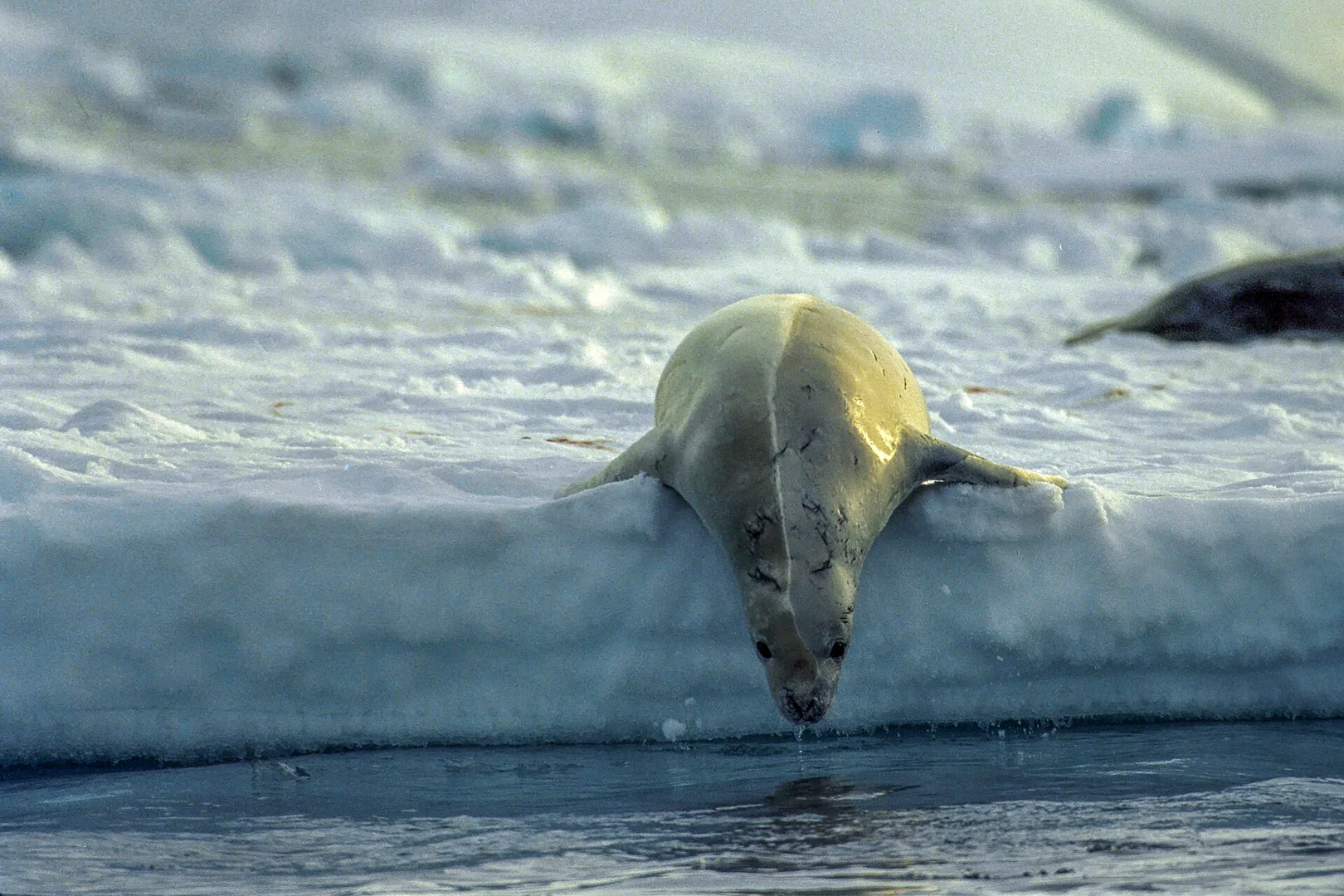
Crabeater seal leaving the ice, Antarctica
Field
notes
Built for the Ice, Built to Sieve
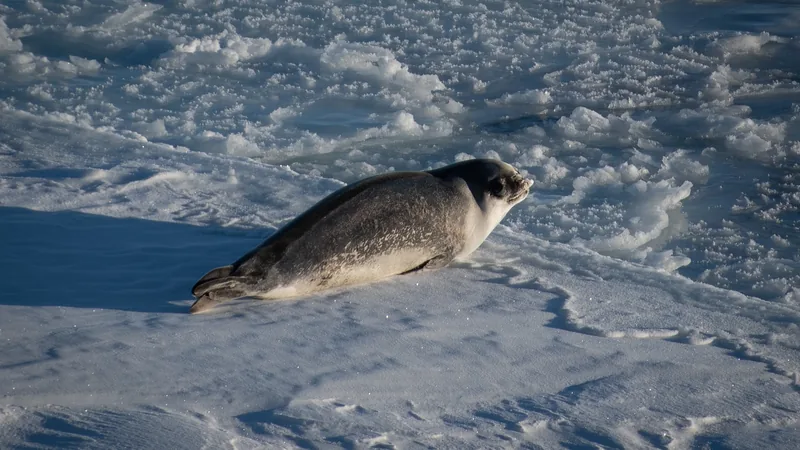
The crabeater seal (Lobodon carcinophaga) is a slender, long-snouted seal of the Antarctic pack ice. Males and females grow to about the same size, reaching lengths of 2.5 meters and weights of 400 kilograms, according to the Australian Antarctic Division. Newborn pups are about 1.2 meters long and weigh 20 to 30 kilograms.
Despite the name, this seal doesn’t eat crabs. It eats krill. The name comes from the German word Krebs, which covers crustaceans in general, not crabs alone, and the label stuck to a seal whose real prey is Antarctic krill (Euphausia superba).
A Sieve for a Mouth The crabeater seal’s teeth have been called “the most complex of any carnivore,” Animal Diversity Web notes: each carries several tubercles, and when the jaws close the only spaces left are the gaps between them. The Australian Antarctic Division says the seal uses this dentition to gulp in a mouthful of seawater and strain out the krill.
Krill, Almost Exclusively
A 2021 study that sampled 21 crabeater seals off the Western Antarctic Peninsula, using stable isotopes and fatty acids, estimated krill made up 84 to 91 percent of their diet depending on the method. A study of seal feeding anatomy says the crabeater’s filter feeding and the leopard seal’s grip-and-tear are specialized strategies with their own adaptations, which let both species “exploit novel ecological niches and prey types.” The Australian Antarctic Division says crabeater seals can dive to 250 meters but usually feed in the top 20 meters of water.
Circumpolar and an Estimated 15 Million Strong
The Australian Antarctic Division says crabeater seals spend their entire lives in the pack ice ringing Antarctica: resting, breeding and moulting on the ice, and feeding in the surrounding water. The Australian Antarctic Division gives an estimated population of about 15 million, calling them the most abundant seal in the Southern Ocean and the most numerous of the world’s larger animals besides humans. A 2021 review similarly calls the species “likely one of the most abundant marine mammals in the world.” A mitochondrial DNA study of seals from the Amundsen and Ross seas suggests their population expanded suddenly around 1.6 million years ago, during a period of intensified glaciation that may have opened up more pack ice habitat for them.
Scars, Orcas and a New Threat
Most adult crabeater seals carry large scars from unsuccessful leopard seal attacks made when they were younger. Killer whales hunt differently: in an observation published in 1981, a pod of seven orcas swam as a group close to a seal lying on an ice floe, raising a wave that tipped the floe and threw the seal into the water. Animal Diversity Web calls the crabeater probably the fastest pinniped on land, reaching speeds of up to 25 kilometers an hour; when sprinting it swings its head from side to side in time with its pelvis. A 2026 preprint, not yet peer-reviewed, reports the first confirmed H5N1 bird flu infection in an Antarctic ice-dependent seal, a crabeater, and crabeater seal deaths across the northern Weddell Sea in November and December 2024.
Published Updated
Traits
Intel
& FAQ
Guess
first
How big is a Crabeater Seal, really? Slide, lock in, and see what the sources say. Every answer is a figure from this page, quoted from where it came from.
Sources
- 01Crabeater seal. Australian Antarctic Division.
- 02Lobodon carcinophaga (crabeater seal). Animal Diversity Web, University of Michigan.
- 03Guerrero et al. (2021). Complementary use of stable isotopes and fatty acids for quantitative diet estimation of sympatric predators, the Antarctic pack-ice seals. Oecologia.
- 04Kienle & Berta (2015). The better to eat you with: the comparative feeding morphology of phocid seals (Pinnipedia, Phocidae). Journal of Anatomy.
- 05Wege, Salas & LaRue (2021). Ice matters: Life-history strategies of two Antarctic seals dictate climate change eventualities in the Weddell Sea. Global Change Biology.
- 06Curtis, Stewart & Karl (2009). Pleistocene population expansions of Antarctic seals. Molecular Ecology.
- 07Smith et al. (1981). Coordinated behavior of killer whales, Orcinus orca, hunting a crabeater seal, Lobodon carcinophagus. Canadian Journal of Zoology.
- 08Younger et al. (2026). High pathogenicity avian influenza virus H5N1 clade 2.3.4.4b in Antarctica: Multiple Introductions and the First Confirmed Infection of Ice-Dependent Seals. openRxiv.
- 09Hückstädt (2025). Lobodon carcinophaga. The IUCN Red List of Threatened Species 2025: e.T12246A294810299.
What the sources say: 37 claims checked word for word against these sources →