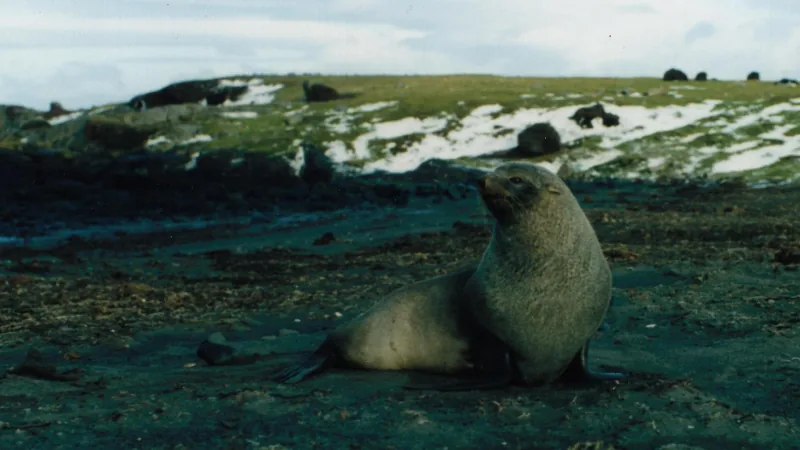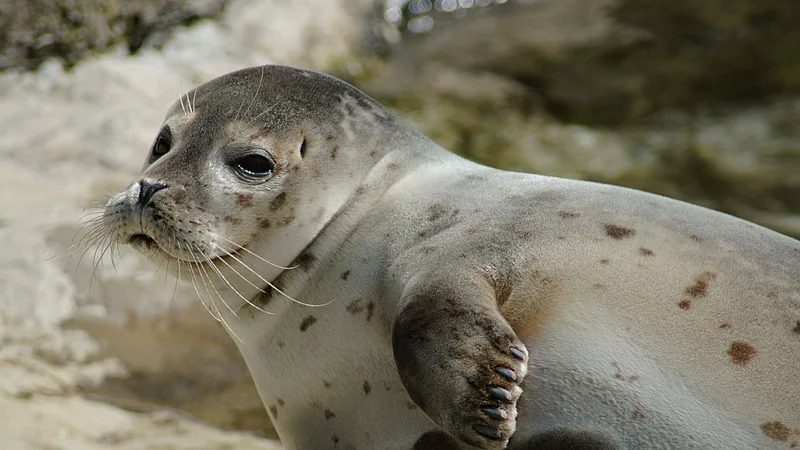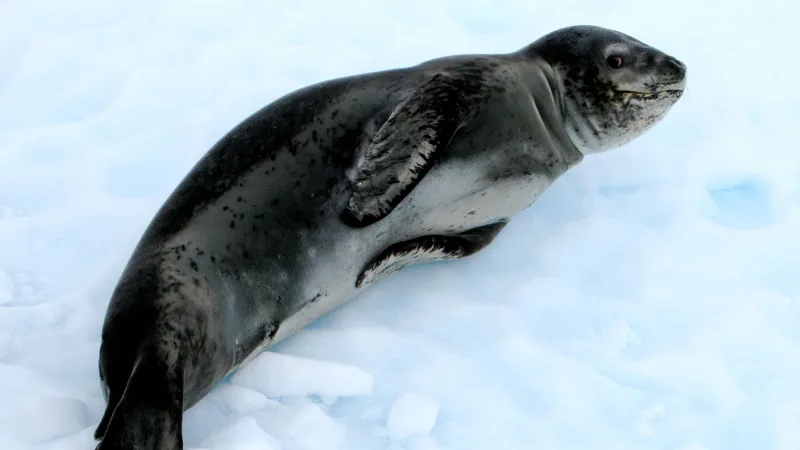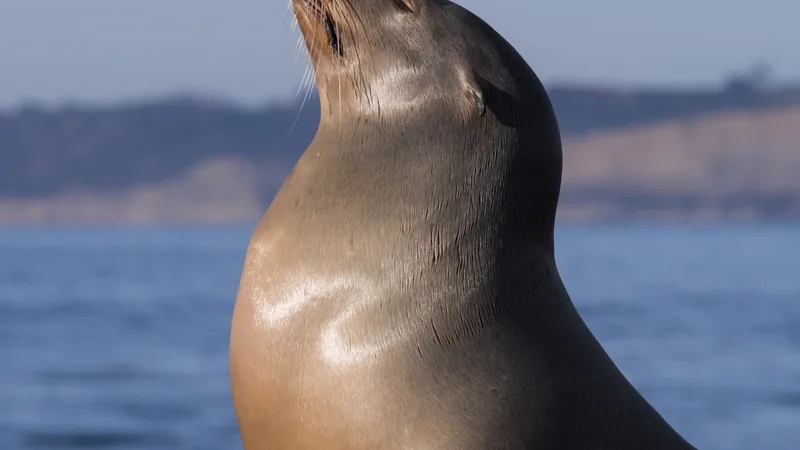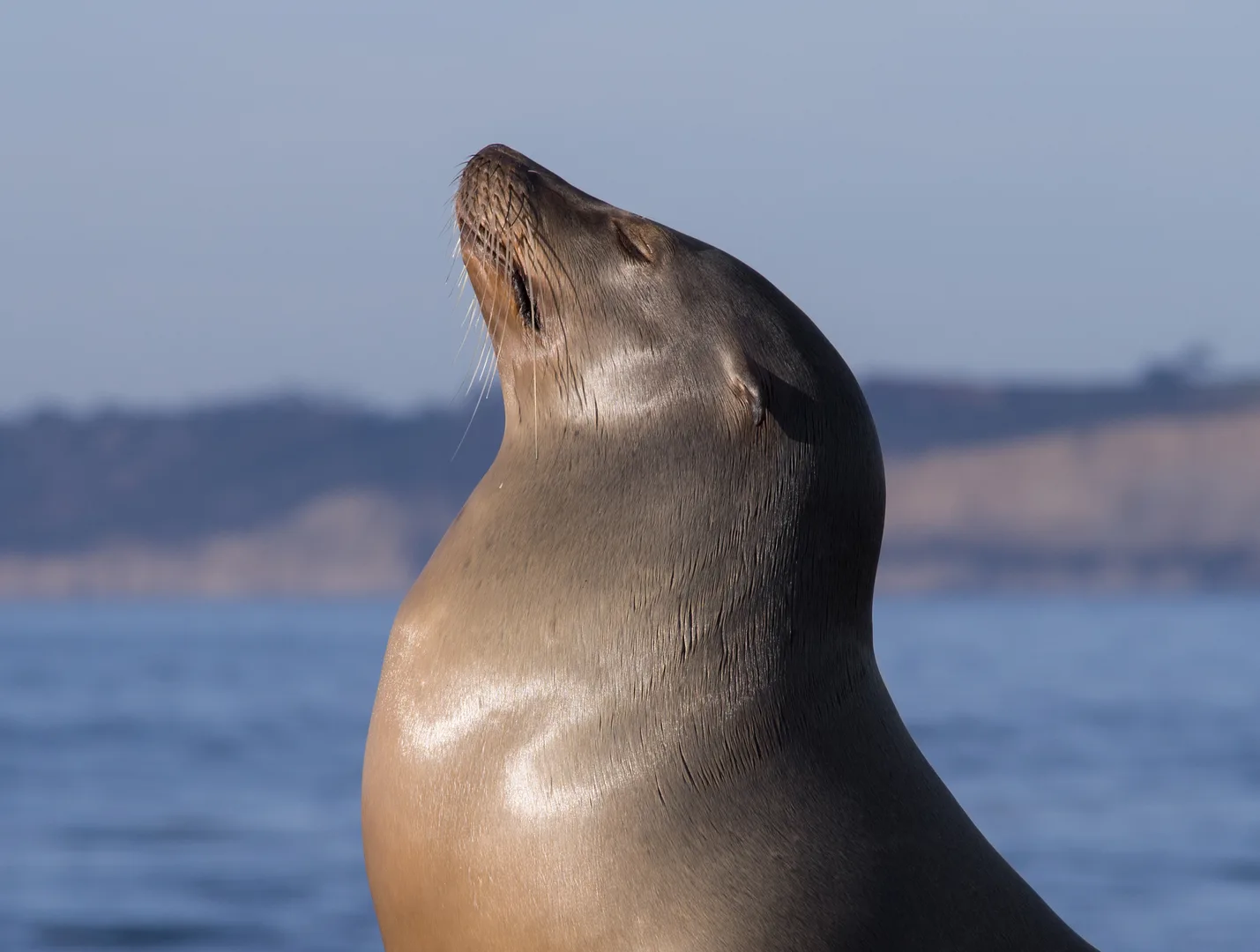
At La Jolla, California.
Field
notes
A seal that barks like a dog
California sea lions are “eared seals”: unlike true seals, they have visible ear flaps, and they live along the West Coast of North America. Males bark like dogs to talk to other males and females, and the National Zoo calls them one of the noisiest pinniped species.
So how does a mother find her pup in a crowd?
Voice, then nose A mother and her pup trade calls unique to the pair. She can find her pup among hundreds of others by its call, then gives it a sniff as a final check.
Bulls, cows and a bony crest
The sexes differ a lot in size. Adult males average about 600 pounds (272 kilograms) and 8 feet (2.4 meters) long, and before the breeding season a male’s weight often increases, to as much as 1,000 pounds (454 kilograms). Females average 220 pounds (100 kilograms) and about 6 feet (1.8 meters). Pups weigh about 18 pounds (8 kilograms) at birth.
At about 5 years old, males develop a noticeable crest along the top of the skull. That bony ridge is called a sagittal crest, and it gives the head a high, domed forehead. Males start holding breeding territories at around 9 to 12 years old, and a territory may include up to 14 females. Bulls patrol it, barking, and fight if they must. In the wild a sea lion lives 15 to 20 years, and about 25 to 30 in human care.
Fast, flexible hunters
In the water their torpedo-shaped bodies can reach 25 to 30 mph (40 to 48 kph), twisting through tight turns as they chase fish. They eat a variety of prey, such as squid, anchovies, mackerel, rockfish and sardines, mostly feeding toward the top of the water column, though they can dive as deep as 1,000 feet if necessary.
One common habit is “rafting”: a sea lion holds its flippers above the water, motionless, for a long time, to rest and regulate its body temperature. It can look like an animal caught in a net.
The species ranges from southeast Alaska to the Pacific coast of central Mexico. The main breeding range runs from the Channel Islands in southern California to central Mexico, and in normal years males migrate in winter to feeding areas off California, Oregon, Washington, British Columbia and southeast Alaska. The Red List rates the species Least Concern.
A sea lion with rhythm
Before a 2013 study, only vocal mimics, including humans, cockatoos and budgerigars, had been shown to keep a beat. Then a California sea lion learned to bob its head in time with an auditory rhythm. It carried that skill over to a range of novel tempos and to complex, musical stimuli.
Published
Traits
Intel
& FAQ
Guess
first
How big is a California Sea Lion, really? Slide, lock in, and see what the sources say. Every answer is a figure from this page, quoted from where it came from.
Sources
- 01California Sea Lion. NOAA Fisheries.
- 02California Sea Lion. Smithsonian's National Zoo and Conservation Biology Institute.
- 03California Sea Lion. The Marine Mammal Center.
- 04Cook et al. (2013). A California sea lion (Zalophus californianus) can keep the beat: Motor entrainment to rhythmic auditory stimuli in a non vocal mimic. Journal of Comparative Psychology.
- 05Hernández-Camacho, González & Hernández (2026). Zalophus californianus. The IUCN Red List of Threatened Species 2026: e.T41666A294651011.
What the sources say: 45 claims checked word for word against these sources →