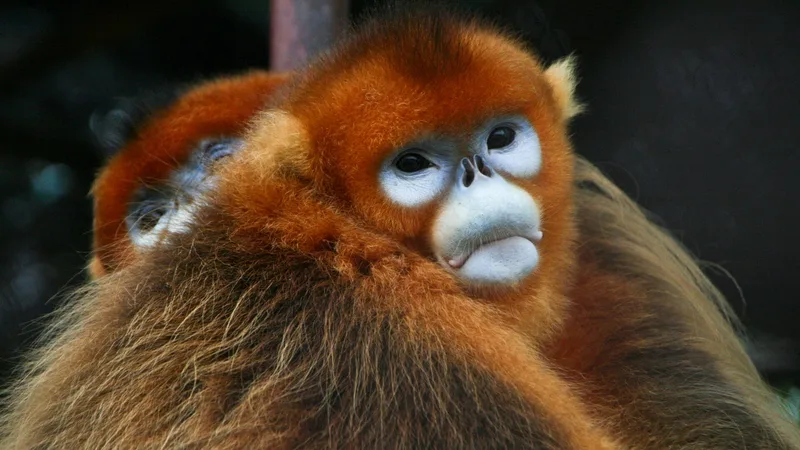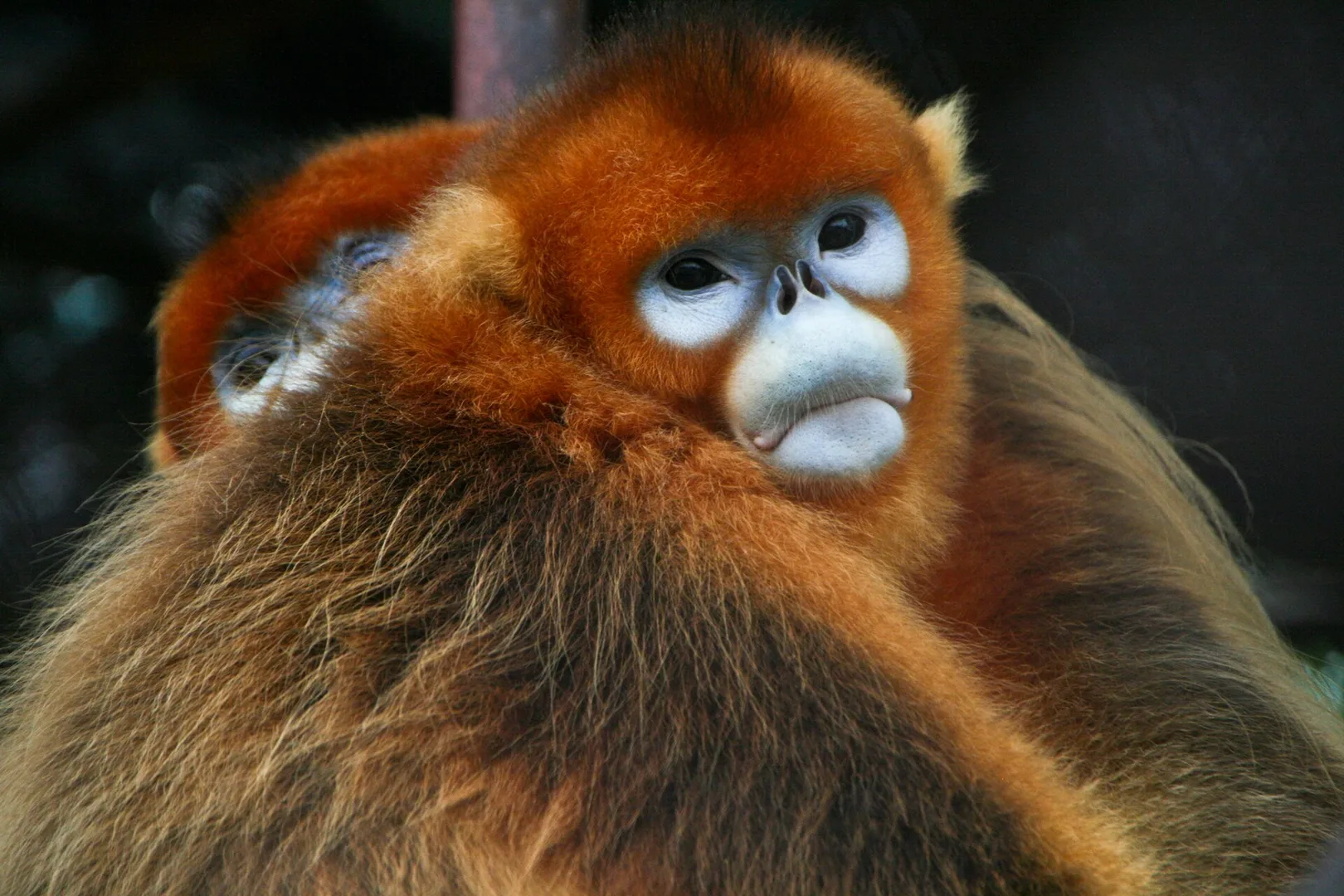
The flattened nose, with forward-facing nostrils, that the species is named for.
Field
notes
Built for a Deep Freeze
Winter in the Qinling and Shennongjia Mountains asks more of a golden snub-nosed monkey than it can repay. A 2020 study found that despite increased feeding, the monkeys still run short on energy through the cold months, so they draw down fat reserves built up over summer and autumn. Over the winter they lose 14 percent of their body mass. They also fight the cold directly, narrowing the blood vessels in their skin, called cutaneous vasoconstriction, which drops their skin temperature by an average of 3.2 degrees Celsius and cuts how much heat escapes.
Freezing temperatures make staying warm a matter of survival. A study of one wild, provisioned band in the Qinling Mountains found the monkeys retire to sleep between 6:04 and 6:58 pm in winter. All of them slept in trees at night, often in the lower canopy rather than the colder, windier branches above. They also formed larger sleeping clusters at night than during the day, most often adult females clustered with juveniles.
A Monkey Built Around Its Nose
Adult males weigh around 15 kilograms in captivity, adult females closer to 9.5 kilograms, and Animal Diversity Web records a head-body length of 570 to 760 millimeters with a tail of 510 to 720 millimeters. AnAge lists a maximum lifespan of 29.5 years in captivity; one wild-born individual was 29 to 30 when it died in captivity. Both sexes carry golden fur across the belly, forehead and neck, while the rest of the coat runs grayish-black in males and brownish-black in females. Its nose is flattened, with forward-facing nostrils and two flaps of skin that form peaks almost touching the forehead.
The Food That Doesn’t Disappear in Winter In winter the menu narrows to bark and lichen. From November to April, lichen is their primary food.
A study in the Qinling Mountains recorded an annual diet of 29 percent fruit and seeds, 29 percent lichens, 24 percent leaves, 11 percent bark and small amounts of buds, twigs and unidentified items. A separate study in the Shennongjia Nature Reserve found lichens made up 43 percent of feeding records overall, the biggest single share of any food type there.
Societies Inside Societies
Golden snub-nosed monkeys live in one of the few complex, layered societies documented in mammals. The basic unit is one male with several females, called a one-male unit. Several one-male units form a cohesive breeding band, which associates with one or more all-male units of bachelors to form a herd. A study spanning 14 years in the Qinling Mountains recorded a neighboring band occasionally merging with the study band into a single troop of more than 300 individuals, and satellite collars tracked one such merger for three weeks in February and March. Radio tracking in the same mountains put a year’s total home range at 22.5 square kilometers. An unusually large home range is a hallmark of this monkey.
Wolves, leopards and golden eagles threaten individual monkeys at one Shennongjia Nature Reserve study site. The same study found the monkeys spend 97.1 percent of their time in trees, mostly in the middle and upper canopy, and 2.9 percent on the ground. The IUCN Red List rates the species Endangered.
Published Updated
Traits
Intel
& FAQ
Guess
first
How big is a Golden Snub-Nosed Monkey, really? Slide, lock in, and see what the sources say. Every answer is a figure from this page, quoted from where it came from.
Sources
- 01Rhinopithecus roxellana (golden snub-nosed monkey). Animal Diversity Web, University of Michigan.
- 02Rhinopithecus roxellana. AnAge: The Animal Ageing and Longevity Database, Build 15, 2023.
- 03Yongcheng & Richardson (2021). Rhinopithecus roxellana. The IUCN Red List of Threatened Species 2021: e.T19596A196491153.
- 04Hou et al. (2020). Cold and hungry: combined effects of low temperature and resource scarcity on an edge‐of‐range temperate primate, the golden snub‐nose monkey. Ecography.
- 05Fan et al. (2018). Vocal repertoire of free‐ranging adult golden snub‐nosed monkeys (Rhinopithecus roxellana). American Journal of Primatology.
- 06Qi et al. (2014). Satellite telemetry and social modeling offer new insights into the origin of primate multilevel societies. Nature Communications.
- 07Guo, Li & Watanabe (2007). Diet and activity budget of Rhinopithecus roxellana in the Qinling Mountains, China. Primates.
- 08Yiming (2006). Seasonal variation of diet and food availability in a group of Sichuan snub‐nosed monkeys in Shennongjia Nature Reserve, China. American Journal of Primatology.
- 09Li et al. (2001). Seasonal Home Range Changes of the Sichuan Snub-Nosed Monkey (Rhinopithecus roxellana) in the Qinling Mountains of China. Folia Primatologica.
- 10Zhang et al. (2011). Sleeping cluster patterns and retiring behaviors during winter in a free-ranging band of the Sichuan snub-nosed monkey. Primates.
- 11Li (2007). Terrestriality and tree stratum use in a group of Sichuan snub-nosed monkeys. Primates.
What the sources say: 60 claims checked word for word against these sources →