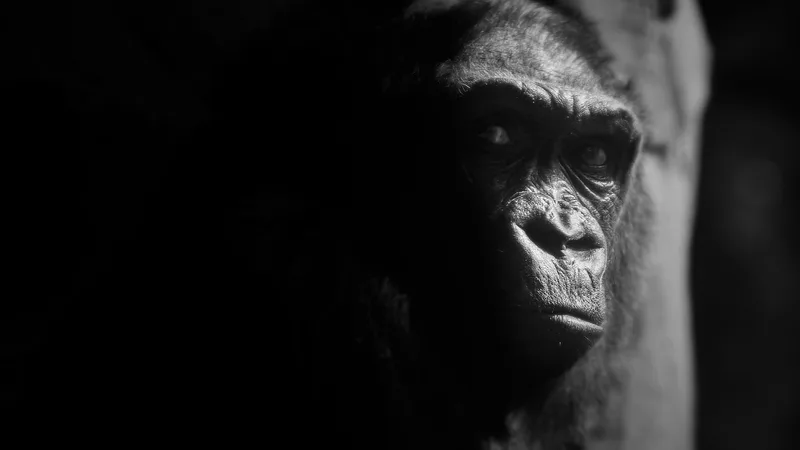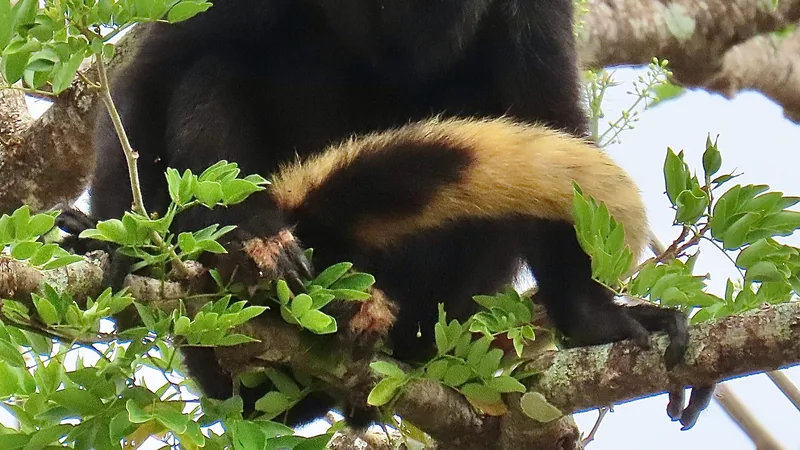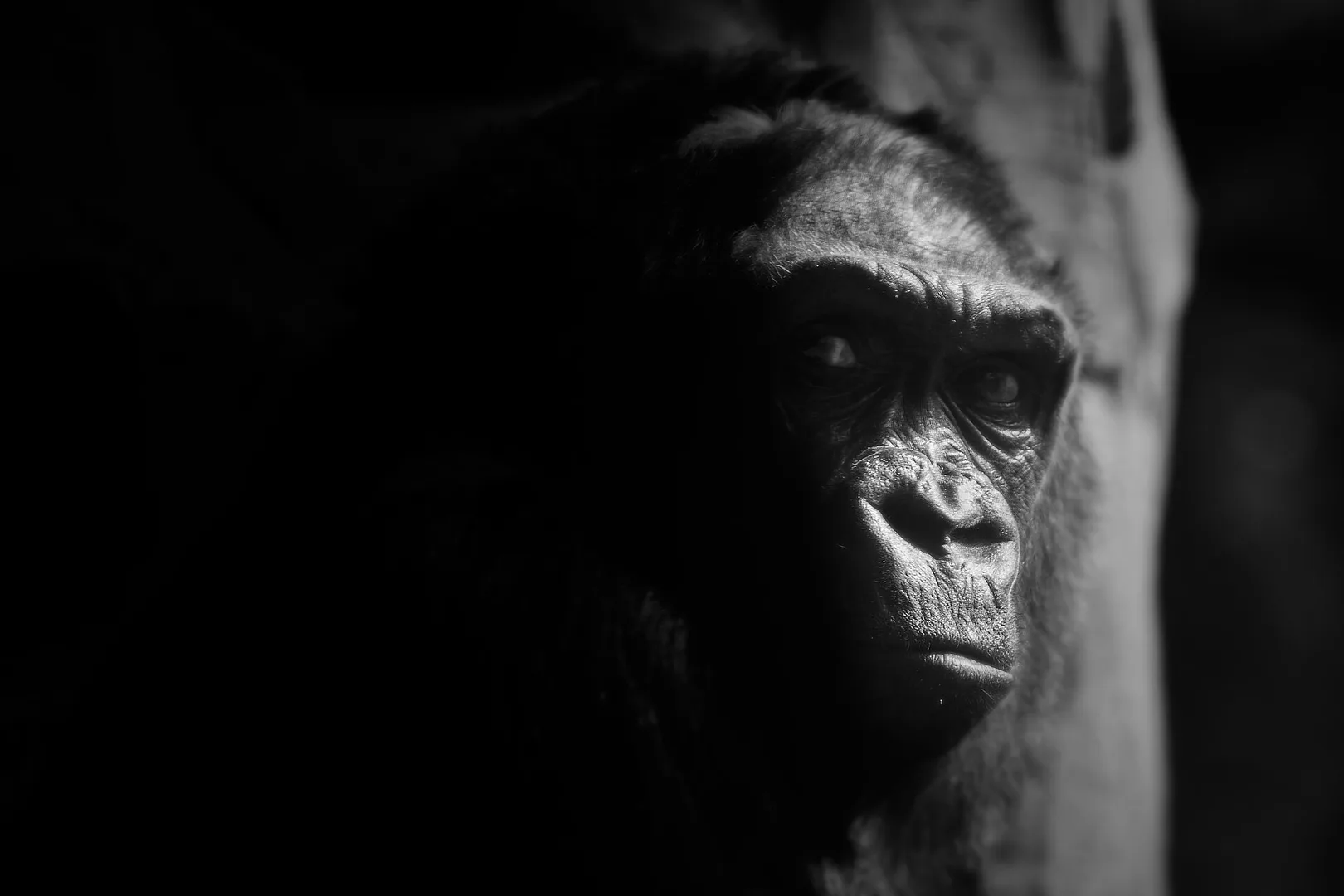
Mountain gorilla (Gorilla beringei beringei), Bwindi Impenetrable National Park, Uganda
Field
notes
A Drumroll Sized to the Drummer
The mountain gorilla (Gorilla beringei beringei) is one of two subspecies of the eastern gorilla. When a silverback puts on a display, he usually rises onto two legs and beats his chest with cupped hands, producing a drumroll that can be heard more than a kilometer away. Researchers who recorded six wild silverbacks in Rwanda’s Volcanoes National Park found that bigger males beat at a lower pitch than smaller ones. Across the six, the average peak pitch was about 639 Hz. That makes the chest beat an honest signal: the sound itself carries information about how big the drummer is. Chest beats are thought to help males judge a rival’s fighting ability, though the researchers say future studies still need to show that listening gorillas use it.
An honest drum The bigger the silverback, the lower the pitch of his chest beat. Researchers call that an honest signal, and it can be heard more than a kilometer away.
Built to Chew Bark
A mountain gorilla eats up to 18 kilograms (40 pounds) of vegetation a day. Its favorites include celery, thistles, wood, and roots, and it rarely needs to drink, because its juicy food and the morning dew on it are full of water. Tree bark is the toughest item on the menu: a study of food plants from Bwindi Impenetrable and Mgahinga Gorilla National Parks measured its fracture toughness at up to 8.2 kilojoules per square meter, tougher than the leaves and bamboo gorillas also eat. The researchers suggest that tough bark, pith, and stems may be key reasons mountain gorillas evolved such robust jaws and faces.
Four Parks, Three Countries
Mountain gorillas live in three countries, across just four national parks: Bwindi Impenetrable, Mgahinga Gorilla, Volcanoes, and Virunga. In the Virunga volcanoes, which separate the Democratic Republic of Congo from Rwanda and Uganda, they mostly live in montane cloud forest, and sometimes climb as high as 4,000 meters into afro-alpine meadows where nights turn subfreezing and there is little food to forage. Their hair is longer than other gorillas’, and that thick black coat helps insulate them from the cold. A 2026 study comparing gorillas from Bwindi and the Virungas found that males from the two places end up almost the same adult size, while Bwindi females stay smaller and keep growing for longer.
An Endangered Comeback
The IUCN moved mountain gorillas from Critically Endangered to Endangered in 2018. About 1,000 live in the wild, according to the most recent census, and they are the only great ape whose population is increasing. They live in groups of 2 to 40, each led by a silverback. Poachers often target infants, and conflict in the Democratic Republic of Congo threatens the gorillas’ future. As more people move in close to the gorillas, they bring the risk of human diseases such as flu and pneumonia.
Published Updated
Traits
Intel
& FAQ
Guess
first
How big is a Mountain Gorilla, really? Slide, lock in, and see what the sources say. Every answer is a figure from this page, quoted from where it came from.
Sources
- 01Wright et al. (2021). Chest beats as an honest signal of body size in male mountain gorillas (Gorilla beringei beringei). Scientific Reports.
- 02Elgart-Berry (2004). Fracture toughness of mountain gorilla (Gorilla gorilla beringei) food plants. American Journal of Primatology.
- 03McFarlin et al. (2026). Variation in body size growth trajectories between ecologically distinct mountain gorilla populations. Proceedings of the Royal Society B: Biological Sciences.
- 04Gorilla beringei (eastern gorilla). Animal Diversity Web, University of Michigan, 2001.
- 05Mountain Gorilla. African Wildlife Foundation.
What the sources say: 44 claims checked word for word against these sources →