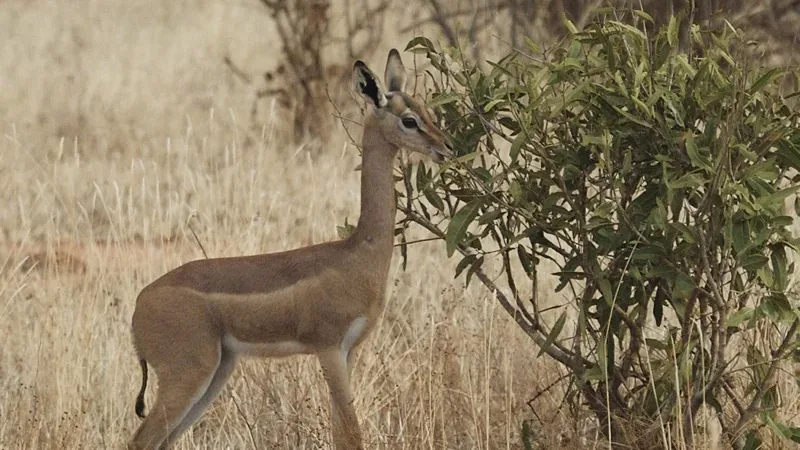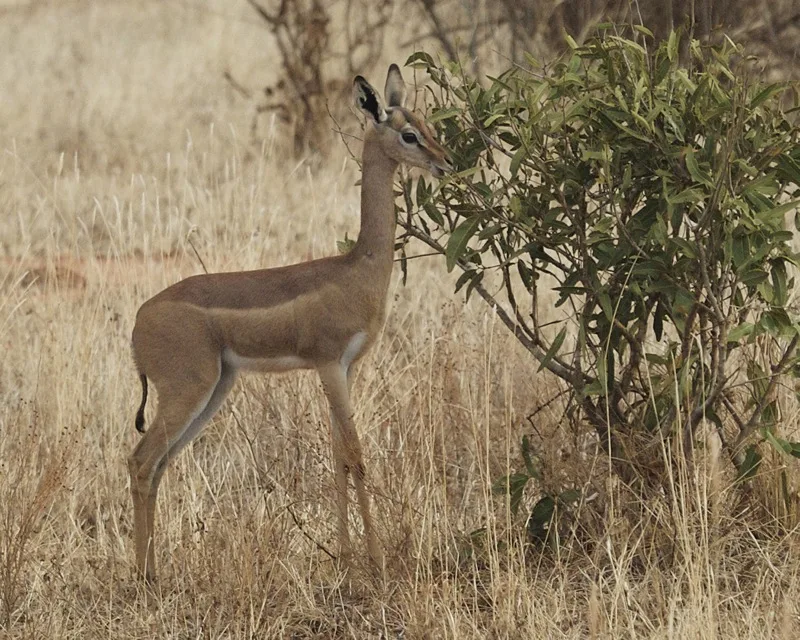
Gerenuk (Litocranius walleri), Masai Mara, Kenya.
Field
notes
The gerenuk (Litocranius walleri) is an antelope of the dry thornbush savannah of northeastern Africa, and it often eats standing up.
A Body Stretched for Height
A gerenuk’s long neck and long, thin legs are its defining features, making it one of the world’s most easily recognized antelopes. It weighs 29 to 58 kilograms and runs 140 to 160 centimetres in body length, plus a 220 to 350-millimetre tail. Only males carry horns, curved and scimitar-shaped, 25 to 44 centimetres long. The coat is pale tawny brown, white along the breast and belly, with a dark patch around each eye that fades outward into a white rim.
Standing Up to Eat
Long neck, long legs and the ability to stand on its hind legs let the gerenuk reach tree leaves that are out of reach for most other antelope species.
A Stomach Full Of Options That reach lets the gerenuk be selective about what it eats. More than 80 different plant species have been found in a single gerenuk’s stomach.
It feeds almost exclusively on thorny shrubs and trees, frequently using this bipedal stance to do it. It’s a medium-sized antelope closely related to gazelles and springbok, but unlike them it has low-crowned teeth, meaning teeth with short chewing crowns.
Skipping the Water Hole
The gerenuk lives across a range of dry habitats, from Tanzania’s treeless plains to Kenya’s high deserts, and does well in a variety of them as long as there’s a good supply of succulent plants. It does not drink from standing water, relying instead on the water it takes in from the succulent plants it eats.
Solitary and Watchful
Male gerenuks are solitary and very territorial. Dominant males mark out a territory on trees and shrubs with their preorbital gland, a scent gland in front of the eye. A male’s territory can run 300 to 850 acres and support several individuals. Females move in small bands of up to about 10, usually related adults with young, roaming freely across male territories. Lions, leopards, cheetahs, African wild dogs, hyenas, servals, caracals, honey badgers and large eagles are known predators of gerenuks. Gerenuks have been estimated to live up to 12 years in the wild, and one captive gerenuk lived for 17.3 years. The IUCN lists the species as Near Threatened because its population is decreasing.
Published Updated
Traits
Intel
& FAQ
Guess
first
How big is a Gerenuk, really? Slide, lock in, and see what the sources say. Every answer is a figure from this page, quoted from where it came from.
Sources
- 01Litocranius walleri (gerenuk). Animal Diversity Web, University of Michigan.
- 02Litocranius walleri. AnAge: The Animal Ageing and Longevity Database.
- 03Bärmann, Klappert & Chen (2021). Litocranius walleri (Artiodactyla: Bovidae). Mammalian Species.
- 04Litocranius walleri (Brooke, 1879). Integrated Taxonomic Information System.
- 05Litocranius walleri. The IUCN Red List of Threatened Species 2016: e.T12142A50190292.
What the sources say: 42 claims checked word for word against these sources →