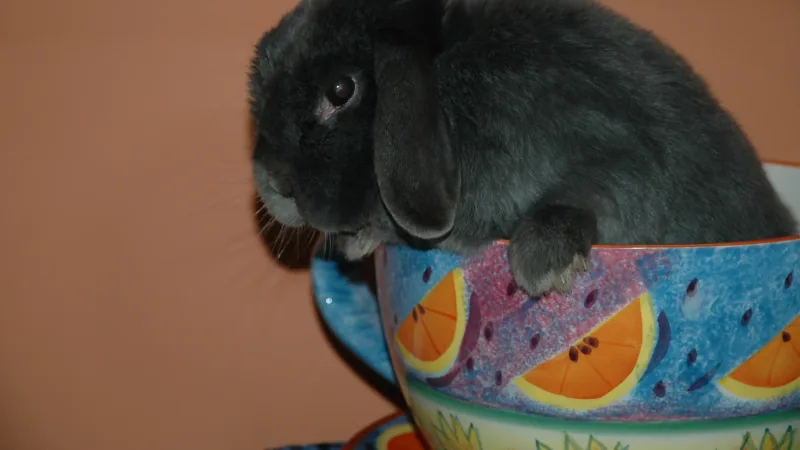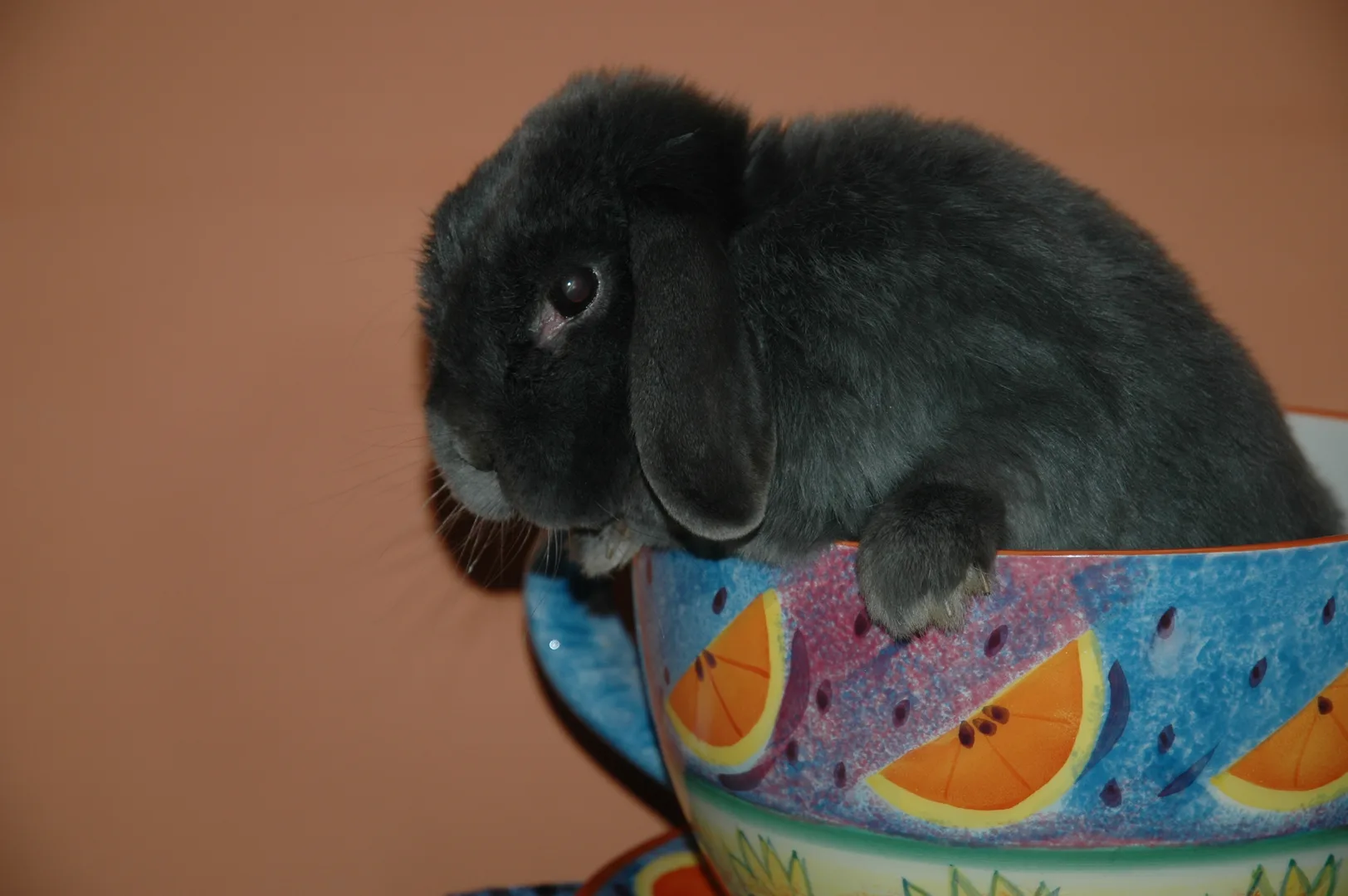
A pet rabbit relaxing at home.
Field
notes
The Binky: Joy in Midair
Rabbits can do more than hop. Sometimes a rabbit leaps really far, twisting and kicking in midair. That is a binky, a sign that the rabbit is very happy.
Not every stomp is joy. When a rabbit thumps its hind legs, danger may be nearby. It can also be a “grump thump”, and the rabbit is mad at you.
How big is the acrobat? In vet records for 6,349 rabbits in England, the median adult bodyweight was 2.1 kg, and adults ranged from 0.7 to 6.3 kg. Their wild ancestor, the European rabbit, is 38 to 50 cm long and weighs 1.5 to 2.5 kg. Pet breeds vary a lot. A 2016 4-H study sheet lists the Holland lop among the small breeds, and among five lops, which are rabbits with ears that hang down.
A Nearly Round View
A rabbit’s eyes sit on the sides of its head, so it sees in almost every direction with nearly 360 degree vision. The cost is two blind spots: just under the chin and directly in front of the nose. Its ears can turn through 180 degrees to locate sound.
Rabbits are most active at dusk and dawn, which is called being crepuscular.
Held on its back, a rabbit often lies still and looks relaxed. That is tonic immobility, an involuntary fear response to extreme stress, and the RSPCA says never to hold one that way. In one lab study, New Zealand white rabbits completely closed 8 mm holes in their ears by day 85, regenerating tissue with no evidence of scarring.
Recycled Dinner, Endless Teeth
Rabbits eat their own droppings The gut makes special droppings called caecotrophs. Rabbits eat these, allowing the food to be re-ingested for maximum nutrition.
The species has a very large caecum, a gut pouch where bacteria ferment material that would otherwise be indigestible. Hay, vegetables and pellets make up a pet’s menu.
Rabbit teeth never stop growing. The front ones gain 2 to 3 mm a week. That is why hay is essential for dental health: it promotes constant, side-to-side chewing that wears them down. A happy rabbit’s teeth chatter gently into a soft purr, though grinding can also signal pain.
Fast Babies, Long Commitment
A doe is pregnant for 30 to 33 days, an average litter is 5 to 6 kits, and she can get pregnant again within hours of giving birth. In one year, two rabbits could multiply to 82.
The RSPCA puts a pet rabbit’s typical life at 8 to 12 years. Vet records tell a harder story: the 370 rabbits that died during that English study, which covered 2013, had a median age at death of 4.3 years, a figure for those deaths rather than a lifespan.
Domestic rabbits can be found worldwide. Their wild ancestor is another matter: the Red List rates the European rabbit Endangered.
Published Updated
Traits
Intel
& FAQ
Guess
first
How big is a Domestic Rabbit, really? Slide, lock in, and see what the sources say. Every answer is a figure from this page, quoted from where it came from.
Sources
- 01Pet rabbits: care, behaviour and welfare. RSPCA.
- 02O'Neill et al. (2020). Morbidity and mortality of domestic rabbits ( Oryctolagus cuniculus ) under primary veterinary care in England. Veterinary Record.
- 03Oryctolagus cuniculus (European rabbit). Animal Diversity Web, University of Michigan.
- 04Study Tips for Rabbit Breeds. Ohio State University Extension, Ashtabula County 4-H, 2016.
- 05Gawriluk et al. (2016). Comparative analysis of ear-hole closure identifies epimorphic regeneration as a discrete trait in mammals. Nature Communications.
- 06Hackländer (2025). Oryctolagus cuniculus. The IUCN Red List of Threatened Species 2025: e.T41291A217911810.
What the sources say: 55 claims checked word for word against these sources →