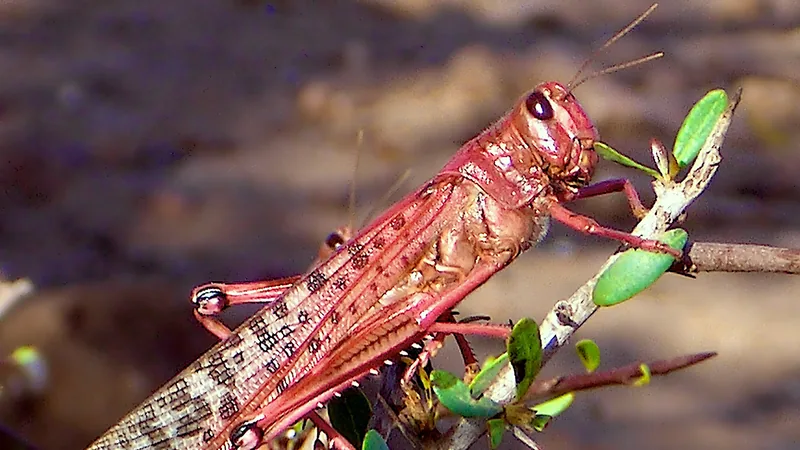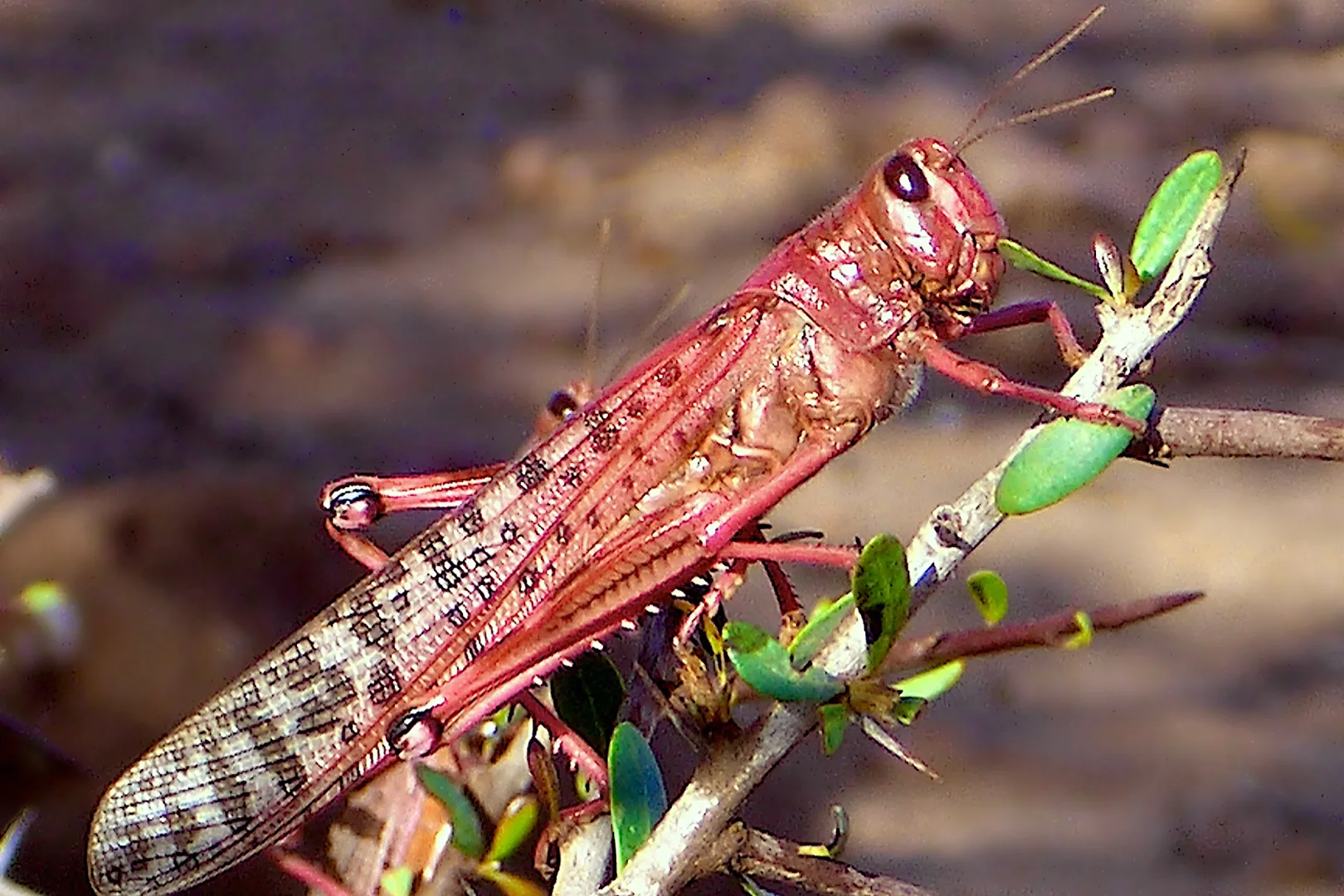
Adulte grégaire immature de Schistocerca gregaria (S.
Field
notes
Loner by default, swarm by crowding
The desert locust has two phases. In its solitary phase it is reclusive, goes out of its way to avoid others of its kind and migrates only at night. In its gregarious phase it turns social, changes colour and shape, and joins a swarm.
Crowding flips the switch. When locusts are forced together, their hind legs bump against one another, and that jostling sets off a cascade of metabolic and behavioural changes. They develop yellow and black warning colours, most strongly in the juveniles. Their bodies become shorter, and they give off a perfume of hormones that attracts them all to the same location.
Serotonin does the switching Researchers showed that serotonin is both necessary for behavioural gregarization to occur and sufficient to induce it. Mothers matter too: females use their experience of being crowded to predict whether their young will hatch into a crowd, and change how the embryos develop to match.
Small body, huge appetite
Each locust weighs about 2 grams and can eat its own body weight in vegetation every day. A square kilometre of swarm can hold up to 80 million adults. They target food crops and forage, and can survive on even the most noxious weeds when they must.
A single swarm can cover 1,200 square kilometres. As many as 60 countries can be affected.
A life measured in weeks
Desert locusts live for 3 months. Eggs hatch after two weeks, and the wingless young, called hoppers, become winged adults after 6 weeks. Adults take at least a month to mature and be ready to lay eggs. Numbers can grow 20 times in three months.
Their jump runs on a spring. For an adult male, one jump takes 9 millijoules of energy (a millijoule is a thousandth of a joule), and the major part of that energy is stored before the leap. The push itself lasts 25 to 30 milliseconds, and the locust reaches 3.2 metres per second.
Where they live
In quiet periods, called recessions, desert locusts are usually restricted to semi-arid and arid deserts of Africa, the Near East and South-West Asia that get under 200 mm of rain a year. That belt covers about 16 million square kilometres in about 30 countries. Females lay their eggs in moist sandy soil, and rain helps them survive and breed.
Published
Traits
Intel
& FAQ
Sources
- 01Desert Locust. Food and Agriculture Organization of the United Nations.
- 02Locust! NASA Earth Observatory.
- 03Anstey et al. (2009). Serotonin Mediates Behavioral Gregarization Underlying Swarm Formation in Desert Locusts. Science.
- 04Bennet-Clark (1975). The energetics of the jump of the locust Schistocerca gregaria. Journal of Experimental Biology.
- 05Simpson, McCaffery & Hägele (1999). A behavioural analysis of phase change in the desert locust. Biological Reviews.
What the sources say: 43 claims checked word for word against these sources →